


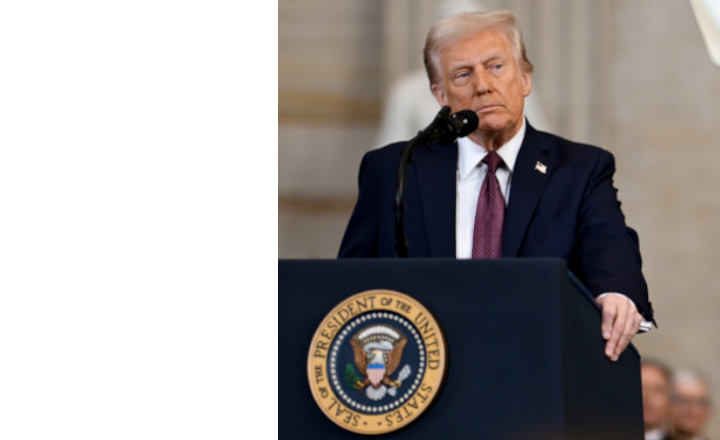
On January 16, President Donald Trump forever declared this day to be Religious Freedom Day, honoring the central place that religion has played in anchoring our freedoms. He specifically cited the Virginia Statute for Religious Freedom, which was codified on January 16, 1786; it is the foundation of the First Amendment.
Only someone who holds an animus against religion would find fault with Trump’s statement. Enter the militant atheists from the Freedom From Religion Foundation (FFRF). They detest it, declaring it to be a “Christian nationalist manifesto.”
As I have said many times, “Christian nationalism” is a bogeyman, a term invented by those who seek to curb the influence of Christianity in American life. But FFRF is nonetheless right to target Christianity: the United States was founded exclusively by Christians, resting their convictions on Judeo-Christian tenets. It was not founded—this has to be said—by those who belong to Eastern religions or by pagans, and it certainly wasn’t founded by atheists. Lucky for them, they are the beneficiaries of our Judeo-Christian heritage.
FFRF is angry at Trump because he “repeatedly invokes ‘God-given rights.’” If anything, Trump could be criticized for downplaying this verity. Has FFRF read the Virginia Statue for Religious Liberty? It should not do so standing up.
It begins by acknowledging that “Almighty God hath created the mind free.” It pays homage to the “Holy author of our religion, who being Lord both of body and mind,” further recognizing “his Almighty power.” That makes what Trump said tame.
FFRF hates to admit that the Founders were right to maintain that our rights do not come from government—which can take them away—but from God. They are therefore inalienable, not subject to whim.
The Virginia law emphasizes conscience rights above all. None of us “shall be compelled to frequent or support any religious worship, nor shall be enforced, restrained, molested, or burthened in his body or goods, nor shall otherwise suffer on account of his religious opinions or belief….” (My emphasis).
This speaks to the “free exercise of religion” provision in the First Amendment. FFRF likes to emphasize the first part, not the latter, which I italicized. It never mentions the “free exercise of religion,” preferring to talk about the “Establishment Clause” (which is not a clause). It cites this provision to advance its cause of protecting “the constitutional wall separating church and state.”
But there is no wall. Jefferson wrote the Virginia law, and he never said anything about this mythical wall. He mentioned this phrase years later in 1801 in a letter he wrote to Baptists in Danbury, Connecticut stating his support for federalism. He wanted no federal laws governing religion, but he said nothing about state-sponsored churches, which existed until 1833. Moreover, he used the phrase “separation of church and state” to guarantee religious liberty, not to curtail it.
Madison secured adoption of the Virginia statute on religious liberty, and he wrote the First Amendment. When asked what he meant by the establishment provision, he said there could be no state church (as they had in England), and the government could not show favoritism of one religion over another. That was it. He most emphatically rejected the idea that there should be a separation of church and society, which is what FFRF wants.
The “wall of separation between church and state” appears nowhere in the U.S. Constitution or the Bill of Rights. It found its way into constitutional law in 1947 when Justice Hugo Black broached it in the Everson v. Board of Education decision. Black wanted to make sure no public funds directly went to Catholic schools. This made sense given he was a former member of the Ku Klux Klan. He joined the Klan not to condemn blacks or Jews, but Catholics.
We are proud of Trump’s promotion of religious liberty. Without it, we would not enjoy the freedoms we take for granted, FFRF protestations to the contrary.