


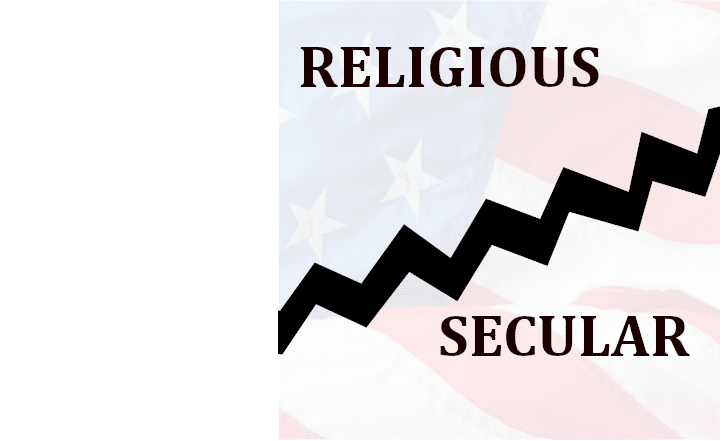
The divide between Americans who are religious and who are secular (religiously unaffiliated) is dramatic: it is evident in all aspects of the culture. That is one conclusion that can easily be drawn by the data provided by the Pew Research Center’s 2023-24 Religious Landscape Study. This is the third such national study, the earlier ones being in 2014 and 2007.
Demographic Profile
Christians comprise 62% of the population; 40% Protestant, 19% Catholic and 3% other Christians. Another 7% belong to a religion other than Christianity, and 29% are religiously unaffiliated.
While the share of those who are Christian has declined since 2014, it has slowed and may even have leveled off.
Among the 7% who belong to a non-Christian religion, approximately 2% are Jewish and 1% each are Muslim, Buddhist or Hindu.
Among the religiously unaffiliated, 5% are atheist, 6% are agnostic and 19% identify as “nothing in particular.”
Here are some of the findings that detail the secular-religious divide.
Political Ideology
Consistent with other surveys, this study found that “The most highly religious Americans are also the most Republican, conservative.” Conversely, secularists are overwhelmingly Democrats.
When it comes to Americans who identify as conservative, moderate and liberal, overall 33% are conservative, 38% are moderate and 24% are liberal. The only groups with a majority who identify as liberal are atheists (67%) and agnostics (57%). As we shall see, this has significant consequences.
Science and Religion
Is there a conflict between science and religion, as is often portrayed by the media and those in education? Religious Americans do not see it that way—it is those without a religious affiliation who believe there is. “Among Americans with low levels of religious engagement, 73% say science and religion are mostly in conflict, roughly twice the share of highly religious Americans who take the same position (35%).”
While the authors of this study do not say why, from a Catholic perspective there is no inherent tension between believing what God has created and a scientific understanding of the universe. Indeed, it was Catholic scientists during the Scientific Revolution who sought to appreciate the scientific basis of God’s creation.
But for atheists and agnostics, who discount the existence of God, all they have to fall back on is science, which they believe has nothing in common with God’s creation of the universe. This belief is central to their dogma.
Government and Helping the Poor
Do secularists care more about the poor than religious Americans? Many of those in the chattering class, who tend to be secularists, believe this is the case. They point to reports like this Pew study as proof.
It is true that this study shows that “Highly religious Americans are less likely to say the government should give more help to people in need.” It is also true that “Two-thirds of U.S. adults with low levels of religious engagement favor a bigger government that provides more services.” In fact, “72% of atheists say the government should provide more assistance to those in need.”
Not so fast. As I pointed out in my book, The Catholic Advantage: How Happiness, Health and Heaven Await the Faithful, the social science evidence is clear: religious Americans are the most charitable and altruistic; secularists are the least generous and the least altruistic.
The reason why secularists score so poorly on these variables has much to do with their belief that government—not private individuals or religious organizations—should provide for the poor. So of course they appear to be more concerned about the poor when they say government should do more to help them. They are the least likely to write a check or volunteer their services.
Morality
On moral issues, the religious-secular divide is astounding.
Is it better for one parent to stay at home to focus on the family? Most Americans (55%) say it is, and the more religious someone is the more likely he is to agree. The only ones who disagree are those who score “low” on this variable. So telling.
Should homosexuality, transgender people and abortion be accepted by society? Christians are the most likely to disagree. It is secularists who are the most accepting. This speaks to the premium which secularists put on individual autonomy, in contrast to the premium which religious Americans put on traditional moral values.
The more religious someone is, the more likely he is to say there are “clear and absolute standards for what is right and wrong.” Secularists are naturally moral relativists: to admit there are clear moral standards is to beg the question—according to whom? By definition, they cannot answer, “God.”
Religious Americans are the most likely to believe that public school teachers should lead their classes in nonsectarian prayers; secularists, of course, disagree. Secularists also oppose religious displays on public property. It’s too bad respondents weren’t asked if they opposed them on private property.
A strong majority of Americans believe that churches and religious organizations enhance community bonds, help the poor and strengthen morality in society. That says a great deal.
We are a divided country, and much of it is reflected, if not caused, by the religious-secular divide.