


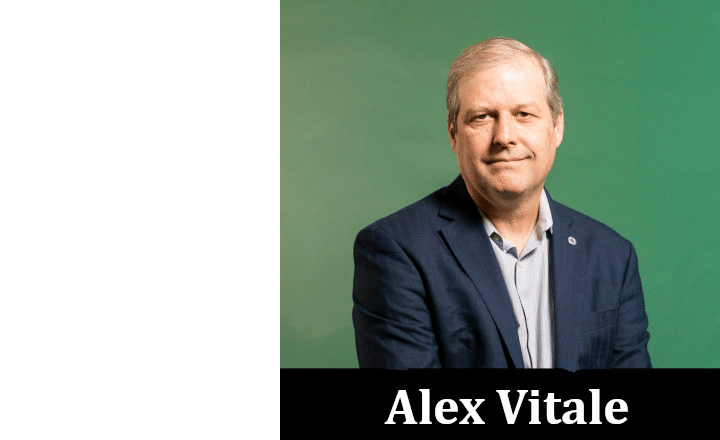
Alex Vitale and I have some things in common: we both have doctorates in sociology, have taught courses on criminology, and have written extensively on the subject. But that’s where the similarities end: I like cops and he hates them.
This wouldn’t mean much if he never left his Brooklyn College classroom. But now that he has joined the transition team of New York City Mayor-elect Zohran Mamdani—he is in charge of public safety issues—he deserves a closer look.
Vitale is the author of The End of Policing, and a study guide that accompanies his book. The latter offers a summary of each chapter, complete with advice to instructors on how to discuss the subject matter with students. It is the basis of my analysis of his work.
In Chapter 1, we learn that “racial profiling is still endemic.” He sees that as a problem. That’s funny—this was never an issue for Rev. Jesse Jackson. “There is nothing more painful for me at this stage of my life than to walk down a street and hear footsteps and start thinking about robbery—then look around and see somebody white and feel relieved.”
What Jackson understood intuitively is borne out in the statistics. In 2021, black New Yorkers were 24 percent of the population, but they made up 65 percent of those murdered in 2020 and 74 percent of the shooting victims. Just as important, the typical victimizer was also black.
Chapter 2 informs the reader that “police do not prevent crime.” But if he were right, then NYPD Commissioner Jessica Tisch would not have been able to drive down the crime rate. She did it by deploying more police to high crime areas. Of course, he wants to defund the police, as does Mamdani. They even want to abolish the prisons.
The problem for them is that blacks want nothing to do with their anarchic ideas. In 2020, when the “defund the police” movement was surging, 79 percent of blacks nationwide who said they had had an interaction with the police in the past year said they wanted the police to spend the same amount of time—or more time—in their neighborhood.
Cops don’t belong in the schools. That’s what we learn in Chapter 3. He calls their presence “damaging.” Yet a study published two years ago by the University of Albany found that police in the schools reduced fights and threats by 30 percent and increased detection of firearms by 150 percent. He also says that the money saved by moving cops out of the schools “could be given to schools directly to build a better academic program.” If he were sincere, he would endorse charter schools and school choice initiatives, but he doesn’t.
In Chapter 4, Vitale argues that the reason why the police don’t work effectively with mentally ill offenders is because they are “trained to view every scenario as a potentially deadly one.” Thank God for that. Only someone hopelessly naïve would confront a suspected violent offender—mentally acute or disabled—with a relaxed attitude.
Chapter 5 tells instructors that the police don’t work well with the homeless because of “a lack of compassion.” Really? I see cops interact with the homeless every day in New York—my office is across the street from Penn Station—and I have never once seen a cop mishandle, or be rude to, the homeless.
Vitale shows his compassion by endorsing “drop-in centers and emergency shelters” for the homeless, but even here he fails the test. Showing his radically secular stripes, he insists the caregivers must be “nonreligious.” In other words, he wants to discriminate against the clergy.
The next two chapters are on prostitution and drugs, respectively. Naturally, he wants to decriminalize both. Vitale needs to visit Jackson Heights, a Queens neighborhood that has been overrun by street prostitution, drugs, robberies, and muggings, and tell the residents that their quality of life is peachy keen.
In Chapter 8, we learn that “gang suppression” is the problem, not gangs themselves. So how do we deal with gangs? Vitale promotes “restorative justice.” This is a “nonpunitive” measure that in practice means having social workers talk to the thugs.
Chapter 9 targets “border patrolling.” He wants it to end. His entire focus is on the “rights” of those who have crashed our borders and have committed unspeakable crimes. He needs to meet with the surviving crime victims of illegal aliens.
Chapter 10 contends that “The threat of potential violence or destruction of property is not a sufficient excuse” for police violating the First Amendment rights of “protesters.” He cites what happened in Ferguson, Missouri in 2014. What he did not say is that these “protesters” went on a violent rampage after a robbery suspect got into an altercation with the police—he assaulted a cop, reached for his gun, resisted arrest, and was then killed after charging the officer.
Vitale ends his study guide by saying, “the single largest threat to American democracy today is policing.” He did not say irresponsible policing—he said all policing.
It is a sure bet that if the Mamdani-Vitale approach to crime is implemented, it will prove to be the “single largest threat” to the safety of New Yorkers.