


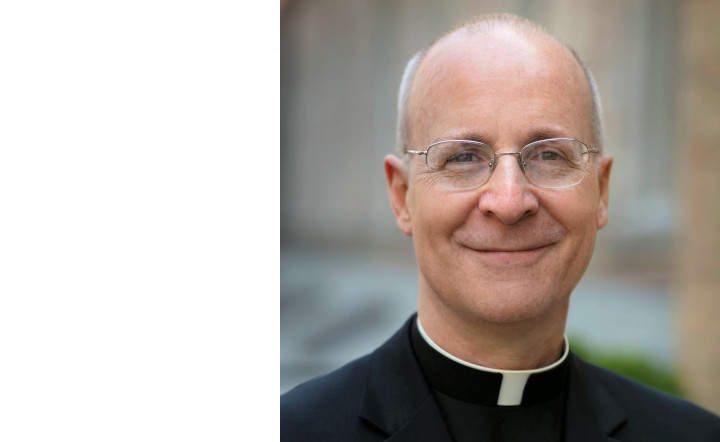
Father James Martin, the gay activist, says we need more homosexual men to join the priesthood. He hastens to add that “we are presuming a life of celibacy.” Full stop. Such a presumption is not practically warranted.
If single men worked and lived with single women, we should presume that the temptation to be sexually active would be great, so great that common sense dictates that such an arrangement should never see the light of day. Ditto for homosexual men working and living with other men. We are just asking for trouble by facilitating such living spaces.
Martin was inspired to write his essay in Outreach, a LGBTQ publication that he founded. What prompted him to act was a study by the McGrath Institute for Church Life at the University of Notre Dame that distinguishes between gay men who have “deep-seated same-sex attraction” and “transitory same-sex attraction.” The former is similar to the language used in 2005 by the Vatican when it declared that men who fit that description should not be admitted to the priesthood.
The distinction made by the Vatican, and restated by the McGrath Institute, is prudent. But this upsets Martin greatly. The authors of the study note that if a candidate for the priesthood admits that he is attracted to other men, the seminarian should be provided with resources that “work toward overcoming his SSA [same-sex attraction] if it is indeed transitory.”
Martin calls this a “dangerous proposal.” What’s dangerous about it? The suggestion that homosexuals need to “overcome” their same-sex attraction. Apparently, Martin is oblivious to how this undercuts his proposal that having more gays in the priesthood presumes a “life of celibacy.” Does he believe that men with “deep-seated homosexual tendencies” can be expected to be celibate?
At bottom, what Martin objects to are the teachings of the Catholic Church on sexuality. He has been quite open about telling everyone that the Catechism of the Catholic Church needs to amend its language about homosexual attractions. The Catechism says such attractions are “objectively disordered,” and it declares homosexual acts to be “intrinsically disordered.” Martin prefers “differently ordered.”
The official teaching of the Catholic Church makes sense beyond the theological. To wit: The human race cannot continue to exist unless it propagates, and the only two people who are capable of doing so are a man and a woman. It is natural for them to be sexually attracted to each other, meaning that deviations from the norm are disordered.
This does not make homosexuals bad people. Indeed, they are equally children of God and command our respect. But we are not commanded to adopt policies—in or out of the Church—that abet homosexual relationships.
There is a mountain of social science literature that details how hard it is for gay men to be in a monogamous relationship. In fact, almost all gay couples cheat on each other. Promiscuity is the norm. Can some gay men be celibate? Sure. But they are in a minority.
We also know that, owing to their emotional and sexual immaturity (I provide evidence of this in my book, The Truth about Clergy Sexual Abuse: Clarifying the Facts and the Causes), a disproportionate number of homosexuals are attracted to minors. With regard to the Catholic Church, studies done by the John Jay College of Criminal Justice on clergy sexual abuse found that 81 percent of the victims were male and 78 percent were postpubescent.
In short, we did not witness a pedophilia crisis in the Catholic Church—it was a homosexual crisis.
Martin quotes Pope Francis as saying that he had met many good gay priests in his lifetime. No doubt he had. It’s too bad Martin didn’t quote what the pope had to say about adopting the right policies on gays in the priesthood.
Pope Francis was adamant in his insistence that men with “deep-seated homosexual tendencies” should not be admitted to the clergy. “The question of homosexuality is a very serious one,” he said, adding that those who run the seminaries must be sure that candidates are “humanly and emotionally mature” before they are ordained. Martin did not quote the pope as saying these things because it would seriously undermine his case.
Martin’s position is further undermined when we consider what the Holy Father had to say about those who make light of having homosexuals in the priesthood. In an interview he gave in 2018, he mentioned that a priest he met told him that having gays in Catholic housing “isn’t so grave” because it’s “only an expression of affection.” Francis exploded, saying this reasoning “is in error,” noting that in “consecrated life and priestly life, there is not room for this kind of affection.”
We know from many studies that today’s seminarians are mostly well-adjusted men who tend to be quite orthodox. That’s good news. The last thing we need now is to welcome men with “deep-seated homosexual tendencies” back into the seminaries. We’ve been through too much to go down this road again.