

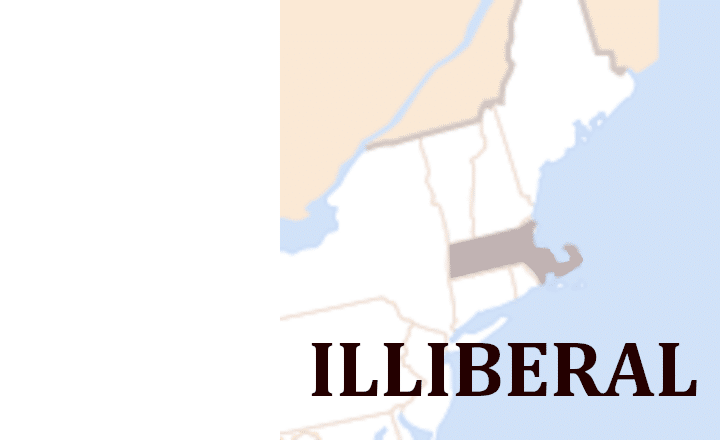
The short answer to this question is because Massachusetts is so liberal.
To be a liberal used to mean being tolerant, especially of free speech. No more. Today it means being an authoritarian. This has been confirmed by many surveys, including ones sponsored by the Foundation for Individual Rights and Expression (FIRE). In other words, many—not all—self-identified contemporary liberals are illiberal in their words and deeds.
Among the most illiberal states in the nation is Massachusetts. One recent example of this verity is the recent lawsuit brought by more than a dozen residents in Quincy objecting to the display of St. Michael and St. Florian on the new police headquarters. The town mayor, Thomas Koch, chose these two figures to adorn the building because they are the patron saints of police and firefighters, respectively. A judge has granted a preliminary injunction stopping the installation of the statues.
The lawsuit argues that the statues violate religious neutrality, as required by law. Mayor Koch responds by saying they were chosen “to honor Quincy’s first responders, not to promote any religion.” The legal issues are critical, but it is not fidelity to the law that is spurring the lawsuit—it is intolerance to anything Christian.
St. Michael was chosen as the patron saint of the police because of his role, as described in Scripture, of being a warrior angel who protected the people. Florian was a third-century military officer who was responsible for assembling an elite corps of firefighters. That’s why the two of them were chosen as exemplary representatives of first responders.
The Supreme Court has several times understood that religious figures can have secular connotations, meaning their non-religious activities can be appreciated independent of their religious status. One example of this would be the many schools, streets and statues named after Martin Luther King. They are a tribute to his civil rights efforts. He was also a minister, yet no one says they should be renamed because he was a man of the cloth.
Corpus Christi is a city in Texas. It means “Body of Christ.” Should it be renamed? Throughout California there are towns and cities that start with “San,” meaning “saint.” Should they be renamed? We are coming into the holiday season: the word “holiday” means “holy day.” Should we cancel that as well? Or are we not being deliriously sensitive?
What is going on in Quincy is a state-wide problem. Take Boston, barely ten miles away.
From 2006 to 2018, the city of Boston authorized 284 flags to fly atop a city flagpole outside of city hall, representing a myriad of government and private interests. But in 2018 it turned down a request by Camp Constitution to fly what they described as a “Christian” flag, maintaining that to do so would amount to government endorsement of religion. But Gay Pride flags were allowed: only Christian flags were banned.
Eventually, the Supreme Court resolved the Christian lawsuit in their favor. The high court ruled that the flagpole represented a public forum, and therefore the government could not discriminate on the basis of religious viewpoint.
Why did secular elites in Boston decide to cherry-pick one group and deny it the right to fly their Christian flag when they had no problem honoring the flags of Communist nations? Why was rejecting the Christian flag so important to them that they appealed lower court rulings to the highest court in the land? Let’s face it, they did so because of their deep-seated animus against Christianity.
The same hostility is at work today in Quincy. Historically, this is bizarre.
The last state to abandon state churches was Massachusetts. That was in 1833. But in 2016, a Pew Research Center poll found that the Bay State was tied with New Hampshire as the least religious state in the nation. In 2007, 81 percent of the residents of Massachusetts identified with a religion; in 2024, it was 63 percent. The decline was driven largely by a decrease in adults who identified as Christian. Moreover, the percentage of adults who identified as religiously unaffiliated jumped from 17 percent in 2007 to 37 percent in 2024.
One major reason for the secularization of Massachusetts is the proliferation of elite colleges and universities; it ranks second on this measure to California. This matters greatly as higher education is one of the most significant drivers of secularism in the nation. Regrettably, these days it is associated with illiberalism.
In its 2026 College Free Speech Rankings, FIRE rated 257 colleges and universities. Harvard University ranked 245, Boston College placed 251, and Northeastern University came in at 253. The study concluded that “Massachusetts is home to some of the most speech-restrictive campuses in the country.” Thus does it represent a textbook case of how liberalism has evolved into illiberalism.
Those who spend their days on campus, as administrators, faculty or students, surely consider themselves among the most enlightened and fair-minded people in America. Nonsense. They are precisely the kind of people who get exercised about the statues that adorn the Quincy police headquarters.