BIDEN ADMIN SPAWNED BIGOTRY; REPORT BACKS OUR INPUT

The report by the Trump administration’s Task Force on Anti-Christian Bias laid out the extent to which Christians had their First Amendment rights violated by the Biden administration, as well as by some states.

None of this is news to the Catholic League—we provided a trove of documents to the Task Force and Bill Donohue personally met with one of the top lawyers working in the Civil Rights Division of the Department of Justice (DOJ)—but it is important that the public learn just how malicious the Biden administration was in its treatment of Christians.

The report correctly notes that there was a different worldview between that of Christians and that of the operatives in the Biden team.

The Biden DOJ was not content to see its policies prevail; rather, it was driven by a desire to punish Christians with whom they disagreed with. Here are ten examples.

  • When dossiers are prepared on pro-life Christians, and information is collected on their children, that is nefarious.
  • When a judge is labeled a “very Catholic magistrate,” that is treacherous.
  • When a Christian nurse is forced to participate in an abortion, that is malicious.
  • When a Christian family is told it cannot be foster parents because they disagree with gender ideology, that is wicked.
  • When Catholics are restricted from going to Mass because of unproven, and unevenly applied, restrictions due to a health scare, that is indefensible.
  • When pro-life protesters are treated as if they were violent thugs, that is despicable.
  • When gay pride flags are flown at the U.S. Embassy to the Holy See, that is unconscionable.
  • When Christians’ parental rights are violated by educators, that is reprehensible.
  • When pro-life students are told to remove their religious symbols when they enter a federal building, that is outrageous.
  • When the religious rights of Christians are put on the chopping block by secular zealots, that is pernicious.

The Catholic League was directly involved in 8 of these 10 instances.

The Biden administration targeted Christians in a way that is unprecedented.

The disinterest in reporting on this by the mainstream media was totally irresponsible. If it were some other demographic group that was being profiled by the federal government— one of the protected classes—all hell would break loose.

The Task Force did its job. But our job at the Catholic League is not over. When vigilance atrophies, so do our rights. It’s not in our DNA to let that happen.


POPE INSISTS ON TRUTH

On May 11, Pope Leo XIV told members of the Vatican Observatory Foundation that nothing is a bigger threat to both religion and science today than the denial of the existence of objective truth. Thus did he make a frontal assault on the reigning doctrine of postmodernism that is prevalent in higher education.

The pope underscored the centuries old link between the Church and science. “It is not surprising that people of deep faith feel called to explore the origins and workings of the universe. The desire to better understand creation is but a reflection of that restless yearning for God that dwells in the heart of every human being.”

The Holy Father punctuated his remarks by saying that the “original purpose” of the observatories was “to be places where the glory of God’s creation is encountered with reverence, depth, and joy.”

Jewish scholar David Klinghoffer observes that “The origins of modern science, from 1300 onward, were overwhelmingly religious,” and the Catholic contribution to astronomy was central. He cites Copernicus, a Catholic priest, for pioneering astronomy. Just as Leo inferred, Catholic scientists sought to understand God through His creation.

Unfortunately, many Americans still believe the wholly discredited Black Legends that pit religion against science. But it is not the Church that denies the existence of truth—without which science could not proceed—rather it is the Church’s critics.

There may be many opinions, but there is only one truth.


MUCH TO CELEBRATE THIS JULY 4TH

Bill Donohue

As a veteran who loves America, and as a proud Catholic, I am delighted that the Catholic League is showcasing the religious roots of our freedoms on a digital billboard in Times Square. Besides tourists, soccer fans from all over the world will be in town for the World Cup, and many will gather in Times Square for the festivities. Our message will be seen by millions over the two-week period prior to the Fourth of July.

On pp. 7-9 in this issue of Catalyst, you will see a report, prepared by our staff, on the status of religious liberty, racial and ethnic minorities, and women that existed in 1776 and that exists today. We have a short summary comparing conditions in the USA to that of Latin America, Africa, the Middle East, Eurasia (Russia), Europe and Asia.

My reason for this assignment is to challenge the left-wing notion that the USA is an inherently flawed nation that never lives up to its promises. Really? Compared to what? Compared to other parts of the world? They’ve got to be kidding.

This is something that has bugged me for decades. When I taught a college course on Social Problems, I assigned a textbook that covered a wide range of subjects: racial and ethnic groups, the poor, women, and many other categories. Invariably, students learned how unjust America is. It was more radical propaganda than anything else.

I countered by discussing how each of these classes of people fared in 1776 and how they fare today. The progress was incredible. I then discussed how these same classes of people are doing today around the world. My goal was to put in historical and cross-cultural context how people were treated in the past and how they are treated today, in the USA and abroad. That is a realistic yardstick to measure progress.

The problem with textbooks on Social Problems is the same with contemporary analysis of America— the comparison is not between where we were, and where other countries are today; it is between existing conditions and some never-never land.

This approach found root in the Enlightenment, during the seventeenth and eighteenth centuries. It was common then, and it is common today, to compare current conditions to the ideal. This conclusion is contrived and ordained: of course current conditions are found wanting. Today, left-wing professors use the blackboard to describe their utopian vision of how people should be treated, and then they can do what they delight in doing— showing how we failed.

We didn’t fail—they did. They failed their students by comparing America today to some fairy land of perfection. That is not realistic. And by the way, who are they to complain? Take a close look at their lives and it will soon be revealed how dramatically flawed they are. Worse, take a good look at the Marxist countries they have supported historically, and then do a body count.

Take slavery. Harvard sociologist Orland Patterson has done the best work on this subject, and he noted that there is not a single place in the world which has not experienced slavery. When the USA was founded, only in western Europe was there no slavery. It was not declared illegal in Africa until 1981, and it still exists in several parts of the continent today.

In our country, the Founders could have done what the revolutionary winners have always done—rule with an iron fist. Instead, they did something that to this day is a freak: they wrote a Constitution that literally took power away from them. They came up with three branches of government (the executive, legislative and judicial) and three sectors of control (the federal, state and local).

If they had been like all of those who came before them, they would have engaged in a power grab, crafting an all-powerful executive branch at the federal level. Our freedoms today derive from their willingness to divest themselves of the power they achieved.

The Declaration of Independence made plain that our rights are unalienable and that they come from God, our Creator, not government. There were plenty of shortcomings in 1776, but without the Declaration, the struggle for greater rights could not have taken place. Rev. Martin Luther King Jr. understood this—he explicitly heralded the Declaration as the prime measure that African Americans could access to achieve equal rights.

If King understood this verity, why don’t our carping critics? There is a sizable segment in our society today which is fixated on the worst elements in American history. Many of their observations are demonstrably false and this can easily be disproven. But we don’t have to go tit-for-tat with them. We just need to ask one question: If America is so bad, why do people from all over the world want to live here? Why do all of these non-white people want to live in a country ruled by “white supremacists”? It is such bunk.

We have much to be thankful for in 2026. Happy Birthday America!


TRUMP’S RELIGIOUS LIBERTY PANEL UNDER ATTACK

Ever since President Trump announced on May 1, 2025 that he wanted a Religious Liberty Commission to make recommendations on how to protect our most important freedom, critics have tried to discredit it. The same is true of the Task Force to Eradicate Anti-Christian Bias; it was created on February 6, 2025, under the aegis of the Department of Justice (DOJ).

The final report of the Religious Liberty Commission will soon be published, but already it is coming under attack, especially by the Associated Press (AP) and the Interfaith Alliance.

On May 9, AP reporter Peter Smith ran a news story on the Commission that teed it up for critics; he did the same thing on May 1 in his story on the Task Force. He listed a series of comments by members of the panel, as well as reported instances of restrictions on religious liberty, followed by remarks from critics. His reporting deserves closer scrutiny.

One of the Commission’s members has called for a Presidential Medal of Freedom for “a baker who refused to create a wedding cake for a same-sex couple.”

That’s right, Jack Phillips, who never denied selling a cake to homosexuals, refused to personally make a “wedding” cake for two men, citing his Christian objections. He won in the U.S. Supreme Court in 2018 but was bullied and badgered by vindictive gay activists and lawyers who sued him in a civil lawsuit. The case bounced around the courts until he finally won again. His courage was exemplary.

Amish parents in New York asserted their First Amendment right to religious liberty when the state denied them a religious exemption allowing them not to have their children vaccinated. Yet the law allows for medical exemptions. Parental rights are also at stake.

Catholic nuns in Westchester, New York are being told they have to call those who falsely claim to be of the opposite sex “they,” and to allow them to use the same room in their care facilities as those of the opposite sex.

The AP reporter notes that “progressive” critics of the Task Force to Eradicate Anti-Christian Bias claim that accusations against the Biden administration lack documentation. This is false. The Catholic League alone turned over a wealth of documents, and Bill Donohue met personally with one of the DOJ attorneys, offering more information.

It is also noted that one of the members of the panel, Carrie Prejean Boller, was ousted. True. The former Miss California and convert to Catholicism claimed, without evidence, that her critical remarks of Israel were representative of what Catholics think; the Palestinian flag pin that she liked to wear was another expression of her partisanship.

The AP story mentions that some who testified before the panel argued that workplace regulations conflicted with their religious beliefs. Yes, when a nurse is forced by the University of Vermont Medical Center to perform an abortion, despite her religious convictions, that is a serious problem.

A Catholic woman was fired by Blue Cross Blue Shield for refusing the Covid vaccine; she won her court case in 2024. Other instances involve an Hispanic woman who was told to remove a crucifix from her desk at school, and students in Michigan who were told they could not sing a Christian song at a talent show.

The AP piece says the Commission is being sued by the Interfaith Alliance for not having diverse members and viewpoints. That’s a keeper. The Interfaith Alliance is one of the least diverse religious associations in the nation: its idea of religious liberty is so narrow as to make it hostile to any honest interpretation of it. To include those of their ilk on this panel would be to sabotage it.

President Trump’s policies on religious liberty are in stark contrast to that of his predecessor. He is expanding this foundational freedom while Biden contracted it. The problem his critics have has less to do with him than it does the plain meaning of the First Amendment.


KEY RELIGIOUS LIBERTY CASE ADVANCES

Three of the most anti-Catholic legal organizations in the nation are the American Civil Liberties Union, Americans United for Separation of Church and State and the Freedom From Religion Foundation. All three have sued the City of Quincy, Massachusetts and its mayor, Thomas Koch, over the proposed placement of statues of Saint Florian and Michael the Archangel on a municipal building.

The trio of Catholic-hating entities are making the usual separation of church and state argument, saying it is unconstitutional for government to endorse religion. But these statues are not intrinsically religious: Florian was chosen because he was a third-century military officer who enlisted in firefighting brigades; Michael the Archangel is the patron saint of the police. They were chosen because they are revered by first responders.

The lawsuit, led by the ACLU, was filed on May 5, 2025. On October 14, 2025, a Superior Court judge sided with the ACLU. More recently, oral arguments were held on May 6, 2026 in Massachusetts Supreme Judicial Court; a decision is expected later this year.

It may very well wind up in the U.S. Supreme Court. We are optimistic about the eventual outcome.


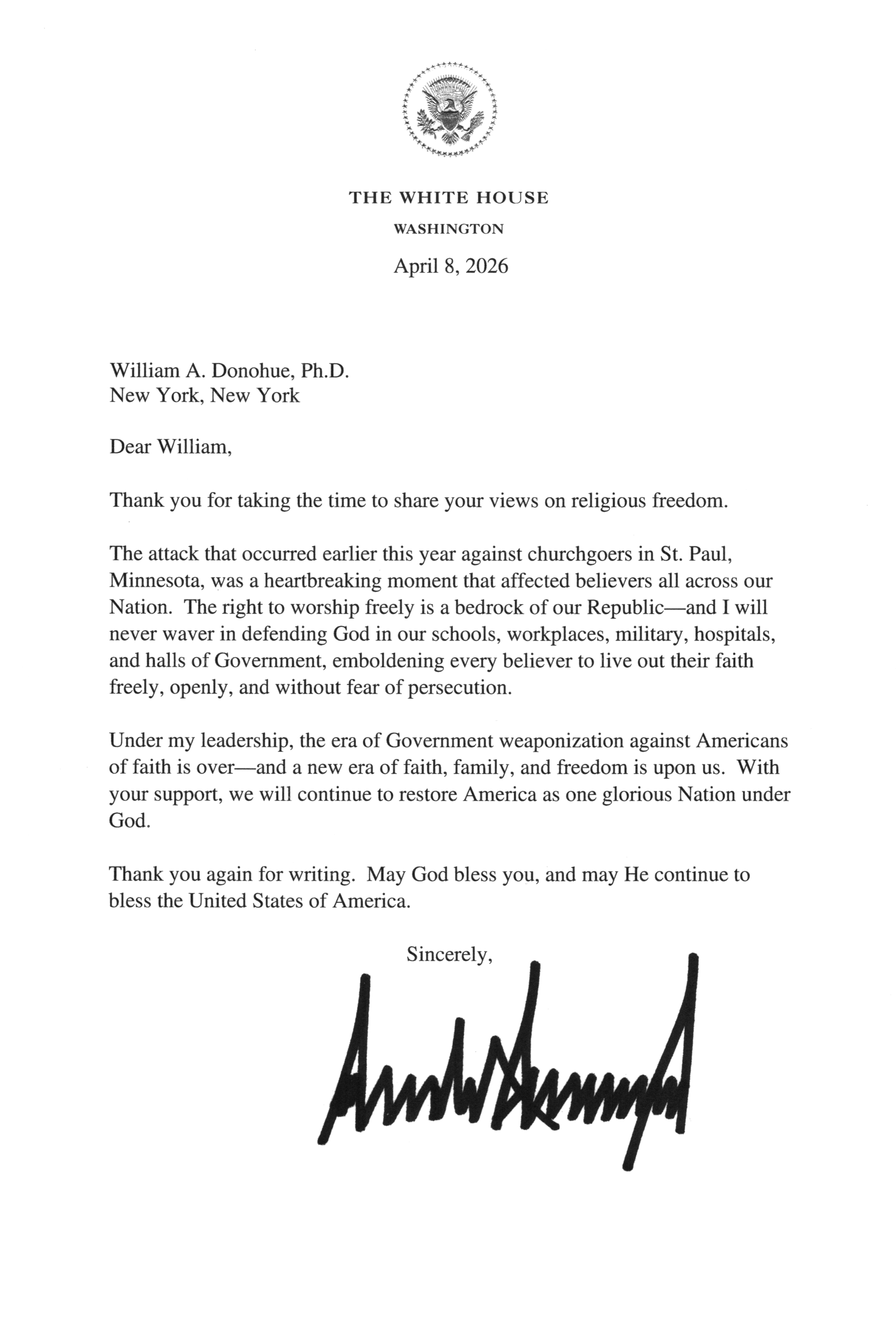
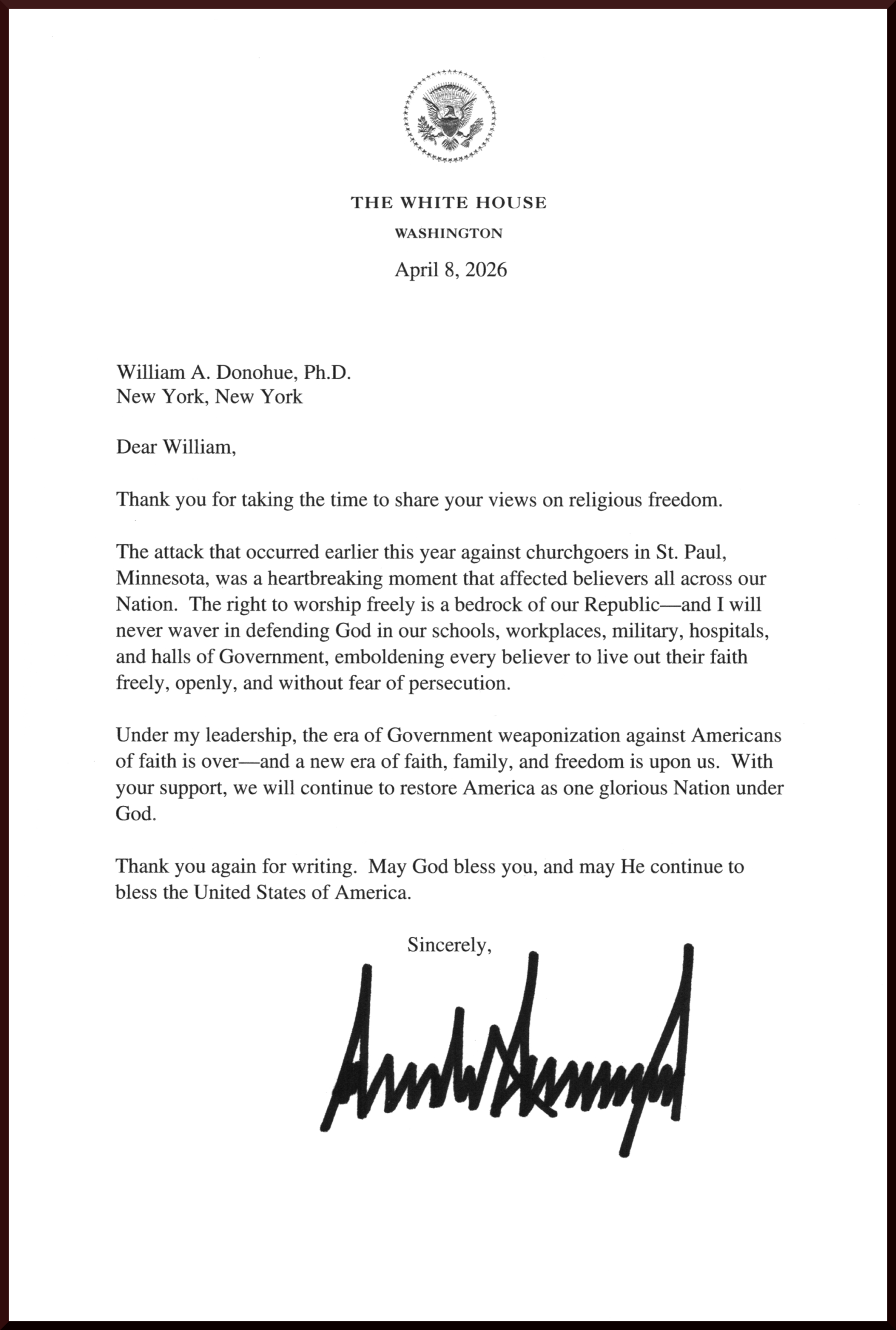
PRESIDENT TRUMP’S LETTER TO BILL DONOHUE


RELIGIOUS PROFILING IS BIGOTED

We have previously noted that Rhode Island Attorney General Peter Neronha has decided to conduct an investigation only of sexual misconduct by priests, allowing the clergy of every other religion a pass. Worse, he is giving a free pass to the public schools, where the problem—unlike that in the Catholic Church—is ongoing.

Neronha is conducting a witch hunt: none of the accused in his report are in active ministry. Just as unethical are the lawyers at Pintas & Mullins, a big law firm in Chicago. They are the ones who are fielding clergy abuse claims from alleged victims of priests in Rhode Island.

On the law firm’s website, it has a section, “Rhode Island Clergy Abuse Claims.” It only applies to the Catholic Church. Ministers, rabbis and imams who rape kids are of no interest to these guys. Just priests.

In a section titled, “Sexual Assault Lawyers Fighting for You,” it says, “It should be underscored that these abuses extend to every faith and type of religious institution, including Islam, Judaism, Mormonism, and various denominations of Christianity, as well as in schools connected with these religions.” This is a subterfuge. They say they are ready to hold these offenders accountable, yet there is no hot line for them—only for Catholic victims.

On April 21, Bill Donohue called the hot line and asked if they would accept cases from victims of ministers, rabbis, imams and public school teachers. The woman stumbled, and in a roundabout way said they would. He then asked why they don’t have a hot line for these people. She got nervous and tried to worm her way out of it. He then asked if she were aware that all 75 priests in Rhode Island whom they have an interest in are either dead or have been kicked out of ministry. Sheepishly, she said she knew that.

The month before, Donohue wrote a letter to William Pintas at the law firm. He explained why he was writing and then asked three questions.

  • Do you have other websites advertising your law firm’s services for victims abused by other religious groups?
  • How many victims abused by other religious groups has your law firm represented?
  • Is there a similar website for victims who were abused in Rhode Island’s public schools?

As to be expected, he did not reply. What was he going to say?

Religious profiling is no less invidious than any other type of profiling. The Rhode Island Attorney General and Pintas & Mullins are wearing their anti-Catholicism on their sleeve. To single out the Catholic Church for a probe of sexual misconduct is just as bigoted as singling out African Americans for street crime.


SEXUAL ABUSE IN NYC SCHOOLS

No institution today has a better record handling the sexual abuse of minors than the Catholic Church. Its record from the mid-1960s to the mid-1980s was bad, but given the reforms initiated in 2002, it has all but eradicated this offense. The same is not true of other institutions, and none has made less progress than the public schools.

Recently, New York City has made a good effort to check this problem, but serious issues remain. Legislation passed on January 29, 2026 allows victims of sexual misconduct to file a civil claim against perpetrators; an 18-month lookback window exists until July 29, 2027. It applies to any form of “gender motivated violence.” Survivors can also bring claims against institutions that enabled these offenses.

While this should have been done decades ago, it is a step in the right direction. Still, there is cause for concern.

The Office of the Special Commissioner of Investigations for the New York City School District recently issued its annual report for 2025. There were 11,775 complaints, 897 of which were for sexual misconduct or inappropriate behavior. A total of 157 were investigated, 62 of which were substantiated.

This means that only 17.5 percent of the complaints for sexual abuse were investigated. In the Catholic Church, 100 percent of these complaints are investigated.

Following the Catholic Church, New York City public schools have a training course on sexual harassment. In the academic year that ended in August 2022, 62 percent of those who were required to take the course did so; this is down from 79 percent the previous year. In the Catholic Church, 100 percent regularly do so.

It took until May 2025 before New York State had a rule suspending teaching licenses over sexual abuse claims; before that school districts had to file charges with the state to have a tenured educator fired, and that took forever. In the Catholic Church, a priest is removed from ministry once an accusation has been deemed credible.

We need public data on the fate of public school employees who refuse to participate in training programs. In the Catholic Church, there is no tolerance for failing to comply.

If the Catholic Church sported these abysmal numbers, the media would be all over it. But because New York City public schools are the guilty ones, there is little interest in reporting on this story.


250TH ANNIVERSARY SCORECARD

United States of America

Religious Liberty

1776:

Religious freedom in America was relatively strong during the time of its founding. While the American approach was already moving toward greater openness and diversity, several colonies still maintained official tax-supported churches. The Declaration of Independence reinforced the idea that rights come from a Creator. America was progressing toward a more tolerant and flexible religious environment that would continue to expand in the years that followed.

2026:

Religious freedom in the USA is widely recognized as one of the strongest in the world. Americans are able to practice whatever faith they choose openly without any government interference. While America has some of the strongest safeguards in the world, rabid secularists remain hostile to religious liberty.

Status of Racial and Ethnic Minorities

1776:

The USA was founded at a time when civil rights were still limited and developing across the globe. Slavery existed and Native American tribes were generally treated as separate nations rather than part of the new republic. However, the ideals expressed in the Declaration of Independence were permeating through the young nation and these principles established a foundation that would guide the future expansion of rights for racial and ethnic minorities.

2026:

The quality of life and opportunities available to racial and ethnic minorities in the USA have progressed significantly. Members of all different minority groups are now participating fully in civic, economic, and political life.

Status of Women

1776:

At this time, women were largely excluded from the legal and political framework of the new nation, just as they were throughout the world.   Their roles were mostly confined to the domestic sphere, with limited access to formal education and virtually no presence in professional or political life.

2026:

In 1869, women were first given the right to vote in Wyoming, and subsequently all the other states endorsed the franchise. Now the legal and social status of women in the USA has been significantly transformed through constitutional amendments and federal legislation.

Latin America

Religious Liberty

1776:

Dominated by the Spanish Empire, religious liberty was not respected as the imperial administrators used the Catholic Church to bolster the regime.

2026:

While the majority of Latin American countries have laws protecting religious liberty, the Communists in Cuba, Nicaragua, and Venezuela actively suppress religious expression.

Status of Racial and Ethnic Minorities

1776:

At the time, Latin America was dominated by a racial hierarchy. Further, slavery was a flourishing institution that was critical to the economy of most of the region with some territories having more than half of the population in bondage.

2026:

While slavery was officially outlawed in the 19th century across the region, racial and ethnic minorities continue to face discrimination and generally have limited opportunities for advancement.

Status of Women

1776:

Although under Spanish law women were in a subordinate station to men, they had the right to inherit property. There was very little in the way of formal education for girls.

2026:

While women have achieved greater legal protections, they continue to suffer from entrenched economic inequalities and violence.

Africa

Religious Liberty

1776:

There was no concept of religious liberty anywhere in Africa in 1776. In many parts of the continent, Islam was the dominant religion and adherence was often mandated by local rulers.

2026:

The status of religious liberty is dire in Africa. Fueled by violent Islamic extremists and weak or failing states unable to protect their people, it is estimated  that 93 percent of Christians martyred for their faith in the last year lived in Africa.

Status of Racial and Ethnic Minorities

1776:

Slavery was deeply entrenched across Africa. Not only were black African enslaved by their own people, it is estimated that over 1 million white European Christians were enslaved by Muslims of the Barbary Coast between 1530 and 1780.

2026:

Although completely legally abolished in the 1980s, Africa remains the epicenter of slavery with estimates of more than seven million people in bondage across the continent. Since the end of the colonial empires, the continent has been racked by ethnic cleansing and genocide.

Status of Women

1776:

The vast majority of women lived in extreme hardship and had very little legal protections.

2026:

There have been slight gains for women. While there is greater political participation and according to some estimates 46 percent of all African legislatures are women, there are still systemic problems holding women back.

Middle East

Religious Liberty

1776:

At the time the Middle East was dominated by the Ottoman Empire. The Ottomans allowed Christians and Jews to exist as second class citizens providing they pay a special tax. Outside of this, non-Muslims had no rights within the Ottoman Empire at the time.

2026:

While the political landscape of the Middle East has changed in the last 250 years, as a general rule, the region remains hostile to religious liberty. As a matter of fact, the region is home to some of the most religiously intolerant regimes in the world. The driving force behind religious oppression is Sharia law, a radical Islamic measure.

Status of Racial and Ethnic Minorities

1776:

While some minorities were able to enjoy a degree of freedom in their own communities, the Ottoman regime still considered these people second-class citizens and denied them many rights outside of their enclaves. Further, slavery remained a legal, flourishing, and integral institution deeply embedded within the economic and social fabric. Most of the slaves came from sub-Saharan Africa or Europeans captured by Barbary pirates.

2026:

Currently, many ethnic and racial minorities face dire conditions in the Middle East. Modern slavery is alive and well in the region. Today, there are approximately 1.7 million people forced into modern slavery across the region.

Status of Women

1776:

Women enjoyed a degree of legal protection at the time. However, the Ottoman Empire strictly segregated women from the male dominated society.

2026:

While some point to the economic advancement of women in the Gulf countries as evidence of progress, by and large the status of women has deteriorated primarily as a result of more stringent implementations of Sharia law and multiple conflicts that have ravaged the region.

Eurasia (Russia)

Religious Liberty

1776:

Tsarist Russia was never a bastion of freedom. During the reign of Catherine the Great, she used religion to advance her political aims. Early in her reign, Catherine strongly favored the people converting to the Russian Orthodox Church, but at the same time she effectively neutered the influence of its clergy.

2026:

Little has changed in Russia in the last 250 years regarding religious liberty. The Kremlin still uses religion to advance its political aims. Traditional religions, including the Russian Orthodox Church, certain Islamic institutions, Judaism, and Buddhism, operate with a degree of support from the state.

Status of Racial and Ethnic Minorities

1776:

During the reign of Catherine the Great, Russia was in a period of attempting to modernize and centralize. This led to harsh repressions of minority groups.

2026:

The status of racial and ethnic minorities in Russia remains about the same as it was in 1776. Although serfdom was officially abolished in 1861, the Kremlin continues to push policies of forced assimilation on minority ethnic groups across the vast nation.

Status of Women

1776:

Despite being a female ruler, Catherine the Great did not usher in an era of widespread liberation for women. The vast majority of women remained poor, uneducated serfs with limited legal protection.

2026:

The status of women is much improved in modern Russia. Women gained the right to vote in March of 1917. Many women have a high degree of economic and educational achievements.

Europe

Religious Liberty

1776:

In 1776, European nations had laws that protected freedom of religion. However, not all religious groups had absolute freedom to practice.

During 18th century England, Catholics did not receive the same rights and protections as the Church of England and other Protestant denominations. Worshippers were forbidden from saying Mass, owning land, or establishing schools. Catholics who were found to be celebrating Mass or practicing their faith were subjected to fines and imprisonment.

In France, Catholicism had been the official state religion after the Edict of Nantes was passed in 1598. However, during the early 1770s, rules were enacted that restricted which regions of the country Protestants could worship.

2026:

Countries in Europe in 2026 guarantee the rights of all citizens to freely worship and practice their respective faith. In 2026, almost all European nations have freedom of religion protections in their constitutions. In recent years there have been reports of discrimination of religious minorities and an increase in hate crimes against Christians and Jews.

Status of Racial and Ethnic Minorities

1776:

In 1776 Europe, racial and ethnic minorities were often not given equal rights. Minority groups that lived there were not treated equally to the majority population. But it must be said that England was the first country in the world to ban slavery, a cause promoted by Christians. In fact, in 1776, Western Europe was the only place in the world where slavery did not exist.

2026:

Racial and ethnic minorities have equal rights in Europe in 2026.

Status of Women

1776:

In 1776, women were seen as of a lower stature than men. This was reflected in the way they were treated throughout the major European nations.

2026:

The status of women in 2026 European society has greatly improved compared to 1776. All European nations give women the right to vote and the right to citizenship.

Asia

Religious Liberty

1776:

Countries in Asia such as China, Korea and Japan, favored Eastern religions, but forbade Western religions such as Christianity.

2026:

Religious freedom in Asian nations in 2026 is more secure compared to the societies in the 18th century. A large majority of Asian countries allow for the universal practice of all faiths and religions in their constitutions. However, in Malaysia, while they guarantee freedom of religion, they also have Islam as their official state religion. In China,  religious freedom is heavily restricted. North Korea essentially bans religious liberty.

Status of Racial and Ethnic Minorities

1776:

In the 18th century, Asian territories often had a hostile view towards minorities, particularly and sought to ostracize or eliminate these groups.  In 18th century Japan, non-Japanese ethnic minorities were often excluded and shunned from main society. Chinese rulers sought the forced removal and genocide of several different ethnic groups. In Korea, foreigners and ethnic minorities were discouraged from living in the Korean peninsula.

2026:

In 2026, Asian societies are more welcoming to ethnic minorities than in 1776. Most countries give protections and services that help minorities assimilate into society.

However, some nations continue to discriminate. In China, reports from human rights groups and the USA government have noted mass imprisonment and torture of predominately Muslim ethnic minorities, most notably the Uyghurs. The Communists in North Korea continue the oppression of the masses.

Status of Women

1776:

In the 18th century, women in Asian countries had little to no rights and were seen as inferior and subordinate to men.

2026:

In 2026, in a large majority of Asian countries, women have equal rights to men in terms of suffrage, freedom of employment, right to education, and marriage.


CHURCH IS RIGHT ABOUT SAME SEX ATTRACTION

Jennifer Roback Morse and D. Paul Sullins

This is a slightly abbreviated version of what we posted online. The full report, “Refuting the Top 5 Gay Myths,” is available online at the Ruth Institute.

If you thought that persons who are sexually attracted to the same sex must be gay or lesbian and can only enjoy intimacy in same-sex relations, you would be mistaken. Not that thinking this would be your fault. In the onslaught of secular media and the sometimes fumbling responses of Catholic leaders, Catholic teaching on same sex attraction is about as misunderstood as it is controversial.

Scientific research strongly supports the Church’s view. Studies of the human genome and of identical twins have cast serious doubt on the often-heard claim that sexual orientation is an innate immutable trait, comparable to race. Furthermore, social science research going back to the 1990s has found that people can, and often do, change their patterns of sexual attractions and behaviors. Yet, as with a lot of research that supports the Church, these studies have been vigorously suppressed by secular academics and journals. Persons who have changed sexual orientation are functionally invisible in cultural and policy debates, including the debates over so-called conversion therapy.

The Ruth Institute sought out and surveyed people who once would have called themselves “gay” or “lesbian” but no longer do. We gathered a sample of 183 men and women who filled out an extensive survey about their journeys into and out of an LGBT experience or identity. We asked questions about religion, child abuse and various types of therapy. We asked “before and after” questions about patterns of sexual attractions and behaviors.

Fr. Paul Sullins has just published the first round of data analysis from this survey, in Cureus, a peerreviewed Springer Nature journal. This paper shows:

  1. Same-sex attractions can often, though not always, change, more so for women than for men. Almost nine in ten women in the sample (88%) had changed sexual attraction from mostly or fully homosexual to mostly or fully heterosexual. Fewer men, but still a sizable minority (39%), had experienced this much change in attractions.
  2. Regardless of how much their attractions changed, all of the individuals in this sample had almost completely eliminated their same sex behavior. 100% of men and women reported “slight” or no same sex behavior.
  3. Therapy can help, but is not necessary, to change sexual orientation. General therapy, not necessarily focused on changing same sex attraction, was more helpful for some individuals in reducing same sex attraction than therapy with a distinct goal of reducing same sex attraction. And therapy with the explicit aim of changing sexual orientation sometimes reduced other psychologically troubling issues, for instance, depression for women and self-harm for men.

The studies purporting to “prove” therapy is dangerous never include people who have “left pride behind” and usually exclude women. In other words, they evaluate change therapy by looking only at people who failed to change. What kind of grade would marriage counseling get if we only asked people who subsequently divorced? This is why our study is so important, to show the many successes from sexual orientation therapy.

Our findings show that the worldwide drive to ban all forms of sexual reorientation therapy is deeply misguided. Women who experience persistent same sex attraction are the most likely to benefit from this therapy. Denying women therapy, based on studies that only include men, is patently unfair. Therapy that does not have the explicit goal of reorienting sexual desires can sometimes result in a reordering of desire. Sweeping bans on “conversion therapy” will likely have a chilling effect on even this type of therapy.

The drive to ban Sexual Reorientation Therapy under the tendentious label of “conversion therapy,” assumes no one can change their sexual orientation, and that even the efforts to change are intrinsically harmful. Every single person in our survey is a standing rebuke to these assumptions.

This is why the entire gay lobby goes into overdrive to discredit them. “You must be lying about living a chaste life.” “You were not really gay in the first place.” And so on.

Our study does not claim to be representative of the entire relevant population. We honestly have no idea how well our sample represents the experiences of everyone who has ever been plagued with unwanted same sex attraction and has left them behind, or who has made substantial changes in their behavior. At this point we are satisfied with showing that these are real people whose stories deserve to be part of the international conversation about “conversion therapy.”

The thoughtful responses from this group of people show that people can indeed change their behavior, feelings and self-understanding. Continuing to ignore them as if they did not exist is simply not acceptable. Our culture tells someone with same-sex attraction that they are locked into a destructive identity from which there is no escape. They don’t really believe this, or they wouldn’t outlaw efforts to try to change. Catholic truth offers something better: a liberation from besetting sin to live a life of freedom and holiness.

Jennifer Roback Morse, Ph.D. is the Founder and President, and Fr. D. Paul Sullins, Ph.D. is the Senior Research Associate respectively of the Ruth Institute.