SNAP UNRAVELS

Bill Donohue
President
Catholic League for Religious and Civil Rights

At the end of 2011, a Missouri judge ordered David Clohessy, the president of the Survivors Network of those Abused by Priests (SNAP), to be deposed regarding his role in cases of priestly sexual abuse. Clohessy fought the order vigorously, but lost. On January 2, 2012, he was deposed; the deposition was made public only recently.

[Click here for Report.  NOTE: all pages cited are taken from the deposition.]

Clohessy proved to be uncooperative, refusing to comply with a request for internal documents; he only released a small portion of them. On the stand, he was similarly recalcitrant, refusing to answer many questions. He took refuge in a Missouri law which protects the confidentiality of rape crisis centers. But there are serious reasons to doubt whether SNAP meets the test of a rape crisis center.

Clohessy was asked point blank, “Did you identify yourself as a rape crisis center?” His reply, “I don’t know.” [p. 87.] At another point, he admitted, “I don’t know under the Missouri statutes exactly what constitutes a rape crisis center.” [p. 112.] The lawyers for an accused priest were not impressed. From their questions, and from subsequent statements they’ve made, it is clear that they do not believe that SNAP qualifies as a rape crisis center. They have plenty of reasons for reaching this conclusion.

When asked what training he has as a rape crisis counselor, Clohessy said, “You know, I’ve done—I’ve provided support to victims of sexual assault for 20—roughly 23 or 24 years. I do not have a—no.” He was then asked, “Do you have any formal education or training with regard to rape crisis counseling?” He answered, “I do not.” [p. 19].

Clohessy has a bachelor’s degree in philosophy and political science. He is not a licensed counselor, yet counseling alleged victims of sexual abuse is what he does for a living. When asked, “Did you have any classes at all in counseling sexual abuse victims?”, he answered, “Any formal classes?” The attorney affirmed his question, answering, “Yes.” To which Clohessy replied, “No, sir.” [p. 191.]

The defense attorneys wanted to know if anyone at SNAP is licensed to counsel abuse victims. Clohessy was asked, “Does SNAP have any licensed counselors in the State of Missouri?” He said, “We are a—as I said at the beginning, we’re a self-help group. We are not—we don’t hold ourselves out to be formal licensed counselors.” [pp. 19-20.]

Clohessy then maintained that SNAP has support groups that “meet on a regular basis and offer support and comfort and consolation and guidance” to alleged victims. The lawyers picked up on this by asking, “Are there any licensed social workers or counselors on the staff at any of those meetings in the state of Missouri?” Clohessy was able to mention the founder of SNAP, Barbara Blaine, who is “a licensed—as I said, she has a Master’s degree in social work.” The attorneys were curious. “Is Barbara Blaine licensed as a counselor or social worker in the State of Missouri or the State of Illinois?” Clohessy answered, “I don’t know.” [p. 20.]

(There is a difference between someone who holds a Master’s in Social Work and someone with a Master’s in Counseling. It is expected that if someone wants to practice independently, he obtains licensure. Typically, this means at least two years of clinical work in a supervised setting. No one at SNAP is a licensed counselor.)

The attorneys for the defense sought to find out where the counseling takes place. Clohessy said, “We meet people wherever they want to meet, in Starbucks, at, you know—wherever people feel comfortable, that’s where we meet.” [p. 22.] When they meet at Starbucks for their “counseling” sessions, they mostly just talk. “You know, the overwhelming bulk of our work is talking to, listening to, supporting sex abuse victims,” he admitted. [p. 23.]

Of interest to the defense attorneys was the amount of money SNAP spends on “counseling.” “How much annually does SNAP spend for individuals in individual therapy sessions?” Clohessy offered a straight-forward answer: “I have no idea.” [p. 26]. He then dug himself in deeper. He was asked how much money has been paid “to an individual counselor for an individual victim.” Explicitly, “out of that $3 million that’s in the tax return,” how much was spent on individual counselors? Clohessy confessed, “Don’t know.” [p. 30.] Regarding the $3 million in SNAP’s bank account, he was asked, “Where is that money kept?” He wasn’t sure. “I’m assuming it’s in Chicago.” [p. 29.]

Clohessy explained what he does for a living. He says SNAP has a business address in Chicago, but that he doesn’t know the zip code. Having no office—he works out of his home in the St. Louis area—he fields phone calls. [p. 9.] “Individuals call me and they share their pain with me.” So what does he do about it? “I console them and I may be on the phone with them for an hour.” He said he doesn’t charge them a fee for his consolation over the phone. [p. 26].

Declaring one’s home to be a place of business raises legal questions. Clohessy was asked whether “at your house do you have an occupational license or a business license to do business out of your house.” He simply said, “No.” [p. 98.]

Clohessy refused to disclose his source of funding. When asked, “You won’t tell us the sources of your funding; isn’t that correct?”, he said, “That’s correct.” [p. 85.] Now it is well known that Church-suing lawyers have generously given to SNAP over the years [see my 2011 report, SNAP EXPOSED: Unmasking the Survivors Network of those Abused by Priests; it is available by clicking here].

When asked specifically about monies SNAP receives from lawyers, once again Clohessy refused to answer. What really set him off was the question, “Does SNAP have any agreements with attorneys regarding referral of victims to those attorneys?” Clohessy snapped, “Can I say I’m offended at the question?” [p. 32.]

Given the type of work SNAP does, it is mandated by law to give a portion of its funds to charity. “As a director of SNAP,” Clohessy was asked, “do you understand that SNAP is required by federal law to contribute so much of their assets every year for charitable purposes.” His reply, “I’m not aware of that.” [p. 82.]

So what does SNAP do with its money? In 2007, it spent a total of $593 for “survivor support.” [pp. 102-03.] The following year it spent $92,000 on travel. [p. 107.]

SNAP says it pursues priests who are “credibly accused.” It may interest bishops and priests what Clohessy means by this. “How would you define the word ‘credibly accused?’” (This is important because many accused priests have been railroaded by those who have made false claims.) Clohessy replied, “You know, there’s all kinds of criteria.” All kinds of criteria? He continued by saying sometimes there are multiple accusers, but at no time did he say what the criteria were. [p. 110.]

Anyone who has followed SNAP is aware how often it holds a press conference condemning a diocese before a lawsuit is filed. By working with its attorneys, and some reporters, SNAP is able to get on the evening news making the diocese look bad (lawyers for the diocese are usually the last ones to receive the lawsuits). So it was not surprising that the defense lawyers would ask Clohessy about this tactic.

For example, in one case, where a lawsuit had a file stamp of October 20, 2011, the time was recorded as 2:44 p.m. When asked how SNAP could have had this information before it was filed in court, Clohessy refused to answer. [pp. 52-53.] In another case, a lawsuit had a file stamp of November 8, 2011 at 1:28 p.m., yet Clohessy was able to post information about this before it was filed with the court. When asked to explain himself, he refused. [pp. 62-63.]

Apparently, Clohessy knows next to nothing about his staff. When asked about his staff, he mentioned the founder, Barbara Blaine. He also said, “We have an administrative person who is new,” but he could only remember the person’s first name. He admitted that they also had a fundraising person but “I apologize, I don’t know the spelling of her last name.” [pp. 13-14.] Later, he was asked, “Who is in charge of SNAP’s website? Is there a specific company or is it done in-house?” Clohessy was blunt: “I don’t know.” [pp.165-66.]

Finally, Clohessy admitted that he has lied about some of his statements to the press. “Has SNAP to your knowledge ever issued a press release that contained false information?” He didn’t blink: “Sure.” [p. 39.] Did he lie about priests he knew to be innocent, or at least thought may have been innocent? We don’t know.

So is David Clohessy a sincere man driven by the pursuit of justice? Or is he a con artist driven by revenge? It may very well be that the former description aptly explains how he started, while the latter describes what he has become.


SNAP UNRAVELS

At the end of 2011, a Missouri judge ordered David Clohessy, the president of the Survivors Network of those Abused by Priests (SNAP), to be deposed regarding his role in cases of priestly sexual abuse. Clohessy fought the order vigorously, but lost. On January 2, 2012, he was deposed; the deposition [it is available on our website] was made public only recently. [NOTE: all pages cited are taken from the deposition.]

Clohessy proved to be uncooperative, refusing to comply with a request for internal documents; he only released a small portion of them. On the stand, he was similarly recalcitrant, refusing to answer many questions. He took refuge in a Missouri law which protects the confidentiality of rape crisis centers. But there are serious reasons to doubt whether SNAP meets the test of a rape crisis center.

Clohessy was asked point blank, “Did you identify yourself as a rape crisis center?” His reply, “I don’t know.” [p. 87.] At another point, he admitted, “I don’t know under the Missouri statutes exactly what constitutes a rape crisis center.” [p. 112.] The lawyers for an accused priest were not impressed. From their questions, and from subsequent statements they’ve made, it is clear that they do not believe that SNAP qualifies as a rape crisis center. They have plenty of reasons for reaching this conclusion.

When asked what training he has as a rape crisis counselor, Clohessy said, “You know, I’ve done—I’ve provided support to victims of sexual assault for 20—roughly 23 or 24 years. I do not have a—no.” He was then asked, “Do you have any formal education or training with regard to rape crisis counseling?” He answered, “I do not.” [p. 19.]

Clohessy has a bachelor’s degree in philosophy and political science. He is not a licensed counselor, yet counseling alleged victims of sexual abuse is what he does for a living. When asked, “Did you have any classes at all in counseling sexual abuse victims?” He answered, “Any formal classes?” The attorney affirmed his question, answering, “Yes.” To which Clohessy replied, “No, sir.” [p. 191.]

The defense attorneys wanted to know if anyone at SNAP is licensed to counsel abuse victims. Clohessy was asked, “Does SNAP have any licensed counselors in the State of Missouri?” He said, “We are a—as I said at the beginning, we’re a self-help group. We are not—we don’t hold ourselves out to be formal licensed counselors.” [pp. 19-20.]

Clohessy then maintained that SNAP has support groups that “meet on a regular basis and offer support and comfort and consolation and guidance” to alleged victims. The lawyers picked up on this by asking, “Are there any licensed social workers or counselors on the staff at any of those meetings in the state of Missouri?” Clohessy was able to mention the founder of SNAP, Barbara Blaine, who is “a licensed—as I said, she has a Master’s degree in social work.” The attorneys were curious. “Is Barbara Blaine licensed as a counselor or social worker in the State of Missouri or the State of Illinois?” Clohessy answered, “I don’t know.” [p. 20.]

(There is a difference between someone who holds a Master’s in Social Work and someone with a Master’s in Counseling. It is expected that if someone wants to practice independently, he obtains licensure. Typically, this means at least two years of clinical work in a supervised setting. No one at SNAP is a licensed counselor.)

The attorneys for the defense sought to find out where the counseling takes place. Clohessy said, “We meet people wherever they want to meet, in Starbucks, at, you know—wherever people feel comfortable, that’s where we meet.” [p. 22.] When they meet at Starbucks for their “counseling” sessions, they mostly just talk. “You know, the overwhelming bulk of our work is talking to, listening to, supporting sex abuse victims,” he admitted. [p. 23.]

Of interest to the defense attorneys was the amount of money SNAP spends on “counseling.” “How much annually does SNAP spend for individuals in individual therapy sessions?” Clohessy offered a straight-forward answer: “I have no idea.” [p. 26.] He then dug himself in deeper. He was asked how much money has been paid “to an individual counselor for an individual victim.” Explicitly, “out of that $3 million that’s in the tax return,” how much was spent on individual counselors? Clohessy confessed, “Don’t know.” [p. 30.] Regarding the $3 million in SNAP’s bank account, he was asked, “Where is that money kept?” He wasn’t sure. “I’m assuming it’s in Chicago.” [p. 29.]

Clohessy explained what he does for a living. He says SNAP has a business address in Chicago, but that he doesn’t know the zip code. Having no office—he works out of his home in the St. Louis area—he fields phone calls. [p. 9.] “Individuals call me and they share their pain with me.” So what does he do about it? “I console them and I may be on the phone with them for an hour.” He said he doesn’t charge them a fee for his consolation over the phone. [p. 26].

Declaring one’s home to be a place of business raises legal questions. Clohessy was asked whether “at your house do you have an occupational license or a business license to do business out of your house.” He simply said, “No.” [p. 98.]

Clohessy refused to disclose his source of funding. When asked, “You won’t tell us the sources of your funding; isn’t that correct?”, he said, “That’s correct.” [p. 85.] Now it is well known that Church-suing lawyers have generously given to SNAP over the years [see my 2011 report, SNAP EXPOSED: Unmasking the Survivors Network of those Abused by Priests; it is available on our website].

When asked specifically about monies SNAP receives from lawyers, once again Clohessy refused to answer. What really set him off was the question, “Does SNAP have any agreements with attorneys regarding referral of victims to those attorneys?” Clohessy snapped, “Can I say I’m offended at the question?” [p. 32.]

Given the type of work SNAP does, it is mandated by law to give a portion of its funds to charity. “As a director of SNAP,” Clohessy was asked, “do you understand that SNAP is required by federal law to contribute so much of their assets every year for charitable purposes.” His reply, “I’m not aware of that.” [p. 82.]

So what does SNAP do with its money? In 2007, it spent a total of $593 for “survivor support.” [pp. 102-03.] The following year it spent $92,000 on travel. [p. 107.]

SNAP says it pursues priests who are “credibly accused.” It may interest bishops and priests what Clohessy means by this. “How would you define the word ‘credibly accused?’” (This is important because many accused priests have been railroaded by those who have made false claims.) Clohessy replied, “You know, there’s all kinds of criteria.” All kinds of criteria? He continued by saying sometimes there are multiple accusers, but at no time did he say what the criteria were. [p. 110.]

Anyone who has followed SNAP is aware how often it holds a press conference condemning a diocese before a lawsuit is filed. By working with its attorneys, and some reporters, SNAP is able to get on the evening news making the diocese look bad (lawyers for the diocese are usually the last ones to receive the lawsuits). So it was not surprising that the defense lawyers would ask Clohessy about this tactic.

For example, in one case, where a lawsuit had a file stamp of October 20, 2011, the time was recorded as 2:44 p.m. When asked how SNAP could have had this information before it was filed in court, Clohessy refused to answer. [pp. 52-53.] In another case, a lawsuit had a file stamp of November 8, 2011 at 1:28 p.m., yet Clohessy was able to post information about this before it was filed with the court. When asked to explain himself, he refused. [pp. 62-63.]

Apparently, Clohessy knows next to nothing about his staff. When asked about his staff, he mentioned the founder, Barbara Blaine. He also said, “We have an administrative person who is new,” but he could only remember the person’s first name. He admitted that they also had a fundraising person but “I apologize, I don’t know the spelling of her last name.” [pp. 13-14.] Later, he was asked, “Who is in charge of SNAP’s website? Is there a specific company or is it done in-house?” Clohessy was blunt: “I don’t know.” [pp.165-66.]

Finally, Clohessy admitted that he has lied about some of his statements to the press. “Has SNAP to your knowledge ever issued a press release that contained false information?” He didn’t blink: “Sure.” [p. 39.] Did he lie about priests he knew to be innocent, or at least thought may have been innocent? We don’t know.

So is David Clohessy a sincere man driven by the pursuit of justice? Or is he a con artist driven by revenge? It may very well be that the former description aptly explains how he started, while the latter describes what he has become.


SNAP UNRAVELS

Bill Donohue
President
Catholic League for Religious and Civil Rights

At the end of 2011, a Missouri judge ordered David Clohessy, the president of the Survivors Network of those Abused by Priests (SNAP), to be deposed regarding his role in cases of priestly sexual abuse. Clohessy fought the order vigorously, but lost. On January 2, 2012, he was deposed; the deposition was made public only recently [click here]. [NOTE: all pages cited are taken from the deposition.]

Clohessy proved to be uncooperative, refusing to comply with a request for internal documents; he only released a small portion of them. On the stand, he was similarly recalcitrant, refusing to answer many questions. He took refuge in a Missouri law which protects the confidentiality of rape crisis centers. But there are serious reasons to doubt whether SNAP meets the test of a rape crisis center.

Clohessy was asked point blank, “Did you identify yourself as a rape crisis center?” His reply, “I don’t know.” [p. 87.] At another point, he admitted, “I don’t know under the Missouri statutes exactly what constitutes a rape crisis center.” [p. 112.] The lawyers for an accused priest were not impressed. From their questions, and from subsequent statements they’ve made, it is clear that they do not believe that SNAP qualifies as a rape crisis center. They have plenty of reasons for reaching this conclusion.

When asked what training he has as a rape crisis counselor, Clohessy said, “You know, I’ve done—I’ve provided support to victims of sexual assault for 20—roughly 23 or 24 years. I do not have a—no.” He was then asked, “Do you have any formal education or training with regard to rape crisis counseling?” He answered, “I do not.” [p. 19].

Clohessy has a bachelor’s degree in philosophy and political science. He is not a licensed counselor, yet counseling alleged victims of sexual abuse is what he does for a living. When asked, “Did you have any classes at all in counseling sexual abuse victims?”, he answered, “Any formal classes?” The attorney affirmed his question, answering, “Yes.” To which Clohessy replied, “No, sir.” [p. 191.]

The defense attorneys wanted to know if anyone at SNAP is licensed to counsel abuse victims. Clohessy was asked, “Does SNAP have any licensed counselors in the State of Missouri?” He said, “We are a—as I said at the beginning, we’re a self-help group. We are not—we don’t hold ourselves out to be formal licensed counselors.” [pp. 19-20.]

Clohessy then maintained that SNAP has support groups that “meet on a regular basis and offer support and comfort and consolation and guidance” to alleged victims. The lawyers picked up on this by asking, “Are there any licensed social workers or counselors on the staff at any of those meetings in the state of Missouri?” Clohessy was able to mention the founder of SNAP, Barbara Blaine, who is “a licensed—as I said, she has a Master’s degree in social work.” The attorneys were curious. “Is Barbara Blaine licensed as a counselor or social worker in the State of Missouri or the State of Illinois?” Clohessy answered, “I don’t know.” [p. 20.]

(There is a difference between someone who holds a Master’s in Social Work and someone with a Master’s in Counseling. It is expected that if someone wants to practice independently, he obtains licensure. Typically, this means at least two years of clinical work in a supervised setting. No one at SNAP is a licensed counselor.)

The attorneys for the defense sought to find out where the counseling takes place. Clohessy said, “We meet people wherever they want to meet, in Starbucks, at, you know—wherever people feel comfortable, that’s where we meet.” [p. 22.] When they meet at Starbucks for their “counseling” sessions, they mostly just talk. “You know, the overwhelming bulk of our work is talking to, listening to, supporting sex abuse victims,” he admitted. [p. 23.]

Of interest to the defense attorneys was the amount of money SNAP spends on “counseling.” “How much annually does SNAP spend for individuals in individual therapy sessions?” Clohessy offered a straight-forward answer: “I have no idea.” [p. 26]. He then dug himself in deeper. He was asked how much money has been paid “to an individual counselor for an individual victim.” Explicitly, “out of that $3 million that’s in the tax return,” how much was spent on individual counselors? Clohessy confessed, “Don’t know.” [p. 30.] Regarding the $3 million in SNAP’s bank account, he was asked, “Where is that money kept?” He wasn’t sure. “I’m assuming it’s in Chicago.” [p. 29.]

Clohessy explained what he does for a living. He says SNAP has a business address in Chicago, but that he doesn’t know the zip code. Having no office—he works out of his home in the St. Louis area—he fields phone calls. [p. 9.] “Individuals call me and they share their pain with me.” So what does he do about it? “I console them and I may be on the phone with them for an hour.” He said he doesn’t charge them a fee for his consolation over the phone. [p. 26].

Declaring one’s home to be a place of business raises legal questions. Clohessy was asked whether “at your house do you have an occupational license or a business license to do business out of your house.” He simply said, “No.” [p. 98.]

Clohessy refused to disclose his source of funding. When asked, “You won’t tell us the sources of your funding; isn’t that correct?”, he said, “That’s correct.” [p. 85.] Now it is well known that Church-suing lawyers have generously given to SNAP over the years [see my 2011 report, SNAP EXPOSED: Unmasking the Survivors Network of those Abused by Priests; it is available by clicking here].

When asked specifically about monies SNAP receives from lawyers, once again Clohessy refused to answer. What really set him off was the question, “Does SNAP have any agreements with attorneys regarding referral of victims to those attorneys?” Clohessy snapped, “Can I say I’m offended at the question?” [p. 32.]

Given the type of work SNAP does, it is mandated by law to give a portion of its funds to charity. “As a director of SNAP,” Clohessy was asked, “do you understand that SNAP is required by federal law to contribute so much of their assets every year for charitable purposes.” His reply, “I’m not aware of that.” [p. 82.]

So what does SNAP do with its money? In 2007, it spent a total of $593 for “survivor support.” [pp. 102-03.] The following year it spent $92,000 on travel. [p. 107.]

SNAP says it pursues priests who are “credibly accused.” It may interest bishops and priests what Clohessy means by this. “How would you define the word ‘credibly accused?’” (This is important because many accused priests have been railroaded by those who have made false claims.) Clohessy replied, “You know, there’s all kinds of criteria.” All kinds of criteria? He continued by saying sometimes there are multiple accusers, but at no time did he say what the criteria were. [p. 110.]

Anyone who has followed SNAP is aware how often it holds a press conference condemning a diocese before a lawsuit is filed. By working with its attorneys, and some reporters, SNAP is able to get on the evening news making the diocese look bad (lawyers for the diocese are usually the last ones to receive the lawsuits). So it was not surprising that the defense lawyers would ask Clohessy about this tactic.

For example, in one case, where a lawsuit had a file stamp of October 20, 2011, the time was recorded as 2:44 p.m. When asked how SNAP could have had this information before it was filed in court, Clohessy refused to answer. [pp. 52-53.] In another case, a lawsuit had a file stamp of November 8, 2011 at 1:28 p.m., yet Clohessy was able to post information about this before it was filed with the court. When asked to explain himself, he refused. [pp. 62-63.]

Apparently, Clohessy knows next to nothing about his staff. When asked about his staff, he mentioned the founder, Barbara Blaine. He also said, “We have an administrative person who is new,” but he could only remember the person’s first name. He admitted that they also had a fundraising person but “I apologize, I don’t know the spelling of her last name.” [pp. 13-14.] Later, he was asked, “Who is in charge of SNAP’s website? Is there a specific company or is it done in-house?” Clohessy was blunt: “I don’t know.” [pp.165-66.]

Finally, Clohessy admitted that he has lied about some of his statements to the press. “Has SNAP to your knowledge ever issued a press release that contained false information?” He didn’t blink: “Sure.” [p. 39.] Did he lie about priests he knew to be innocent, or at least thought may have been innocent? We don’t know.

So is David Clohessy a sincere man driven by the pursuit of justice? Or is he a con artist driven by revenge? It may very well be that the former description aptly explains how he started, while the latter describes what he has become.


SNAP EXPOSED: UNMASKING THE SURVIVORS NETWORK OF THOSE ABUSED BY PRIESTS

Special Report by William Donohue
August 22, 2011

The Survivors Network of those Abused by Priests (SNAP) held a national conference in Washington, D.C., July 8-10. This report details what happened. 

Over the past decade, Catholics have been rocked by revelations of priestly abuse. Bad judgments were made; cover-ups took place; and inexcusable conduct was tolerated. Much of the criticism has been constructive, and to that extent, welcomed. But some has been malicious. There is a profound difference between reasoned criticism and irrational assaults on the Catholic Church. What happened at the SNAP event clearly fell in the latter category.

Catholics understand the anger that many have about the way things were handled in some dioceses. When anger becomes a pattern, however, it can consume. Indeed, it can blur one’s vision, leading to irrational and wholly indefensible accusations. This is precisely what has happened to SNAP, and to its allies. Logic, reason and evidence no longer matter: what matters is payback. Make no mistake about it; SNAP has decided to wage war on the Catholic Church.

There are many good reasons why the proceedings of the SNAP conference should concern Catholics, but none is more salient than the precarious state of due process rights for priests. A hostile climate is evident in many parts of the country, so much so that prosecutors, judges and juries are not inclined to see accused priests as innocent. This is due, in no small way, to the pressure being applied by professional victims’ groups and their sister organizations, as well as their allies in law and the media. It does not exaggerate to say that there is a vested ideological and economic interest in putting the worst possible face on the Catholic Church these days. This conference being Exhibit A.

SNAP bills itself as “the largest, oldest and most active support group for women and men wounded by religious authority figures (priests, ministers, bishops, deacons, nuns and others).” In fact, it rarely deals with ministers, and there are few “others.” Almost all of its work is directed at the Catholic Church. Unfortunately, it has succeeded in getting others to believe its propaganda. To wit: the recent John Jay College report on the “Causes and Context” of priestly sexual abuse said that “SNAP has developed into a national movement of support for victims of sexual abuse by any church leader and, more recently, all victims of sexual abuse by any person in a position of authority.” Not true. As if more evidence were needed, the entire SNAP conference was focused exclusively on priests and the Catholic Church.

The information about the SNAP conference contained in this report was provided by individuals who were there. They have impeccable credentials and are a trusted source. What they saw and heard is disturbing, and not just to those who are grateful for all the good work that Catholic priests have done, and continue to do: any fair-minded person would be just as taken aback by what occurred. Imbued with rage, most of the presentations had all the markings of a people possessed by revenge. Their goal has less to do with helping victims than it does in punishing the Catholic Church.

What follows is an account of the SNAP conference as it was related to me by persons who attended the event. [In describing some of the speakers, biographical and other information was added.] Not all of the break-out sessions were monitored, and not all of those which were monitored are mentioned. The major presentations, of course, are covered, and direct quotes are occasionally offered. While some of the presentations were informational, others were more in the vein of an agit-prop workshop straight out of the 1960s. The latter proved to be quite revealing.

There were approximately 110-130 people in attendance at the conference. All were white and approximately 60% were female (one male wore a Voice of the Faithful T-shirt). The ages ranged from about 40-75; the majority were 55-65. Attendees were seated according to the state in which they reside; only a few were represented.

The recurring theme of the conference was the evil nature of the Catholic Church. The word “evil” was used repeatedly to describe “the institution.” There was no presumption of innocence: accused priests were spoken of as if they were guilty, and this was true of all the speakers, including the attorneys.

Christine Courtois made a presentation, “Relational and Betrayal Trauma,” that offered a “psychological analysis” of the impact of sexual abuse. The seminaries, the psychologist said, were a “breeding ground” of sexual activity and abuse. In keeping with the established narrative, she denied the role of homosexuality in the abuse scandal, opting to blame pedophilia. Without offering any evidence, she remarkably created a new class of victims: she contended that “therapists are vicariously traumatized” by their own patients.

An “Overview of the Philadelphia Grand Jury Reports” was offered by William Spade. He was an Assistant District Attorney in the Philadelphia District Attorney’s Office from 1995-2004. His relationship with Catholicism is eclectic. “I don’t like the institution,” he allows, “but I like the faith.”

Cardinal Justin Rigali, the outgoing Archbishop of Philadelphia, was described by Spade as a “cagey and wily” guy who made a “cagey move” to replace the Secretary of the Clergy position in the archdiocese with a review board comprised of priests. But there is nothing “cagey” about adopting the same panel that almost all the other dioceses have adopted. No matter, to Spade, the review board was simply a “legal buffer” that allowed Cardinal Rigali to “shield himself from legal liability in priest abuse cases.” Of course, had Rigali chosen not to establish such a board—breaking ranks with most of the other bishops—he would have been pilloried for doing so.

When Spade was in the D.A.’s office, the man he wanted to get more than anyone else was Cardinal Anthony Bevilacqua, the former Archbishop of Philadelphia (they always go after the top cleric). To Spade’s chagrin, he noted that Bevilacqua was able to escape again and again. He did not say why he always failed. After striking pay dirt, Spade went into private practice. What he drew from his experience, he told the audience, was that the best way to prosecute the Catholic Church was at the federal level.

Despite what Spade said, Cardinal Bevilacqua would have been irresponsible had he not demanded evidence when allegations were made against his priests. Isn’t that what all employers would do? Spade told the gathering that he didn’t like it when Bevilacqua said he needed more in the way of proof before asking accused priests to step down. This just goes to show how thin the evidence has to be before lawyers like Spade jump to conclusions.

Spade also told the conference that Bevilacqua has moved from the “palatial quarters” of the seminary to his niece’s “estate” in Bucks County. Indeed, he claimed that both the niece and her husband are physicians and have “concocted” a diagnosis of dementia in order to help him escape indictment. Naturally, not one of the attendees pressed him to offer evidence of this matter.

When it comes to attorneys who have made a career out of suing the Catholic Church, Jeffrey Anderson has no equal. The Minnesota lawyer was raised as a Lutheran. But that didn’t work out so he became a Catholic. Then he became an atheist. Not just an ordinary one—he became a self-described “dedicated atheist.” Then he had another conversion: last year he described himself as “deeply religious.” His religious convictions, however, proved not to be too deep, which is why he is now touted as an “agnostic.”

Anderson has had a checkered life in more ways than one. A hippie who dropped out of college, he sold shoes after finally graduating from the University of Minnesota. He didn’t have an easy time at William Mitchell College of Law, but the diminutive 5’4″ activist was emboldened when, in his last year in school, he won a highly questionable case: he successfully defended a homeless black man who urinated in a church, charging that the white and wealthy churchgoers were racist. Then he went on to bigger things, such as defending accused murderers and gay activists fighting bathhouse raids.

A recovering alcoholic, he claims his daughter was molested by a therapist when she was eight. While he has no history of exhibiting a vendetta against therapists, he has a long, and profitable, record of suing the Catholic Church. In one settlement alone, he netted half a billion dollars; he regularly collects upwards of 40 percent from each settlement. Not surprisingly, the lion’s share of his work is directed at the Catholic Church.

Anderson led a legal panel at the conference that included Church-suing attorneys Jeffrey Herman and Mitchell Garabedian. Virtually the entire session was devoted to discussing the legal impediments to suing the Church. The biggest problem, they said, was the way the statute of limitations differed from state to state. Never once was it even hinted at that these statutes were written to protect the constitutional rights of the accused. Without due process, civil liberties are a sham. Yet to these trial lawyers, they are nothing but an unfair intrusion on their work. For Anderson, in particular, eliminating the statute of limitations is a vital weapon. In fact, he wants to see this happen globally, making it easier to sue the Catholic Church around the world.

This mindset is not above entertaining cabals. “The USCCB [United States Conference of Catholic Bishops] is aligned with the Republican party and insurance companies,” and together they are “actively lobbying against changing the statute of limitations around the country.” Of course, no evidence was presented to support this absurd claim. More hyperventilation surfaced when it was observed that settlements with the Church are still taking place, and confidentiality clauses are still being used. This raises the question: why would those who purport to be interested in justice have a problem with alleged victims who settle out of court? Thus do they give their real hand away. Then came the roar, “DO NOT GET GAGGED!”

When Anderson said that the lawsuits are not about the money, he was speaking honestly. To be sure, money is a major motivator for his clients. But greed is not what fires him. No, what inspires him, and those of his ilk, is something deeper, something money can’t buy. Hatred. That’s the only way to understand why Anderson continues to file suit after suit against the Vatican—nothing would make him happier than to bring down the pope. Even though Anderson continues to lose, the outside chance that he might get the pope is enough to get his juices going.

Garabedian, a Boston attorney, isn’t interested in balancing the scales of justice: he wants to go for the kill. “This immoral entity, the Catholic Church, should be defeated. We must stand up and defeat this evil.” That’s exactly what he told the true believers. Candid statements like this give the lie to the argument that those who routinely bring suits against the Church are doing so out of fidelity to the law. Nonsense. What drives them is not outreach to alleged victims—what ignites them is the satisfaction of going after the Catholic Church. I learned this first-hand when I recently called Garabedian asking if he had any remorse after a spurious lawsuit he filed against a fine priest was tossed by the judge. What prompted my call was the revelation that the priest, though never found guilty of anything, died a broken man—this was the attorney’s second lawsuit against him!

Garabedian not only showed no remorse, he went ballistic when questioned.

A breakout session, “The Culture of Narcissism and the Spirituality of Reform,” featuring Richard Sipe, Marianne Benkert and Tom Doyle, was the most incendiary of them all. Indeed, it was so bad that the anger was described as “off-the-charts.”  Here is another description of what transpired: “Each presenter in this session exhibited a very high level of hatred and anger towards the Church. They exhibited a visceral, deep-seated hatred of the Church.” The persons who offered this commentary, it should be noted, are not given to hyperbole, making their report all the more disturbing.

Sipe is a former Benedictine monk who has been ripping the Church for years. He bluntly told the crowd, “The Church is corrupt.” Worse, he opined, “Abuse is only the tip of the iceberg.” He did not allude to what was next. Without evidence, he claimed that “six to nine percent of priests are involved in the sexual abuse of minors.” The cause of molestation, he alleged, is narcissism. “Narcissism is embedded in the clerical culture that produces sexual abuse.” No attempt was made to explain why self-absorbed people are more likely to be molesters, as opposed to, say, thieves. Random assertions like this went uncontested throughout the conference.

Benkert, a psychiatrist, is also a proponent of the narcissism thesis. She maintained there are many ways in which the Church manifests this trait, among them being the following: the Church refuses to acknowledge sin; it engages in scapegoating; it sacrifices others; it is a master of disguise and pretense; it fosters intellectual deviousness; it lies; it forces the faithful to submit their will to the Church; it is controlling; it causes “religious duress”; etc. She stressed that the narcissist is the personification of evil. “It can be evil in a person or in an institution,” suggesting we are dealing either with evil priests or the evil Catholic Church. Finally, she told the gathering, “Sue the Church because they understand money; they are not empathetic.”

It was sad to learn that the worst anti-Catholic rant of the day was delivered by Thomas Doyle, an ordained Dominican priest. The recovering alcoholic has butted heads with bishops before, and after one such confrontation he was removed from a military chaplain post. He also likes to blame Pope John Paul II for the abuse scandal. At the conference, Doyle spewed out every anti-Catholic canard possible. Here are a few examples:

  • The Church was established by Constantine—not Jesus Christ.
  • The Church = fear, power, and guilt.
  • The Church is inauthentic and there is a “toxic religiosity” in this institution. The toxicity keeps people subjugated.
  • There needs to be a radical restructuring of the priesthood.
  • The Mass = magic words. People are compelled to sprinkle water on the forehead of babies or they will go to Hell when they die.
  • He referred to priestly vestments as “dresses.”

“State of the Survivor Movement: Amazing Successes and Challenges Ahead” was the subject of Barbara Blaine’s talk; she also provided an update on SNAP. Blaine, who is the founder and president of SNAP, is known for justifying a raid by Belgian police on churches looking for damaging evidence. She has also said that while aggrieved priests who countersue have “a LEGAL right to sue others, [they] don’t have a MORAL right to do so.” [Her emphasis.] So much for equal rights. Her “state of the survivor movement” presentation was simply a photo montage of various events, demonstrations and press conferences held by SNAP.

What was most noteworthy about Blaine’s session was the role played by Anderson. Now it is well known that Church-suing attorneys have been generously greasing SNAP for years. But if this incestuous relationship needed further proof, it was provided in spades by Anderson. As part of an emotional financial appeal to the attendees, he stated that “this is a titanic worldwide struggle to protect children. We are ‘the chosen ones’ to expose the abuse and we need to organize, share, and mobilize.” Then came the shakedown.

Anderson shamelessly conducted a fundraising appeal on the spot, matching dollar for dollar any donation made by an attendee. But even the multimillionaire has limits: he made it clear that he wouldn’t match a $10,000 donation made by fellow attorney, Jeffrey Herman. One woman encouraged the gathering to “put SNAP in your will,” and an appeal was also made to become “a sustaining member of SNAP for $25 per month”; everyone was encouraged to sign up with a credit card right then and there.

[Note: A few weeks after the conference ended, attendees were provided with a summary of its highlights. The fundraising appeal was described as an “amazing event,” so much so that it was touted as “an emotionally charged moment.” The final tally: “The people in the room set a record for fundraising at the conference by contributing over $30,000.”
Let’s do the math. If Herman gave $10,000, and Anderson pledged to match all donations save for Herman’s contribution, that means the attendees dished out $10,000. In other words, two steeple-chasing attorneys accounted for two-thirds of all the money raised. Absent their input, SNAP folds. Not exactly the face of a grass roots movement.]

Author Jason Berry discussed “Human Rights Movements in the Church.” He also spoke about his new book, Render Unto Rome: The Secret Life of Money in the Catholic Church, and his documentary, “Vows of Silence.” According to Berry, the “face of corruption in the Catholic Church is Cardinal Angelo Sodano.” It was Sodano’s handling of the Father Marcial Maciel Degollado case that prompted the accusation. Berry also charged that the Church uses “property and money to blunt the force of justice.”

As it turns out, Berry is the one who has little interest in justice. Here’s a personal example. In Render Unto Rome he says that Father Maciel “cultivated powerful conservatives.” He lists me as one of them. But I never met, corresponded with, or in any way had anything to do with the disgraced priest. Nor did I ever defend him. Berry knows all of this because I’ve corrected him before, putting forth the evidence. Yet he persists in lying.

In 1997, in a letter to the editor of the Hartford Courant, I took issue with a news story that reported, “Several [of the accusers] said Maciel told them he had permission from Pope Pius XII to seek them out sexually for relief of physical pain.” To which I replied, “To think any priest would tell some other priest that the pope gave him the thumbs up to have sex with another priest—all for the purpose of relieving the poor fellow of some malady—is the kind of balderdash that wouldn’t convince the most unscrupulous editor at any of the weekly tabloids. It is a wonder why The Courant found merit enough to print it.” I will leave it to the reader to decide whether this is proof that Maciel “cultivated” a relationship with me.

“The Unmasking of the Dallas Charter and Other Recent Game-Changers” was the subject of a discussion by Anne Barrett Doyle, co-director of BishopAccountability.org, and Terence McKiernan, founder and president of the group. Many pundits and media outlets see BishopAccountability as nothing more than an organization that tallies accusations against priests. In actual fact, its agenda, which was made positively clear at the conference, has more to do with stabbing the Catholic Church.

Doyle is a founder, or co-founder, of several Catholic dissident groups, including Voice of the Faithful. She told the audience that “the conspiracy begins at the Vatican” and the “zero tolerance policy is a sham.” That’s right—she believes that Rome is at the heart of a world-wide conspiracy to protect molesting priests (it is precisely this kind of mindset that is shared by Anderson; otherwise, he wouldn’t constantly be suing the Vatican). She made it plain that she wants the names of all priests accused between 1930-1960 to be released, notwithstanding the fact that many are long dead and cannot defend themselves. She also stated that the “review boards have become a new pressure point,” and that “the Gavin Group [which gathers diocesan data for the bishops] is getting worried” that their audits may be found to be flawed or false.

McKiernan informed the audience that the “Causes and Context” report by John Jay College was a “dangerous document.” The report, he charged, makes the “pernicious claim that most priests had a single victim.” Does he have evidence to the contrary? He presented none. According to Penn State professor Philip Jenkins, an expert on this subject, the original 2004 John Jay report found that “of the 4,392 accused priests, almost 56 percent faced only one misconduct allegation, and at least some of these would certainly vanish under detailed scrutiny.” Moreover, Jenkins wrote that “Out of 100,000 priests active in the U.S. in this half-century, a cadre of just 149 individuals—one priest out of every 750—accounted for over a quarter of all allegations of clergy abuse.” That’s not the kind of statistic that the alleged archival group, BishopAccountability, will ever report.

McKiernan showed what he is made of when he boasted, “I hope we can find ways of sticking it to this man.” The man he wants to “stick it to” is none other than the head of the New York Archdiocese, and the president of the USCCB, Archbishop Timothy Dolan. This is not the voice of someone engaged in a fact-finding mission.

McKiernan went on a rant against the New York Archbishop. Dolan was accused of being a “doctrinal enforcer” who “only cares about climbing the ladder.” [That Dolan is already at the top of the ladder seems not to be understood by McKiernan.] Without a shred of evidence, he said that Dolan is “keeping the lid on 55 names” of predator priests in his archdiocese. It must be a pretty tight lid: not a single person in the entire country has ever made such a scurrilous accusation. It’s time to either put up or shut up.

David Clohessy, the executive director of SNAP, was joined by one of his colleagues, Joelle Casteix, to present a breakout session, “Working With Media to Reach Survivors and Expose Wrongdoers.” There was much in the way of advice, some of which was pedestrian. But there were some eye-popping moments.

Clohessy took the time to share some of the ways he manipulates the media. For example, attendees were instructed that to get media attention, it is best to hold press conferences outside a chancery or a police station. If it’s held outside the chancery, it makes it easy for the media because they only have to go to one location. After you are interviewed as a SNAP representative (they evidently have lots of deputies), he said, reporters will go inside to interview the diocesan PR person.

Talk, however, is not sufficient. Here are more of their schemes:

  • “Display holy childhood photos!” Attorneys should conduct an interview in front of the parish where the priest was assigned (on public property). Why? Because then you will get clients and you’ll also have whistleblowers call you after they see the interview on TV.
  • Use “feeling words” in interviews: “I was scared. I was suicidal.” Be sad and not mad. The goal is to make an emotional connection with the audience. If you don’t have compelling holy childhood photos, we can provide you with photos of other kids that can be held up for the cameras.
  • Use the word “kids” as often as possible when being interviewed.
  • It is not certain whether the media, which generally give a sympathetic hearing to SNAP, care how orchestrated these events are. But Catholics should care. After all, what is at stake is an attempt to manipulate public opinion, rallying Americans against the Catholic Church. Staging sadness is not only phony, it is unethical.

SNAP’s mission statement says its goal is to “support one another in personal healing,” and to pursue “justice and institutional change by holding individual perpetrators responsible and the church accountable.” But its alleged interest in “personal healing” and “justice” was not on the minds of the presenters at the conference. What was clearly evident was their expressed interest in sundering the Catholic Church.

Those who have been truly victimized by priests, or anyone else, deserve our sympathy and charity. Those who posture as a victims’ support organization, as well as those who work in tandem with them, do not. SNAP and its allies have long pulled the wool over the eyes of many in the media—it’s time we all looked under the mask.


JUDGE HAMMERS SNAP

Bill Donohue comments on a ruling by U.S. District Court Judge Carol E. Jackson that dropped the hammer on the Survivors Network of those Abused by Priests (SNAP):

As I previously demonstrated, SNAP executive director David Clohessy is a professed liar who runs a phony “victims group” whose real goal is to attack the Catholic Church. But he is protected by the media because, for the most part, those who work in journalism are not exactly Catholic-friendly, and some are seriously anti-Catholic.

Now Clohessy is back in the news, this time for being slapped down by a federal judge. And as we shall see, he is now smearing St. Louis Archbishop Robert Carlson.

SNAP has publicly accused Father Joseph Jiang of sexually molesting minors. It says it knows who the victims are. But it provides no evidence whatsoever, and refuses to disclose—under court order—who they are. This partly explains why U.S. District Court Judge Carol E. Jackson accused SNAP of defaming Father Jiang.

In a just world, Judge Jackson would not have had to issue her ruling. That’s because in 2013 charges that the priest had an inappropriate contact with a high school student were dismissed. The court found that there was no evidence that he was ever alone with the student.

In 2015, in another case, not only were criminal charges against Father Jiang dismissed, he agreed to an independent polygraph investigation; he easily passed the lie test.

After being trashed in the media, Father Jiang filed a defamation suit last year against the boy’s parents, the police, Clohessy, and his colleague, Barbara Davis. On June 27, Judge Jackson ordered SNAP to turn over the details of those who claimed they were victimized by the Chinese priest. It failed to do so. This is why she accused SNAP of “deliberate and willful refusal to comply.”

Judge Jackson was explicit in her statement to SNAP: She wanted the emails, text messages, and contact information of those who claimed that Father Jiang molested a boy in a Catholic school bathroom. The charges were dropped, but that didn’t matter to SNAP, which is why it persisted in its crusade to ruin him. When Judge Jackson called SNAP’s bluff—put up or shut up—Clohessy ran for cover, dishonestly claiming that SNAP was exempt from her order on the basis of its alleged “rape crisis center privilege.”

SNAP’s ploy didn’t work. Judge Jackson blasted Clohessy for his “repeated assertions of nonexistent privileges.” Not only is the judge right about this phony exemption, this is not the first time the SNAP director has pulled this stunt.

In 2012, Clohessy was deposed by a Missouri court, wherein it was shown that he (a) lied to the media about his work (b) falsely advertised SNAP as a rape crisis center (c) exploited his clients by providing unauthorized “counseling” services (d) ripped off those who are truly in need of help by failing to contribute even a dime for licensed counselors and (e) pursued priests on the basis of legal criteria he admits he cannot explain. It bears mentioning that neither Clohessy nor anyone on his staff is a licensed counselor, yet they provide their “services” at places such as Starbucks.

In her court order, Judge Jackson charged SNAP defendants with conspiracy: they conspired “to obtain plaintiff’s conviction on sexual abuse charges.” She also stated why: it was due to “discriminatory animus against plaintiff based on his religion, religious vocation, race, and national origin.”

Yes, Clohessy and his staff conspired against Jiang because he was a Catholic priest—in their minds all accused priests are guilty—and because he was an easy Asian target. But now they know that Father Jiang is no pushover: SNAP must now pay for the priest’s legal fees, and other charges.

One of the reasons why Father Jiang is not a pansy is because of his no-nonsense boss. Archbishop Carlson is a courageous leader of the Catholic Church, one who has the moxie to take on the likes of SNAP. This is why Clohessy hates him.

Clohessy’s hatred of Archbishop Carlson is what drove him to smear this prince of the Church. In a statement released August 23, Clohessy said, “Archbishop Carlson refuses to reveal where Fr. Jiang is living, why he had a bedroom in Carlson’s home and why Fr. Jiang followed Carlson from city to city (a highly unusual arrangement in the Catholic Church).”

How cute. Why doesn’t Clohessy have the guts to say what he is implying? Furthermore, does he think the archbishop is under some obligation to inform him where Father Jiang lives? Does he know that bishops typically have spare rooms in their residences? Similarly, does he know how common it is for bishops to be accompanied—city to city—by priests? Perhaps if Clohessy were a practicing Catholic he would know the answers.

SNAP is not some innocent, well-intentioned, organization out to help the victims of abuse. It is not innocent: it is guilty of lying to the media about its cause. It is not well intentioned: its goal is to malign the Catholic Church. It is not an organization: Clohessy does not have an office that he reports to daily, and he commands no staff. It does not seek to help victims: it rips them off by offering unlicensed counseling. And in the case of Clohessy, when he learned that his brother was a molester, he never called the cops to report on Father Kevin.

Nothing would make me happier than to see SNAP go bankrupt, but regrettably it has enough unethical, anti-Catholic lawyers to bail it out. Although who knows—maybe they are tired of rescuing it?

True victims of abuse deserve justice, not the kind of injustice rendered by SNAP. Kudos to Judge Jackson for doing her job, and to Father Jiang and Archbishop Carlson for standing up to these bullies.


JUDGE HAMMERS SNAP

We note with relish a recent ruling by U.S. District Court Judge Carol E. Jackson: she dropped the hammer on the Survivors Network of those Abused by Priests (SNAP).

On several occasions, we have revealed SNAP executive director David Clohessy to be a professed liar who runs a phony “victims group”; its real goal is to attack the Catholic Church. Now he is back in the news, this time for being slapped down by a federal judge.

SNAP has publicly accused Father Joseph Jiang of sexually molesting minors. It says it knows who the victims are. But it provides no evidence whatsoever, and refuses to disclose—under court order—who they are. This partly explains why U.S. District Court Judge Carol E. Jackson accused SNAP of defaming Father Jiang.

In a just world, Judge Jackson would not have had to issue her ruling. That’s because in 2013 charges that the priest had an inappropriate contact with a high school student were dismissed. The court found that there was no evidence that he was ever alone with the student.

In 2015, in another case, not only were criminal charges against Father Jiang dismissed, he agreed to an independent polygraph investigation; he easily passed the lie test.

After being trashed in the media, Father Jiang filed a defamation suit last year against the boy’s parents, the police, Clohessy, and his colleague, Barbara Davis. On June 27, Judge Jackson ordered SNAP to turn over the details of those who claimed they were victimized by the Chinese priest. It failed to do so. This is why she accused SNAP of “deliberate and willful refusal to comply.”

Judge Jackson was explicit in her statement to SNAP: She wanted the emails, text messages, and contact information of those who claimed that Father Jiang molested a boy in a Catholic school bathroom. The charges were dropped, but that didn’t matter to SNAP, which is why it persisted in its crusade to ruin him. When Judge Jackson called SNAP’s bluff—put up or shut up—Clohessy ran for cover, dishonestly claiming that SNAP was exempt from her order on the basis of its alleged “rape crisis center privilege.”

SNAP’s ploy didn’t work. Judge Jackson blasted Clohessy for his “repeated assertions of nonexistent privileges.” Not only is the judge right about this phony exemption, this is not the first time the SNAP director has pulled this stunt.

In 2012, Clohessy was deposed by a Missouri court, wherein it was shown that he (a) lied to the media about his work (b) falsely advertised SNAP as a rape crisis center (c) exploited his clients by providing unauthorized “counseling” services (d) ripped off those who are truly in need of help by failing to contribute even a dime for licensed counselors and (e) pursued priests on the basis of legal criteria he admits he cannot explain.

In her court order, Judge Jackson charged SNAP defendants with conspiracy: they conspired “to obtain plaintiff’s conviction on sexual abuse charges.” She also stated why: it was due to “discriminatory animus against plaintiff based on his religion, religious vocation, race, and national origin.”

Yes, Clohessy and his staff conspired against Jiang because he was a Catholic priest—in their minds all accused priests are guilty—and because he was an easy Asian target. But now they know that Father Jiang is no pushover: SNAP must now pay for the priest’s legal fees, and other charges.

One of the reasons why Father Jiang is not a pansy is because of his no-nonsense boss. Archbishop Carlson is a courageous leader of the Catholic Church, one who has the moxie to take on the likes of SNAP. This is why Clohessy hates him.

Clohessy’s hatred of Archbishop Carlson is what drove him to smear this prince of the Church. In a statement released August 23, Clohessy said, “Archbishop Carlson refuses to reveal where Fr. Jiang is living, why he had a bedroom in Carlson’s home and why Fr. Jiang followed Carlson from city to city (a highly unusual arrangement in the Catholic Church).”

How cute. Why doesn’t Clohessy have the guts to say what he is implying? Furthermore, does he think the archbishop is under some obligation to inform him where Father Jiang lives? Does he know that bishops typically have spare rooms in their residences? Similarly, does he know how common it is for bishops to be accompanied—city to city—by priests? Perhaps if Clohessy were a practicing Catholic he would know the answers.

SNAP is not some innocent, well-intentioned, organization out to help the victims of abuse. It is not innocent: it is guilty of lying to the media about its cause. It is not well intentioned: its goal is to malign the Catholic Church. It is not an organization: Clohessy does not have an office that he reports to daily, and he commands no staff. It does not seek to help victims: it rips them off by offering unlicensed counseling.

True victims of abuse deserve justice, not the kind of injustice rendered by SNAP. Kudos to Judge Jackson for doing her job, and to Father Jiang and Archbishop Carlson for standing up to these bullies.


ACTIVIST ORGANIZATIONS

January – February2012 Annual Report 2
Cranston, RI – The Cranston School Committee voted not to appeal a decision by U.S. District Court Judge Ronald Lagueux mandating the removal of a prayer mural from the wall of an auditorium at Cranston High School West because the process could be prohibitively expensive. In January, the judge had sided with the complainants—a student atheist and the ACLU. The atheist group, American Humanist Association, applauded the school’s decision not to appeal.

January 2
David Clohessy, president of the Survivors Network of those Abused by Priests (SNAP), was deposed regarding his role in cases of priestly sexual abuse pursuant to an order by a Missouri judge issued at the end of 2011. Clohessy fought the order vigorously, but he lost. The deposition was made public in March and is available on the Catholic League website. It demonstrated SNAP’s fraudulence beyond any reasonable doubt. Bill Donohue noted in a news release, “Even if Clohessy started out as an activist for justice, it is crystal clear that he has evolved into something altogether different.” For Donohue’s special report, SNAP UNRAVELS, [click here].

January 6 – 8
Boston, MA – The “10th Anniversary Celebration & Conference” was convened to “celebrate” media reports of 2002 on the Boston clergy sexual abuse scandal. The speakers included actors, artists, activists from the Survivors Network of those Abused by Priests, psychiatrists, lawyers, and journalists. They were all representatives of the professional victims’ lobby and had a demonstrated history of anti-Catholicism. The event ended on a Sunday at Boston’s Holy Cross Cathedral, not for the purpose of going to Mass, but to hold a demonstration, even though the scandal ended in the 1980s. Seventy-five people attended the conference, 25 of whom were the speakers.

February – November
Kalispell, MT – Since 2010, the Freedom From Religion Foundation (FFRF) had waged a campaign to remove a statue of Jesus from a mountainside location; the Knights of Columbus (KofC) erected the statue in 1955 as a memorial to the fallen of World War II.  FFRF had initially pressured the U.S. Forest Service to remove the statue from its location on federal land in Montana. After public outcry, the Forest Service reversed its decision in February. FFRF responded by suing to have the memorial removed permanently.

On May 30, the Becket Fund for Religious Liberty, on behalf of the KofC and several other members individually, petitioned the U.S. District Court to intervene as defendants on First Amendment grounds. The petition was granted the next day by order of the judge, who acknowledged that the First Amendment rights of the KofC were at stake.

The KofC had asked the judge to throw out FFRF’s legal challenge because it had not named anyone actually harmed by the statue. In response, FFRF found an atheist who submitted a statement saying he had skied past the statue many times and had been offended by it. As a result, on November 27, a U.S. District Judge threw out the KofC’s request. A trial was scheduled for March 2013.

February 6
Republican lawmakers wrote a letter of protest to Air Force Secretary Michael Donley and Chief of Staff Gen. Norton Schwartz, urging them to restore the original logo of the the Air Force Rapid Capabilities Office (RCO). In December 2011, RCO expunged a reference to God on its logo, changing it from the Latin phrase for “Doing God’s Work With Other People’s Money” to “Doing Miracles With Other People’s Money.” The Air Force capitulated after months of pressure from the Military Association of Atheists and Freethinkers, which claimed victory.

March 7
Vatican City – After a failed attempt in August, the activist hacker group Anonymous twice attacked the Vatican’s website, rendering it inaccessible. The group issued an anti-Catholic statement saying why it targeted the “corrupt” Catholic Church: “Anonymous decided today to besiege your site in response to the doctrine, to the liturgies, to the absurd and anachronistic concepts that your for-profit organization spreads around the world.”

March 9
The opening salvo of the Freedom From Religion Foundation’s anti-Catholic ad campaign was a full-page advertisement in the New York Times. The timing of the ad coincided with threats to religious liberty from the Obama administration. Variations of the ad appeared on May 8 in the Washington Express as well as the Washington Post, on June 1-3 in the weekend edition of USA Today, and on July 4 in the the Los Angeles Times.

The pretext of the ad was the Catholic Church’s opposition to the Health and Human Services mandate forcing Catholic non-profits to include abortion-inducing drugs, contraception and sterilization in its insurance plans. Many in the media vilified the bishops in framing opposition to this mandate as a “war on women.”

The ad began: “It’s time to quit the Roman Catholic Church. Will it be reproductive freedom, or back to the Dark Ages?” The ad blamed the Catholic Church for promoting “acute misery, poverty, needless suffering, unwanted pregnancies, overpopulation, social evils and deaths.” It said the bishops are “launching a ruthless political Inquisition” against women. It talked about “preying priests” and corruption “going all the way to the top.” In an appeal to Catholic women, it opined, “Apparently, you’re like the battered woman who, after being beaten down every Sunday, feels she has no place else to go.” The ad took the form of an open letter to “liberal” and “nominal” Catholics. It ended with a pun on the phrase “exiting en masse,” imploring Catholics to “Please, Exit en Mass.”

March 24
Washington, D.C. – A “Reason Rally” attended by atheists expressed an animus against Christianity in general, and Catholicism in particular. “Hey Kids,” one sign read, “It’s Okay—GOD is PRETEND.” “Religion is Like a Penis,” another sign read. “It’s OK to have one…But it is NOT OK to whip it out in public, shove it in my face, or tell me what to do because you have one….” One woman held a sign demanding that adherents of the three monotheistic religions “Get Out of My Panties.” There were signs such as “So many Christians, so few lions.” There was a man dressed as Jesus riding an inflatable dinosaur; another man held a large wooden cross with a mask of “The Joker” on top.

The entertainment featured Australian songwriter Tim Minchin, who thrilled the crowd with “The Pope Song.” The lyrics were explicit: “I don’t give a f*** if calling the pope a motherf***er means…You see I don’t give a f*** what any other motherf***er believes about Jesus and his motherf***ing mother.”

The big draw was atheist Richard Dawkins. He implored the crowd to “ridicule and show contempt” for people of faith. “Mock them, ridicule them in public,” he bellowed. Dawkins not only mocked the Eucharist, he advised the crowd to ask Catholics, “Do you really believe…that when a priest blesses a wafer, it turns into the body of Christ?”

March 28
The Air Force removed a mandatory reading from its Squadron Officer School correspondence course in response to pressure from the Military Religious Freedom Foundation (MRFF). The document was intended for a part of the course called “Spiritual and Ethical Responsibilities” and connected regular chapel attendance with good leadership: “If you attend chapel regularly, both officers and Airmen are likely to follow this example. If you are morally lax in your personal life, a general moral indifference within the command can be expected.” These words offended one atheist captain taking the course. He enlisted the help of MRFF to expunge any mention of the connection between religion and morality.

March 31
Fort Bragg, NC – Atheists organized a festival called “Rock Beyond Belief” at Fort Bragg in retaliation against “Rock the Fort,” a Billy Graham Evangelistic Association event that took place in 2011. The organizer of the festival stated that he was personally offended by a Christian event on the base. The festival was promoted with a music video celebrating the burning of churches and synagogues.

April 12
Americans United for Separation of Church and State issued a press release attacking the “Fortnight for Freedom” as “thoroughly misguided.” Americans United executive director Barry Lynn accused the bishops of seeking to “maintain their privileged status.”

April 16 – 30
Woonsocket, RI – The Freedom From Religion Foundation (FFRF) issued letters to the mayor and fire chief demanding that a memorial cross dedicated to fallen soldiers of the two world wars be removed from its location outside the fire department headquarters. FFRF’s demands also extended into cyberspace when the group effectively called for censorship by requesting that the Fireman’s Prayer and the image of a grieving firefighter consoled by an angel be removed from the Woonsocket Fire Department’s web page dedicated to honoring fallen firefighters. The Mayor of Woonsocket stood his ground and said: “I’m not going to fold. This monument is not going to go away.”

April 19
Americans United for the Separation of Church and State filed a formal complaint with the IRS against Bishop Daniel Jenky of the Diocese of Peoria. In a press release, Americans United executive director Barry Lynn claimed that Bishop Jenky was in “violation of federal law” when he said that “every practicing Catholic…must vote their Catholic consciences.” This was an attempt to intimidate and silence a bishop who had every right to voice his opinion on the political process.

April 25
The Military Association of Atheists and Freethinkers (MAAF) pressured the Air Force to remove Bibles from on-base lodging. A legal review by the Air Force Services Agency demonstrated “no requirement to have Bibles in the lodging checklist.” Although the Air Force did not comply with MAAF’s demand and cited “multiple First Amendment practices and obligations,” a revised checklist was slated to take effect in October 2013.  Although MAAF declared, prematurely, that “Air Force Services Operations has promised to end their Bible requirement,” whether or not the Air Force will comply with the atheist demand remains to be seen.

April 25
Faithful America, a non-Catholic group, petitioned Bishop Robert McManus of the Diocese of Worcester to change his mind after he disinvited pro-abortion, pro-gay marriage Catholic Victoria Kennedy (widow of Sen. Edward Kennedy) from giving the commencement address at Anna Maria College. After collecting 20,000 signatures, Faithful America delivered them to the bishop, who remained firm in his decision.

April 27
Catholics for Choice (CFC) issued a dissident “open letter” in a ploy to discredit the bishops’ authoritative defense of Catholic teaching on contraception. This was an attempt to frame the bishops’ defense of religious liberty against the Health and Human Services abortifacient mandate as a “war on women.” What was more pernicious, however, was that CFC, an anti-Catholic front group, claimed to speak for all American Catholics, pitting them against the authority of the bishops.

Predictably, instead of the Magisterium, the letter invoked “our tradition of social justice.” The letter said: “The bishops’ insistence on eliminating access to contraception does not reflect our view or the views of many of the 68 million Catholics in the United States.” The letter concluded by saying that “if you want to know what Catholics think about contraception, ask us—not the bishops” and implored readers to sign on in support.

May 23
Hamilton County, TN – The Freedom From Religion Foundation lashed out at the Hamilton County Commission for holding Christian prayers before meetings. The group sent a letter asking commissioners to “discontinue official, government prayers before government meetings.”

June 7
John Gehring, an official at Faith in Public Life (an organization funded by atheist billionaire George Soros), sent a memo to his comrades in the media, a copy of which was leaked to the Catholic League. He instructed them on how to handle the bishops and the “Fortnight for Freedom” events that were to be conducted from June 21 to July 4. He recommended they begin by questioning the prelates why the Obama “accommodation” wasn’t good enough. “You have to ask why the bishops can’t take yes for an answer,” he wrote.

Teaching them how to handle the “war on the Catholic Church,” Gehring advised, “Several bishops have used inflammatory and irresponsible rhetoric that conflates a process of working through complex policy issues with a fundamental attack on the Catholic Church.” He also worried about the politicization of the religious liberty campaign, an effort made possible, he neglected to say, because of the politicization of religion by President Obama.

Gehring pressed his lackeys to victimize the victim, beckoning them to ask the bishops—all of whom refuse to prostitute their principles— “Are you willing to sacrifice Catholic charities, colleges and hospitals if you don’t get your way on the contraceptive mandate?”

Finally, Gehring provided a go-to list of Catholic activists who can be counted on to subvert the bishops’ message.

June 13 – August 6
Clifton Park, NY – In a June 13 letter, the Freedom from Religion Foundation (FFRF) wrote to Shenendehowa Central Schools of Clifton Park demanding that a music teacher refrain from having children pray. FFRF also took offense at “pervasively Christian music.” FFRF followed with another letter on July 24 and another on August 6, insisting on the removal of songs which mention God from the curriculum. One FFRF lawyer stated in a letter, “It is deeply troubling that the school district will not take action to remove prayers—even in the form of songs—from the curriculum.” The offending songs were “Thank You for the World So Sweet,” which contains the line, “Thank you God for everything,” and “Now I Lay Me Down to Sleep,” which contains the verse, “I pray the Lord my soul to keep.” FFRF accused the school district of “improper proselytizing” and threatened the use of “legal options.” In response, a school attorney said that the songs “did not violate any of the District’s First Amendment obligations” and that “none of the songs were taught, or used, as a prayer.” The attorney was careful to point out that “the musical selections…were used appropriately to teach specific musical concepts, and as the basis for secular classroom activities.”

June 19
St. Louis, MO and New York, NY – After placing it’s “Quit the Church” ads in papers across the country, the Freedom from Religion Foundation erected billboards in two major cities. In New York, the billboard was located in a prominent part of Manhattan: Times Square. In St. Louis, the billboard was located at I-70 and North Broadway, allowing 300,000 people driving by each week to see it during its four-week run. The billboard read, “QUIT THE CHURCH.” Underneath this headline were the words, “PUT WOMEN’S RIGHTS OVER BISHOPS’ WRONGS.” This was an attempt to denigrate the U.S. bishops and frame Catholic opposition to the Health and Human Services abortifacient mandate as a “war on women.”

June 20
Westchester, NY – A class-action lawsuit was filed on behalf of a lesbian employee of St. Joseph’s Medical Center. She was seeking medical coverage for her “spouse.” Because St. Joseph’s Medical Center is self-insured, it is not bound by New York State law that recognizes gay “marriage”; it is therefore exempt from granting medical benefits to a “married” lesbian. That is why the attorney for the lesbian employee was challenging the constitutionality of the Defense of Marriage Act, a federal statute.

June 21
The Freedom From Religion Foundation launched a major TV ad campaign. In allusion to the French Revolution, the militant atheist group described their campaign as “storming the ‘Bishops’ Bastille.’” The campaign ran for two weeks on CNN, Comedy Central, Discovery, History Channel, Science Channel, MSNBC, and Fox. In the ad, actress Julia Sweeney declared that she is a “cultural Catholic” and is “no longer a believer.” She demonized the U.S. bishops for their opposition to the Health and Human Services abortifacient mandate: “…the Catholic bishops are framing their opposition to contraceptive coverage as a religious freedom issue, but the real threat to freedom is the bishops, who want to be free to force their dogma on people who don’t want it.”

July 10
The Survivors Network of those Abused by Priests (SNAP) ran an ad in the New York Times demonstrating just how disgraceful the professional victims’ lobby had become. The ad was part and parcel of SNAP’s agenda to sunder the Catholic Church while purporting to protect children. Instead of looking at the positive reforms made by the U.S. bishops over the last decade, SNAP rehashed its claim that there is an ongoing abuse crisis in the Catholic Church, despite all the evidence to the contrary. Indeed, 99.98% of Catholic priests did not have a credible accusation made against them in 2011.

July 31 – October 5
Frankenmuth, MI – A steel cross was erected with private funding in 1976 as part of the city’s celebration of America’s Bicentennial. It came under attack from Americans United for Separation of Church and State. In July, Americans United demanded that the city promptly remove the cross, threatening litigation on the grounds that it violated the constitutional prohibition against the “establishment of religion.” In a letter, the group claimed to have received a complaint regarding the cross, but did not disclose the name of the complainant. The Thomas More Law Center sprung into action on September 6 to defend the city against this attack. On October 5, the city rejected the demand. Chief counsel of the Thomas More Law Center responded on behalf of the city: “The cross was raised up by a grateful community. And this community will fight to keep it.”

August 13
Cranford, NJ – At a press conference, American Atheists unveiled their billboards that were to appear in Charlotte, North Carolina in time for the Democratic National Convention. The billboards attacked Mormonism and Christianity as part of a campaign that “exposes the foolishness of religion in the political landscape.” The billboard attacking Christianity read “Christianity: Sadistic God; Useless Savior / 30,000+ Versions of ‘Truth’ / Promotes Hate, Calls it ‘Love’ / Atheism: Simply Reasonable.” The billboard attacking Mormonism read: “Mormonism: God is a Space Alien / Baptizes Dead People / Big Money, Big Bigotry / Atheism: Simply Reasonable.” Both billboards implored viewers to join American Atheists.

August 16 – 19
Milwaukee, WI – A complaint by the Freedom From Religion Foundation (FFRF) claimed that a promotion by organizers of the Milwaukee Irish Fest was discriminatory and violated civil rights laws. According to the Irish Fest website, “guests who donate nonperishable food items prior to the liturgy are admitted to the festival free of charge after the Mass.” In response to FFRF’s intolerance, Irish Fest organizers stripped their promotion of the Mass attendance requirement and offered free admittance to everyone who dropped off a food donation by 11 A.M. In the name of “tolerance,” a tradition that had been going on for years was stamped out to appease a few, described by FFRF as “some Irish folk who have been attending the event for years, but do not subscribe to the Catholic faith—or any faith for that matter—and felt ostracized by festival officials.”

August 18
The Freedom From Religion Foundation ran a feature spot on select national public television affiliates for three months, reaching three million people. There were two versions of the ad, which was called “Spotlight on Freethought and the First Amendment.” In the ad, the narrator ascribed the worst bloodshed in world history to religion: “More wars have been waged, more people killed, in the name of religion than by any other institutional force in human history.” Furthermore, the ad falsely spun American history to say that Christianity had no role in the founding of America.

August 21
Rossville, GA – The Freedom from Religion Foundation sent a letter to the superintendent of Walker County Schools, taking offense at the activities instituted by the coach of Ridgeland High School’s football program. The alleged offenses included: team trips to a church; post-game prayers led by the coach; team apparel sporting Bible verses; the participation of the coach in the Fellowship of Christian Athletes; and advocating a Christian football camp for students.

August 21
The public relations director for American Atheists explained on Fox News that the reason the group was filing a lawsuit against the display of the Ground Zero cross at the 9/11 museum was that it made non-Christians “physically ill.” However, the great majority of people who died in the September 11 attacks were Christians. The cross to be displayed was a non-denominational symbol formed by two beams retrieved from the rubble.

August 22 – September 28
Jefferson City, MO – The ACLU filed a lawsuit in federal court on behalf of the Survivors Network of those Abused by Priests (SNAP), Call to Action, and the Voice of the Faithful-Kansas City to block a new state law prohibiting the disruption of worship services. The “House of Worship Protection Act,” was signed into law on July 8 and went into effect on August 28. It prohibits the intentional disruption of a house of worship through profanity, “rude or indecent behavior” or noise. It also prohibits “intimidation” of those “exercising the right of religious freedom in or outside a house of worship or seeking access to a house of worship.” The plaintiffs claimed that the law would be used to “chill” them “from engaging in expressive conduct,” which could potentially include SNAP’s demonstrations near churches. After a hearing on the plaintiff’s motion on September 11, their request for preliminary injunctive relief was denied on September 28.

August 23
Lyndonville, VT – Two lesbians settled a discrimination lawsuit filed against a Vermont inn that refused to host a homosexual wedding reception; they were represented by the ACLU. The Catholic owners agreed to the settlement because of the threat that litigation posed to their business. According to the settlement, the Wildflower Inn had to pay a civil penalty in the amount of $10,000 to the Vermont Human Rights Commission for violating Vermont’s Fair Housing and Public Accommodations Act. In addition, the inn had to pay $20,000 to a charitable trust which would be disbursed according to the couple’s discretion.

September 3
Worcester, MA – A “married” homosexual couple filed a “discrimination” lawsuit against the Catholic Church, alleging that the Diocese of Worcester backed out of a transaction to sell them a mansion that they wanted to turn into an inn for the purpose of hosting homosexual weddings and other events. This was an attempt to criminalize the Church for its defense of traditional marriage. One of the plaintiffs said: “Here we are in the 21st century in Massachusetts and we’re experiencing this kind of discrimination.” Lawyers for the diocese said the plaintiffs did not come up with the financing.

September 18
New York, NY – A New York City Catholic priest was accused of promoting Mitt Romney for president after the weekly bulletin of an Upper East Side Catholic church included a letter by six former U.S. ambassadors to the Vatican; the letter endorsed Romney. The priest responsible for including the letter became the subject of a petition asking New York Archbishop Timothy Cardinal Dolan to do something about it. The petition drive was a staged by two groups unconnected to the parish: Catholics United and Americans United for Separation of Church and State.

The Catholic League pointed out at the time that Catholics United is a left-wing group funded by atheist billionaire George Soros with virtually no support in the Catholic community. It continually misrepresents Catholic teachings while working against the religious liberty rights of Catholics. Americans United was founded in the 1940s as an expressly anti-Catholic organization (it was known as Protestants and Other Americans United for Separation of Church and State), and was responsible for fomenting hatred against Catholics at the time. It has since worked relentlessly to diminish religious liberty.

September 18 – October 18
Kountze, TX – The Freedom From Religion Foundation (FFRF) sent a threatening letter to the superintendent of the Kountze Independent School District claiming that the banners and signs used by football cheerleaders were unconstitutional because they contained bible verses. In response to FFRF’s letter, officials prohibited the cheerleaders from displaying these messages. The edict went into effect on September 18. Students and parents were so outraged that they filed a lawsuit against the district on September 20. On October 18, the judge ruled in favor of the cheerleaders.

September 21
San Francisco, CA – Homosexuals paraded around naked at the annual Folsom Street Fair and, as always, mocked the Catholic clergy and religious. They dressed as cardinals, bishops, and nuns. There was even a group that disparaged the Jesuits, the “Society of Janus”; their specialty is BDSM (bondage, domination, sadism and masochism).

October 3
A petition demanding the resignation of Bishop Robert Finn was found on the website of change.org, home to mostly left-wing activists. Anyone could sign it—one didn’t have to be Catholic or from Finn’s diocese. There was no grassroots rebellion against Bishop Finn: Almost 7,400 signatures were sent to the diocese, and all but approximately 150 were from outside the area; the signatories even included activists from foreign countries. The Catholic League responded with a press release exposing the petition and the real source behind the phony petition drive, none other than Bishop Finn’s enemies: the Kansas City Star and the National Catholic Reporter. Both are located in Kansas City, Missouri. Both had been calling for Finn to resign. The petition drive was evidence of the most important goal of anti-Catholics for the past decade: to bring down a bishop.

October 5
Jon O’Brien, president of Catholics for Choice (CFC), issued a statement attacking Sister Mary Ann Walsh, director of media relations for the United States Conference of Catholic Bishops. Sister Walsh had warned on her blog that “Some agenda groups who oppose one or more Catholic teachings, for example use the name ‘Catholic,’ even when there seems little evidence of Catholics in their ranks and no evidence that they represent Catholic teaching.” She singled out CFC and pointed out that, for 25 years, the organization was led by the former director of the National Abortion Federation. O’Brien lashed out, going even so far as to say that “the bishops haven’t said or done the right thing” when it comes to “matters of social justice.”

October 18
Yelm, WA – A YouTube video captured the profanity-laced, vitriolic anti-Catholicism of JZ Knight, a spiritual leader of the cult, Ramtha School of Enlightenment. Her tirade included the following statements: “F*** you, you Catholics, you a**holes!” “I take your f***ing faith on.” “We will come to you in a terror. We will quake your g**d*****, God-released country. We will bring … Saint Peter’s temple down and we’ll swallow it in the sea.” “F***ing, absolute, g**d*****, demon-possessed religion of the earth.”

October 24 – January 15
Americans United for the Separation of Church and State filed an amicus brief with the First Circuit Court of Appeals concerning a case in which the Department of Health and Human Services (HHS) gave the United States Conference of Catholic Bishops (USCCB) control over a program assisting sex-trafficking victims. The USCCB refused to fund other social service agencies that would not promise to not use public funds for abortion or contraceptive services.

The ACLU challenged this arrangement, claiming that it violated the separation of church and state and that it denied essential services to sex trafficking victims. Although a federal district court had ruled in the ACLU’s favor, the USCCB and HHS were now both claiming that the case should be thrown out on the grounds that taxpayers lack the “standing” to bring such matters into court.  Americans United claimed that there was a “taxpayer right” to “challenge government grants that violate church-state separation.” In this tag-team effort, one activist group abetted another in trying to usurp the legal autonomy of the Catholic Church using the canard of “essential public services.”

November
The Freedom From Religion Foundation (FFRF) claimed five victories:

In Buhler, Kansas, as a result of a complaint from FFRF, the city of Buhler agreed to redesign its city seal and replace a large sign in the city’s park. FFRF objected to the appearance of a cross on both.

In Rosenberg, Texas, the principal of Deaf Smith Elementary School was instructed by the school district to refrain from sending his newsletters because of their biblical references after FFRF complained.

In Elkhorn City, Kentucky, intimidation by FFRF resulted in the cessation of prayer at a public school. Religious fliers were banned, as well.

In Barnsdall, Oklahoma, FFRF forced Barnsdall Junior/Senior High School into removing the reference to God in the Student Creed, which formerly included the words, “reverence to our God.”

In New Haven, Michigan, FFRF pressured Endeavor Elementary School into removing a promotional church sign located on the school’s lawn. The school would now only display the sign on Sundays, when the church rents its cafeteria.

November 7-13
For standing fast in their commitment to the civil rights of the unborn, the defense of marriage, and the cause of religious liberty, the bishops were condemned by three entities: Catholics for Choice (CFC), Catholics United, and Faithful America. CFC told the bishops that they need to “realize the error of their ways.” Catholics United and Faithful America told the bishops to “refocus their attention on caring for the poor and vulnerable,” by which they meant pushing for more welfare.

November 14
Riverside, CA – Americans United for the Separation of Church and State threatened to sue the City of Riverside unless it removed a giant cross atop Mount Rubidoux, where it has stood since 1907.

November 15
Brentwood, MD – Americans United for the Separation of Church and State retaliated against the Brentwood Town Council for reciting the Lord’s Prayer in council meetings. Americans United sent three letters asking that they terminate the practice or make it inclusive to also encompass other religions’ prayers.

December 4
The American Humanist Association, an atheist group, advised all newcomers to the U.S. House of Representatives to stay away from the Congressional Prayer Caucus because it believes in the National Motto (“In God We Trust”) and wants to continue the practice of opening Congress with a daily prayer.

[box type=”shadow”]

SNAP UNRAVELS

On March 13, the Catholic League issued this report [click here] by Bill Donohue examining the deposition of Survivors Network of those Abused by Priests (SNAP) director David Clohessy. The deposition made clear that Clohessy has been (a) lying to the media about his work (b) falsely advertising his group as a rape crisis center (c) working with unseemly lawyers (d) exploiting his clients by providing unauthorized “counseling” services (e) ripping off those who are truly in need of help by failing to contribute even a dime for licensed counselors, and (f) pursuing priests on the basis of legal criteria he admits he cannot explain. The report was also mailed to the bishops.
[/box]

[box type=”shadow”]

SNAP’S DEFENDERS RETALIATE

After the Survivors Network of those Abused by Priests (SNAP) was issued subpoenas demanding 23 years of the group’s communications with victims in the course of lawsuits in St. Louis and Kansas City, supporters in the media as well as activist groups fell in line behind SNAP director David Clohessy and his discredited activist organization.

March 13: Terence McKiernan, the president of  the activist group BishopAccountability.org,  declared his belief that “SNAP’s achievements, and their leading role in the worldwide movement for children’s rights, will earn Barbara Blaine and David Clohessy the Nobel Peace Prize.”

March 13: Terry O’Neill, president of the  National Organization for Women, attacked the U.S. Conference of Catholic Bishops: “In addition to playing a major role in the right-wing war on women, the all-male hierarchy of the Catholic Church is trying to silence an organization dedicated to helping women and men who have been victimized by clergy.” She accused the bishops of “shooting the messenger,” i.e., SNAP.

March 13: Eleanor Smeal, president of the Feminist Majority Foundation, said, “The bishops are playing hardball with survivors of priest abuse, but the bishops are not playing hardball with priest predators. The Conference of Catholic Bishops needs to focus on stopping cleric sexual abuse and the hierarchy’s cover ups.”

March 13: In a blog post entitled “The Hierarchy Re-Abuses the Sex Victims,” Andrew Sullivan attacked Catholic League president Bill Donohue for defending the Catholic Church: “Donohue is a thug. But he is for the hierarchy what Hannity is for the GOP base.” Sullivan took issue with Donohue’s remark that the Church does not need “altar boys” for lawyers, who need to get tough. Sullivan remarked, “Sometimes, you realize that for some Catholics, nothing has changed since the revelation of the mass rape of children, altar boys often a prime target.”

March 13: The New York Times ran a front-page story on Clohessy’s deposition. Bill Donohue was quoted in the story, and his comments set off a firestorm.

March 14: A New York Times editorial entitled “Hurting Victims’ Advocates” was critical of the Catholic Church for allowing “aggressive” lawyers to press Clohessy. In doing so, the newspaper provided cover to SNAP’s rapacious activism abetted by vengeful lawyers using methods that are unethical at best and illegal at worst. Clohessy was quoted as saying, “The real motive is to harass and discredit and bankrupt SNAP, while discouraging victims, witnesses, whistle-blowers, police, prosecutors and journalists from seeking our help.” To which the Times responded, “Given the aggressive legal tactics, it’s hard not to think that he is right. The judges asked to rule on motions to compel information must reject unfairly burdensome discovery requests. When the sex-abuse scandal erupted a decade ago, church leaders spoke of reconciliation with the victims. Now, in threatening to expose private files compiled by advocates for abuse survivors, they are giving victims new reason to retreat into fear and secrecy. For the church to target SNAP compounds the horror.” At the time, the Catholic League remarked, “When the Times is sued, does it hire wimpy lawyers? Does it allow itself to be a punching bag? Not on your life: they hire the most agressive attorneys they can buy.”

March 19: In an opinion piece, New York Times columnist Frank Bruni said of the Catholic hierarchy that it “keeps giving American Catholics fresh reasons for rebellion.” He contended that widespread media coverage of priestly sexual abuse was not the result of “anti-Catholic and anti-religious bias,” but instead resulted from a “magnitude of the violation of trust.” If this were the case, the Times would have covered with equal intensity the epidemic of child sexual abuse by rabbis as well as the alarming rate of child sexual abuse in the public schools.

March 19: The Newark Star Ledger demonized the Church in no uncertain terms: “The church’s new legal assualt on SNAP is unconscionable. For decades, pedophile priests created thousands of voiceless victims. SNAP gives those victims a voice–and now the bishops want to silence that, too.” Catholic League president Bill Donohue responded by sending our report on Clohessy to the editorial page editor, pointing out in no uncertain terms that “the man is a liar and a fraud.”

[/box]
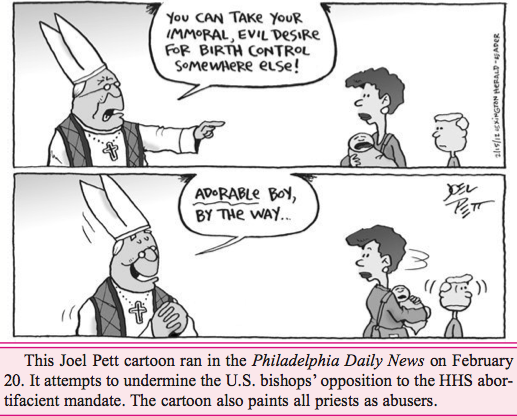
Joel Pett cartoon

Back to Top


BETRAYED BY VICTIMS’ ADVOCATES

The following is a first-hand account of a clergy sexual abuse victim. Last year, he met with Catholic League staff in New York City; we are protecting his anonymity. Some of what he recounts was previously noted by Catholic News Agency.

As an adolescent victim of homosexual clergy abuse, I know the challenges that men face in coming forward. Many of us are silenced in shame after being abused by our homosexual superiors. Aggravating the recovery process is that, despite the evidence, there is an ongoing agenda to cover up the homosexual nature of the abuse crisis, disenfranchising more than 80% of us victims.

Recovery is difficult enough without predatory advocacy groups and their lawyers trolling us for profit and politics. The added torment of being told the problem isn’t related to homosexuality only compounds our pain. For this reason, I am grateful to the Catholic League for giving me the opportunity to relay the difficulties facing victims of homosexual abuse in particular, with all due respect and recognition of the grief suffered by victims who were subjected to heterosexual abuse.

For all of us men who were robbed of the opportunity to allow our sexual identities to mature before being assaulted, the abuse may be ruinous, to the point that some victims never speak of it. Sadly, the odds of suicide attempts are 2-4 times higher among women and a staggering 4-11 times higher for men compared to those who are not abused. These statistics do not account for the compounded effect of betrayal of our faith caused by our spiritual fathers.

I never spoke a word about my abuse until seven years later, feeling safe only to disclose under the seal of confession. The problem was that I didn’t know that the priest behind the confessional screen was an active homosexual. So, when I confessed to him, and he offered to help me, I didn’t know I was being solicited.

I was 22 years old, it was 1989, and there was no public knowledge of the predatory homosexual cadre in our Church. Over the ensuing 18 months the priest from the confessional provided pastoral counseling, but I was also subjected to lewd homosexual conversation and harassment. It was complicated, I was benefitting from his counseling as I was preparing for medical school and hoping to get better, so I tolerated his sporadic foulness. I became dialed into my faith like never before, attending mass and praying on my knees every night. I seemed to be recovering. But that all ended one night when he phoned me, ostensibly drunk, blurting out the most appalling sexual propositions. It was truly devastating. After that I could no longer sit through a mass. I left the Church, vowing I would never speak about my abuse again.

Decades would pass before I found myself in professional counseling. Not knowing I had PTSD, I was dealing with severe anxiety. I didn’t intend to tell the psychologist about the abuse, however, he got to the source, and thus began my recovery. I was 44 years old, with a wife and four kids. We had made the difficult decision years earlier to educate our kids in Catholic schools.

I’d like to share some experiences I had in the recovery process to benefit other survivors and their families to learn from my mistakes, and for members of the Church to understand what happens to us victims when we step forward. Recovery is a difficult course to navigate with plenty of bad actors and hidden agendas out there.

The first step I took after coming forward was to learn what happened to my abuser. I found the “Bishop Accountability” website and read that he had been incarcerated in Oklahoma for assaulting boys there. On that webpage I saw a banner ad for a group called “Road to Recovery”.

I reached out, and had an immediate response by founder and former priest, Bob Hoatson. In that first email he asked if I would like an attorney. I was surprised by this, it wasn’t why I was contacting him, I declined the solicitation and told him I only wanted to get better.

I took his counsel thinking he was an expert on clergy abuse. He appeared on CNN with Anderson Cooper and was in countless newspaper articles. He became a significant influence on me. Ultimately, under his influence, I brought a suit against the Church and I would leave the Church, again. I drew the line when Hoatson encouraged me to get my children out of the Church. Nonetheless, my family was going to mass without me with a negative effect on us.

Hoatson introduced me to the petulant attorney, Mitchell Garabedian, at the Survivors Network of those Abused by Priests (SNAP) conference in Chicago. SNAP proclaims to be a support group for survivors, but what I experienced was anything but support for survivors. SNAP invited the shark attorneys, used the victims like chum, and watched the frenzy unfold.

I saw Jeff Anderson, the mega-sex abuse plaintiff attorney, giggly and excitedly prance around the conference to funnel money to SNAP. All the attorneys raised their hands to show how much they “cared”, but it was an obvious pledge to their motherlode, SNAP. Anderson offered to match all donations up to $50,000. I thought Anderson was entirely inappropriate and found his exuberance personally offensive for the occasion. I watched in disbelief as survivors were subjected to the machinations of SNAP.

After the victims were commoditized with attorneys in the conference room, we broke into small groups. I was looking forward to this part, thinking someone could tell me how to break through. Our group leader, Patrick Wall, was an ex-priest. I thought, “surely these ex-priests, Hoatson and Wall, must be good people and can help.” Instead, what happened in my small group had no therapeutic value. From my years of training in medicine, my assessment was that Mr. Wall had no skills in facilitating a group like this. There were about 10 men in my group and nothing was accomplished. Nothing.

Then, Wall told us he was an attorney working in Jeff Anderson’s practice. My heart sank, my eyes welled up with tears. I went to the SNAP conference to get better, and I had hoped they would help, but all I saw was SNAP aligning victims with attorneys for money and to weaponize victims against the Church.

I left the small group session deflated, and sat in the hallway. A woman came asking if I was OK. I told her that SNAP wasn’t what I thought it was going to be. She said, “I’m sorry that you feel that way.” I asked if she was part of SNAP. She said no, “I am an attorney, here to see how I can help.” She handed me her card. I felt sick and had to get out of there.

I found David Clohessy, the president of SNAP, in the hotel lobby. He authored an article about my abuser. I wanted to know where he got his information and where I could learn more. When asked, he couldn’t remember writing the article. He couldn’t give me any information about my abuser. I thought, “how can someone write an article and not remember a single thing about it?”

What I’ve come to learn over the years is that SNAP will regurgitate negative news about the Church to multiply the exposure. That’s why Clohessy didn’t remember his article. He did not offer to help me, he only apologized for not knowing anything.

Soon after the conference, a whistle blower, Gretchen Hammond successfully sued SNAP. She witnessed SNAP taking kickbacks from the attorneys. I was happy and felt vindicated that someone stood up for victims against SNAP.

Fast forwarding through the years, I was able to prosecute my abuser with a loophole in the statute of limitations. He was convicted, sentenced to prison, and will likely expire there. On December 23rd, 2017, I had a remarkable and unexpected reversion to our Faith. Being back in the Faith brought joy that superseded the happiness I was seeking in counseling.

Hoatson made some disparaging remarks about my return to the Church and my communication with him fell off. In reflection, I realized how he funneled victims to Garabedian, manipulating them much like SNAP. I asked Hoatson what his financial relationship was with Garabedian, he only said “Mitch takes good care of me.”

In September of 2018, I was traveling across the Great Rift Valley in Africa, leading a team on a medical mission. I received an email from Hoatson in our satellite-equipped safari truck. He sent me his press release in response to the Pennsylvania Grand Jury Report. It read, “homosexuals don’t rape minors, predators rape minors.” He went on, “sure, some homosexuals rape minors, and some heterosexuals rape minors,” leading the reader to believe that there is no difference. He also implored Catholics to embrace homosexual and transgender priests.

I confronted him, asking him to add facts to his press release and tell the truth. I replied, “Bob, I was raped by a homosexual and you’re telling the press that I wasn’t. How do you think that makes me feel?” He told me I was the only survivor who felt that way. I reported this to Cardinal Tobin, in New Jersey, where Hoatson’s organization is located. I learned that I am not the only survivor who feels disenfranchised by the position that homosexuality has nothing to do with the crisis.

The effort to protect and harbor active homosexual priests in the Church adds insult to victims’ injury. Many point to “clericalism” as a cause. Alright then, let’s recognize that homosexuals far and away outpace heterosexuals in using clericalism as a means to an end. Can we stop with this politically correct nonsense? We are the Church, forever counter-cultural, with no duty to bow to the gay agenda.

Sometimes I hear words of hope. Like Pope Francis’ statements on homosexuals in ministry. Recently our local rector sent out a notice about screening homosexuals from entering the seminary. In response, I immediately sent a $1,000 donation in gratitude.

Today, SNAP continues to smear our Church. Recently, Clohessy appeared in my city with TV coverage accusing our Bishop of not including my abuser on a list of accused, highlighting my abuser on the news. But he was never in this archdiocese. I contacted the TV station and SNAP multiple times asking them to correct their false reporting but they never responded. SNAP created false news, smeared the Church, their mission accomplished. SNAP also recognized Bob Hoatson with an award last year.

Navigating the recovery process is tough. There are forces vying for victims’ money and souls. However, for me, it was my return to the Catholic Faith that pulled me through the effects of abuse. I am grateful to God for that.