Religious Expression at Christmastime: Guidelines of the Catholic League

Guidelines of the Catholic League

Christmas 2003

This booklet was prepared by Gerard Bradley of the University of Notre Dame School of Law and Robert Lockwood of the Catholic League. It is a guide that we hope will be of use to Catholics, as well as to the general public, regarding what kinds of religious expression are permissible at Christmastime.

William A. Donohue
President
Catholic League for Religious and Civil Rights

Guidelines from the Catholic League for Religious and Civil Rights on the proper means for the religious celebration of Christmas in the public arena

 Introduction

Each year during the Christmas season, there are reports that the religious aspects of Christmas are being banned or omitted from the public arena. These stories can involve anything from threats of legal action over the placing of traditional nativity crèches on public property, to various directives from administrators that eliminate the very mention of the religious aspect of the season from public schools. Such stories can reach ridiculous proportions, as when a city manager in Eugene, Oregon, banned the display of decorated trees on public property. In Vancouver, Washington, transit authorities cited the constitutional separation of church and state in forbidding employees to wear seasonal ties or jewelry that displayed a religious symbol.

There is a tendency to either treat these seasonal stories as something to be laughed at, or to respond to them by assuming that the constitution and court decisions mandate the elimination of the spiritual aspects of Christmas from public life. In many cases, activist organizations employ bullying tactics and threats of lawsuits to attempt to force their private interpretation of the role of religion in public life, particularly within the public school environment. Those who are unaware of the actual legal precedents in these matters and the proper interpretation of the constitution find themselves cowed into submission.

The purpose of this booklet is to outline not only what is permissible, but also what is proper in acknowledging and recognizing the religious aspects of the Christmas season in the public arena. The booklet will provide an overview of the issues involved, and guidelines for civic groups, private organizations and individuals, as well as public school administrators, teachers, and parents.

Overview

Christmas is at its roots a religious celebration. Yet, within American culture there has been a long accretion of secular customs and traditions surrounding the feast, so much so that non-Christians and avowed non-believers celebrate the holiday. At the same time, there has been a growing diversity within American culture. While 86 percent of Americans identify themselves as Christian, there is a growing non-Christian cultures.

In discussing how to recognize and allow for appropriate celebration of the Christmas season in the public arena, there has always been a certain tension among the religious significance of the celebration, the overwhelming secular traditions of the season, and respect for those for whom Christmas is not a part of their culture or religious faith. In the public arena, there needs to be an understanding of the difference between accommodation of religious belief, and giving the appearance of the establishment of religious belief.

At the same time, there needs to be a sensible understanding of the right to freedom of religious expression, and the right of religious groups, civic organizations and private citizens to use public property in the same fashion allowed to secular organizations. Finally, it must be clearly understood that within a public school environment, the religious aspects of the Christmas season have no less right to expression and recognition than the secular aspects of the season, or non-Christian faiths and cultural celebrations that are recognized and explained within the school year.

The issue of recognizing Christmas in the public arena generally arises in two forms: 1) the display of secular and/or religious seasonal symbols on public property at the expense of either government or private groups; and 2) the treatment of the Christmas season within public schools. Yet, as noted above in Eugene, Oregon, and Vancouver, Washington, the issue can also come up in a host of different ways where the action that is taken is decidedly hostile to religion, or even to the secular observance of the Christmas season. These issues are sometimes raised by administrative fiat resulting from an individual complaint, or under threat of legal action.

Even well meaning people attempting to avoid alleged controversy, or under threats, give in to a view that holds that there is a constitutional requirement that the government be hostile to religion in the public arena, rather than neutral. Such was the case when a public school system in Georgia responded to threats of legal action by ceasing any reference to a “Christmas break” for the traditional period when schools close around the holidays. Though it defied logic and common sense—the break has always been associated and timed for the Christmas season, and will continue as such—this kind of intolerance and censorship of speech have been common. And the response is often complete surrender to the complaint.

There is the unfortunate aspect to much of this discussion about Christmas in the public arena that certain elements within society consider religion—particularly Christianity—to be a divisive, if not dangerous force, in society. Their campaigns are built on intolerance, restriction of free speech and hostility toward religion. They believe that people need protection from religion and religious expression. While they have a right to such views, they do not have the right to treat Christian religious expression as in and of itself a secondary right. Unfortunately, the Supreme Court has allowed private religious expression to be limited when it could appear to the “reasonable” observer that the government is “endorsing” that expression—meaning that the government appears to agree with or affirm a particular view of religion. (County of Allegheny v. ACLU, 492 U.S. 573 (1989)). Although four members of the Supreme Court have disagreed with use of this “endorsement test” against privately sponsored religious free speech, that test—derived from Allegheny—has not yet been explicitly overruled. (Capitol Square Review & Advisory Board v. Pinette, 515 U.S. 753 (1995)).

The publicly sponsored display of religious symbols in the public arena, however, is a different matter. Worried that publicly sponsored religious displays could reasonably be seen as an endorsement of religion or a particular religion, the Supreme Court has applied a more exacting standard to publicly sponsored displays than private ones. The focus of the guidelines given in this booklet, however, will be on privately sponsored religious expression in the public arena, and religious expression by students or teachers in public schools during the Christmas season.

The display of religious Christmas symbols in the public arena certainly involves a greater understanding and tolerance for different religious traditions within the United States. It is also an opportunity to see that First Amendment rights of religious expression and free speech be guaranteed to all on an equal basis. Openness to religious expression, recognition, and speech in forums that are traditionally open to secular speech is not a violation of separation of church and state, or government seal of approval for any particular religious sect.

State Constitutions

Keep in mind that the guidelines presented in this booklet are based on the First Amendment to the Constitution of the United States. Most state constitutions also contain, like the First Amendment, guarantees of non-establishment and free exercise of religion. The non-establishment clause of a state constitution may be more specific in defining what constitutes an “establishment” of religion than the non-establishment clause in the First Amendment. Theoretically, what might be permissible under the First Amendment might also be expressly prohibited by a state constitution. At the same time, a state constitution may not limit or burden the free exercise clause guaranteed by the First Amendment. Whether the two ever conflict is a state-specific determination beyond the scope of this pamphlet. While it is highly unlikely that any state constitution could successfully prohibit a nativity scene that satisfies the federal First Amendment, the concern is one to be kept in mind if litigation might arise.

Forums

In relation to expression or free speech, all public property generally falls under the classification of one or another types of forums: the traditional or open public forum, the limited or designated use forum, and the non-public forum. The classification of a forum critically affects how much the government may limit expression or speech in that forum. As one can see after reviewing the guidelines, the question of whether a court will uphold any given nativity scene display is not easily predictable, nor does it depend on any formulaic rule. Therefore, the guidelines in this booklet are not a sure formula for winning litigation. Rather, they are principles applied by the courts in determining such litigation. By considering these principles, one can erect a nativity display where it is most likely to be upheld and least likely to be struck down.

Guidelines for Private Groups or Individuals Erecting Nativity Scenes on Public Property

I. In which kind of forum will the nativity scene be erected?

A. Traditional/Open Public Forum

1) A traditional/open public forum provides the best protection for nativity scenes.

2) The traditional/open public forum is characterized by being an open public thoroughfare with an objective use of open access (examples: streets, sidewalks, and parks).

3) The government may place objectively reasonable time, place, and manner regulations on the display of the nativity scene so long as the regulations are content-neutral (example: limiting the amount of electricity a display can use for safety reasons).

4) In order to subject a nativity scene to content-based regulations (example: no nativity scenes are allowed because they are religious), the government must show a compelling interest in having the regulations and must show that the regulations are narrowly tailored to that interest.

a) Governments may have a compelling interest in avoiding a situation where a reasonable observer of the situation would conclude that the government was endorsing religion over non-religion, one religion over another, or several religions over others.

b) If a nativity scene or other religious display stands alone in front of a public building, especially a seat of government (example: a courthouse or city hall), courts have often found that such a display would impermissibly give the reasonable observer the impression that the government was endorsing religion—even though the scene was privately sponsored.

c) Secular symbols, such as Christmas trees, Santa Claus, reindeer, and candy canes, if placed prominently around a nativity scene, can downplay what a reasonable observer would otherwise see as a government endorsement of religion.

d) Merely grouping together religious displays (example: a crèche and a menorah) does not solve the endorsement problem. Without secular symbols present, the reasonable observer might still conclude that the government was endorsing several religions over others (example: Christianity and Judaism).

e) Nevertheless, governments may not from the beginning subject a nativity scene or the permission to erect one to more unique rules or a more restrictive application process than the rules or process applicable to any display in the open public forum.

B. Limited/Designated Use Forum

1) The limited/designated use forum is one that the government purposefully makes available to a particular class of persons or for a particular class of uses. (example: the government may open a government-owned area to use by military veterans, or for religious and cultural displays).

2) The limited/designated use forum is just like a traditional/open public forum for all those falling within the class to which the forum was opened. Apply the traditional/open public forum guidelines.

3) The government’s ability to limit use of the forum to a particular class is not unlimited, but the courts have not defined what the limits are. The courts have said that once a limited forum has been created, entries of a similar character to those allowed access may not be excluded. (example: if the forum has been opened to religious displays, nativity scenes may not be excluded).

4) Note that the government simply allowing some speech or expression on public property that is not an open/traditional public forum does not created a limited/designated use forum. The government can keep the forum non-public by allowing selective, permission only access that depends upon non-discretionary judgments (example: x amount of insurance coverage)

C. Non-Public Forum

1) Non-public fora are generally all those government properties that are not traditional/open public fora and have not been made designated/limited use fora.

2) The government can refuse to allow a nativity scene display in a non-public forum when that display would interfere with the objective use to which the property has been dedicated (example: the government may refuse to allow a nativity scene near the runway of an Air Force base because it would distract landing pilots).

 Public Schools

Most people are surprised to discover that the courts have issued few guidelines at all for public schools concerning seasonal religious displays. When the Supreme Court has touched on the issue, it has generally found in favor of religious expression and displays, for example, in favor of allowing the performance of religious music in public school choral performances during the Christmas season, and the performance of public school choirs at religious institutions. While some administrators of public schools—and activist organizations that attempt to bully public schools—will often cite vague references to separation of church and state, there is no legal precedent in this area that bans the display of religious symbols at Christmastime. The reason for this is that courts will not interfere in the educational process. Display of religious symbols, when done even-handedly and without devotional intent, is perfectly legitimate as part of the school’s mission to educate.

Some Christmas symbols—reindeer, Santa Claus, and candy canes, for example, have been viewed by the courts as secular rather than religious symbols of Christmas, and their display is legitimate. Other symbols have been viewed as secular or religious depending on the context. When the Supreme Court has dealt with Christmas trees it has generally viewed them as a secular symbol. Even so, in the specific context of public schools, a lower court has treated a Christmas tree as a religious symbol when it was placed next to religious items from non-Christian faiths. That court seemed to feel that the very name of the Christmas tree evoked the Christian meaning of Christmas when the Christmas tree was placed next to a menorah and Kwanzaa symbols. Menorahs are viewed as mainly religious, but have been considered secular when surrounded by largely secular items. It seems unclear in the courts whether Kwanzaa symbols are religious or secular in nature. Whether the display of these secular-religious symbols is legitimate depends, like the display of nativity scenes, largely on rules of context.

Unfortunately, too many public school authorities have become convinced that any recognition of Christmas violates the separation of church and state, to the point where the use of the word “Christmas” is effectively banned, traditional Christmas carols silenced, and both religious and secular Christmas symbols prohibited. In many areas of the country, there is the imposition within public schools of an essentially pagan “winter solstice” and “winter holiday” celebration while banning all reference to the traditional Christmas celebration. While the display of religious symbols in public schools obviously cannot involve school-sponsored religious ceremonies, the courts have never banned a basic recognition of Christmas—with songs and seasonal activities and displays—within public schools. There is no basis for such a ban in law, and it could quite possibly be interpreted as actively hostile to religious freedom of expression, which hostility is illegal.

Following are guidelines and recommendations for the proper recognition of the religious aspects of the Christmas season within public schools:

Christmas in Public Schools

  1. An increasing number of teachers throughout the country, including those in public schools, recognize that study aboutreligion in social studies, literature, art, and music is important to a well-rounded education.
  2. Therefore it is entirely appropriate and good for public school teachers to educate their students about religious traditions, including those of Christianity, so long as the approach is academic and not devotional; that is, so long as, for example, Christmas is not taught as truly the Son of God’s birthday. It is permissible for teachers to state, however, that Christians celebrate Christmas as the birthday of Jesus, whom they believe to be the Son of God.
  3. While teachers may not promote religion, they may not denigrateit either. Teachers may never consciously lure students away from their own religious beliefs, denigrate those beliefs, or show hostility to those beliefs.
  4. It is perfectly acceptable to use religious symbols, such as nativity scenes, as an aid or resource in teaching about religious holidays, but the religious symbols must be used onlyas examples of religious or cultural heritage.
  5. It is appropriate to display Christian religious symbols of the Christmas season along with symbols of other faiths and secular symbols.

– Most courts view Santa Claus, reindeer, and candy canes as secular symbols

– Menorahs can be considered either a secular or religious symbol, depending upon the context in which they are placed. For example, a menorah placed next to a crèche and Kwanzaa symbols would likely be considered a religious symbol. A menorah placed next to a Santa and candy canes, however, would probably be considered a secular symbol.

– Christmas trees are a predominately secular symbol, but might be considered religious in certain contexts. For example, one court found that a Christmas tree placed next to a menorah and Kwanzaa symbols acted as a Christian symbol. Therefore, the court held, the school display did not discriminate against Christianity and the school could not be compelled to display a crèche.

  1. The use of religious symbols in class and the display of religious symbols in schools should only be done on a temporarybasis, such as during a particular season or the study of a particular lesson.
  2. School rules about the display of religious symbols should be uniform and even-handed. They cannot apply to one faith alone or discriminate against one faith alone. A school may notban the mention of Christmas by students, and may not refuse to display Christian religious symbols of Christmas when other faith and traditions are being recognized. Note, however, that a Christmas tree might sometimes count as a Christian religious symbol.
  3. The use of religious music, art, or literature in school Christmas performances that present a variety of selections is appropriate. Concerts should avoid programs heavily dominated by religious music, particularly when such concerts coincide with holidays such as Christmas.

In many cases, bans against the mention of Christmas or the use of Christian Christmas symbols within public schools are explained as a means to respect “diversity.” Unfortunately, this term is too often used as a club wielded intolerantly. It is used not to respect diversity, but to restrict free speech and religious expression.

“Diversity” means recognizing the diverse cultures and faith traditions within America. It does not mean banning recognition of a part of that culture and faith tradition within public schools. Most of all, “diversity” does not mean hostility toward Christian religious expression and recognition. It means a balanced, fair, and even-handed treatment that does not exclude the religious significance and meaning of the Christmas celebration.



The December Celebration

A response to the ADL’s December Dilemma


Guidelines for the recognition of Christmas for Public Schools

Posted on the website of the Anti-Defamation League are guidelines called December’s Dilemma. Essentially, the ADL proposes to public school administrators, teachers and parents guidelines that in essence banish virtually any mention of Christmas. These guidelines have absolutely no legal standing and turn the First Amendment on its head. “December Dilemma” is the product of ADL’s own philosophy that would ban any expression of religious belief in public schools. Below, the Catholic League has drafted a revision of the ADL guidelines that give an alternative to a philosophy that has reduced Christmas to a pagan “winter solstice” ritual in our public schools.

December presents public schools with the opportunity of acknowledging the diverse religious beliefs of their students while avoiding the kind of divisiveness that some activist organizations foster by misinterpreting the constitutional mandate regarding freedom of religion. Teachers, administrators and parents should try to promote greater understanding and tolerance among students of different traditions by taking care of First Amendment rights which guarantee the right of religious expression. Public Schools cannot prohibit legitimate acknowledgment of Christmas as an important cultural and religious celebration.

The First Amendment guarantees freedom of religion to all Americans, including young schoolchildren. It forbids the government or public school authorities from imposing arbitrary, coercive and prohibitive regulations that directly threaten to interfere with the right of students to acknowledge the Christmas season. The courts have long interpreted that students in public schools have the right to engage in individual prayer, organize student-led religious clubs, and engage in organized prayer with other students. Additionally, the courts have not banned the recognition of Christmas – with songs and seasonal symbols – within public schools. Unfortunately, certain activist organizations have convinced far too many public school authorities that such recognition of Christmas is unconstitutional, to the point where the use of the word Christmas is effectively banned, traditional Christmas carols silenced, and symbols of Christmas such as nativity scenes prohibited. The imposition within public schools of an essentially pagan “winter solstice” or “winter holiday” celebration while banning all reference to the traditional Christmas celebration is not supported by any rational interpretation of the First Amendment.

Our goal is to explain that the Christmas holiday observance in public schools is constitutionally permissible. If you have any questions about this issue, contact the Catholic League for Religious and Civil Rights.

Christmas as an Educational Lesson

There are appropriate educational benefits to teaching and recognizing within public schools the diverse religious traditions and cultures of our country. School officials must be sure they do not give students the impression that one set of holiday beliefs, specifically Christmas, is less acceptable than others.

Courts have never ruled that the study of Christmas as a religious celebration must be banned from public schools. Courts have stressed that religion is a pervasive and enduring human phenomenon which is an appropriate, if not desirable, subject of secular study. In fact, it might well be said that one’s education is not complete without a study of the comparative religion or the history of religion and its relationship to the advancement of civilization.

Additionally, there is a critical difference between school-organized prayer services and teaching about religion. Most importantly, it is constitutionally permissible for public schools to teach about the role of religion in the Christmas celebration and to acknowledge the religious dimensions of the Christmas celebration. School officials and parents must be careful not to misunderstand the difference between school-organized religious observance and the impermissible banning of Christmas discussion, symbols and song that have religious foundations.

Contrary to certain assumptions, the Supreme Court has never banned the acknowledgment of religious holidays in public schools, including Christmas. The Supreme Court has said that religion can be presented objectively as part of a secular program of education. That cannot be interpreted to mean that the Bible passages cannot be read in public schools in a secular context of study, or that explanations of the religious meaning of Christmas, or the right to display religious symbols of Christmas with other religious or secular symbols of the season can be banned. It is important to remember that, in any context, the public schools must not coerce students away from their religious beliefs, denigrate religion nor be hostile to religion.

It is often appropriate to teach about the historical, contemporary and cultural aspects of religious holidays. Unfortunately, many public school administrators and teachers have been misled to believe that any mention of the religious context of the Christmas celebration is forbidden. The use of religious Christmas symbols within the context of a discussion of the season, or acknowledging the religious Christmas celebration along with the secular aspects of the season and the traditions of other faiths within December is not only permissible but appropriate. From these lessons, young children often gain understanding and respect for the diverse cultures and beliefs in our country.

Teachers should make sure not to avoid covering the religious meaning of the Christmas celebration when recognizing the holiday celebrations of different traditions. For example, in any given year a number of holidays may occur in December – Christmas, Chanukah, Kwanzaa, Bill of Rights Day, and Bodhi Day (a Bhuddist celebration) – and are appropriate for lessons, recognition and acknowledgement. Banning the mention of Christmas, or refusing to display religious Christmas symbols when other such holidays are acknowledged and displayed, is impermissible.

Holiday Assemblies and Other Public School Activities

The study of religious holidays may also include more than mere classroom instruction. For instance, public performances or presentations of music, literature and art are permissible. It is also permissible that such performances and presentations include material from a religious Christmas tradition.

Religious music, literature, art or other religious activities cannot be banned from school activities. These activities are permissible and they cannot be prohibited from a school-sponsored event. For instance, it is permissible to have students act out a play which contains a scene where a family is shown exchanging Christmas presents on Christmas morning. School-sponsorship of a play that makes mention of the birth of Jesus on Christmas is permissible and can be a part of a school-sponsored event. School authorities have no obligation – or right – under the constitution to ban any mention in a school-sponsored event of the religious meaning of Christmas.

School-sponsored activities that focus on more than one religion and religious holiday, or a secular celebration of “winter holiday,” can also focus on Christmas. Depicting a diversity of beliefs and customs is important to teaching public school students about religion and culture. It also helps to ensure that public schools do not denigrate Christmas and promote a purely secular or pagan view of the celebration of the “winter holiday” or “winter solstice.”

It is also important to provide students the opportunity to choose to participate in activities that they find sensitive to their beliefs. Banning Christmas symbols, customs and traditions while forcing students to participate in a “winter holiday” or “winter solstice” program is inappropriate. School administrators must be sure that students have the option to avoid such programs that ban mention of Christmas and not be forced to participate out of embarrassment or peer pressure.

Performing Religious Music

Due to the dominance of religious music in serious choral music, it is perfectly permissible to allow public school choirs to sing religious music as part of a choral performance.

In fact, forbidding choirs to sing music that is religious has been found to be hostile toward religion. School officials have no right to forbid the singing of religious music in a school assembly or at other religious activities. School choirs can sing secular Christmas songs and religious music. No student can be forbidden in choir from singing religious songs out of fear of embarrassment or peer pressure.

For instance, at a winter public school choral concert, it is permissible to include religious songs from a religious Christmas tradition. It is not appropriate for a public school choir to perform a concert at Christmas that is dominated solely be secular songs or songs from other religious traditions while completely excluding Christian Christmas songs.

Christian students certainly have the right to sing songs reflecting their understanding of Christmas if other students are engaged in songs reflecting their perspective of the season.

Public school students have the right to perform at churches, synagogues or temples. A public school choir cannot be forced to sing exclusively at neutral or secular sites.

As with other public school activities that legitimately involve religion, school authorities and parents should consider the effects of denying all religious music to impressionable young children.

Decorating Classrooms and Grounds With Holiday Symbols

Public school officials can decorate classrooms and other areas of public schools to recognize certain holiday seasons. They must be careful not to send a message through these decorations that the expression of the religious nature of Christmas is banned or prohibited by the school.

The Supreme Court has never ruled on holiday displays in public schools. Certain activist organizations have attempted to interpret court decisions to mean that all religious symbols of the Christmas season as decorations are banned. This is not so. Certain symbols common to the month of December, such as dreidels or Christmas trees, are permissible. In addition, schools are not required to avoid any decoration that reflects a religious understanding of Christmas when other secular and religious symbols of the season are being used. Religious Christmas symbols cannot be the sole holiday decoration banned.

If schools choose to recognize holidays through decorations, they should represent the diversity of the season’s celebration. Schools should avoid banning any religious symbol to avoid sending the message to students that a religion or a particular denomination is forbidden.

Additionally, symbols depicting secular celebrations of the season are most appropriate when accompanied by both Christian objects and symbols from holidays of other religions. This combination of faith and of sacred and secular helps to avoid messages of favoritism to a secular understanding and concerns about arbitrary banning of religious symbols.

For instance, on a board filled during December with images of snowflakes, candles and evergreen trees, it might be appropriate to add images of Santa Claus and even a dreidel because clearly the message is a celebration of the season. To include a nativity scene or menorah or other undeniably religious symbols is not inappropriate as long as all these other objects are displayed.

If a school wishes to recognize seasonal holidays, temporary displays that depict the secular aspects of the season and holidays with a religious origin are appropriate and permissible. If symbols that depict religious holidays are used, the display should visibly represent that religious origin, as well as the secular aspects, and should also include holidays of several religions. But it would be inappropriate to ban all religious symbols of the Christmas season and solely depict its secular aspects.


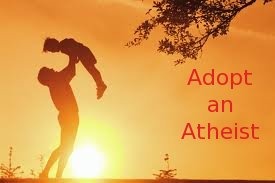
“ADOPT AN ATHEIST” CAMPAIGN


President
David Silverman
[email protected]


Ken Loukinen, Director of State Operations
[email protected]


Alabama
Scott Savage
[email protected]


Arizona
Don Lacey
[email protected]


California
Larry Hicok
[email protected]


Connecticut
Dennis Paul Himes
[email protected]


Florida
Greg McDowell
[email protected]


Georgia
Al Stefanelli
[email protected]


Idaho
Susan Harrington
[email protected]


Iowa
Randy Hendersom
[email protected]


Kentucky
Edwin Hensley
[email protected]


Massachusetts
Zach Bos
[email protected]


Michigan
George Schiffer, Assistant State Director
[email protected]


Military
Justin Griffith
[email protected]


Minnesota
Randall Tigue
[email protected]


Missouri
Greg Lammers
[email protected]


North Carolina
Wayne Aiken
[email protected]


Oklahoma
Ron Pittser
[email protected]


Pennsylvania
Ernest Perce
[email protected]


Ohio
John Welte
[email protected]


Rhode Island
Brian Stack
[email protected]


Texas
Joe Zamecki
[email protected]

Virginia
Rick Wingrove
[email protected]


Washington
Wendy Britton
[email protected]


West Virginia
Charles Pique
[email protected]


WAR ON CHRISTMAS

AR2014-CoverThe annual “War on Christmas” continued in 2014 with both sides having achieved roughly the same number of wins and losses. This is certainly an improvement over the days when the anti-Christmas side appeared to be winning this battle in the culture war. The good news is that the pro-Christmas side has been pushing back, even reversing previous losses.

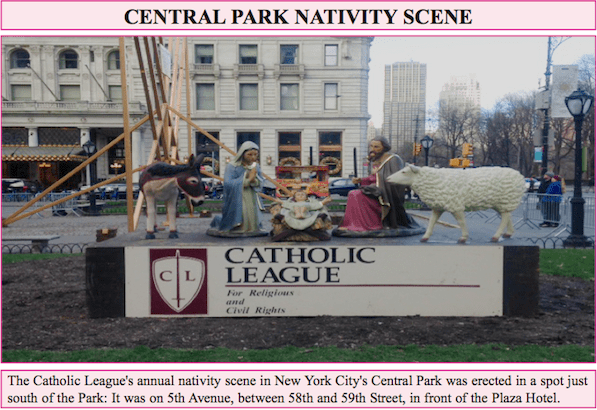
The presence of the Catholic League was felt in New York City where a record number of people commented on our nativity scene in Central Park; this year it was displayed right in front of the Plaza Hotel.

When it comes to putting a nativity scene on public property, the pro-Christmas activists claimed several victories, despite the fact that almost all of them were challenged by the anti-Christmas forces. They too had their victories, succeeding in getting some displays removed. 

Freedom from Religion Foundation was active in many of the attacks, as were American Atheists, the ACLU, and Americans United for Separation of Church and State; the latter advised Satanists of their rights, thus proving that their real agenda is to attack Christianity. American Atheists erected anti-Christmas billboards in some cities, mocking the holiday. 

Most atheists either celebrate Christmas in a secular fashion, or are wholly dismissive of it; few are terrified of it. American Atheist President David Silverman showed his hand when he said “Millions of American children are forced to go to church under the threat of being denied meals, losing household privileges, having their college tuition cut off, or being kicked out of their homes. Many atheists are forced to go to church under threat of divorce or lose custody of their children.” It is this mindset which shows the true goal of these activists, not just to censor Christmas, but to attack those who celebrate it.  

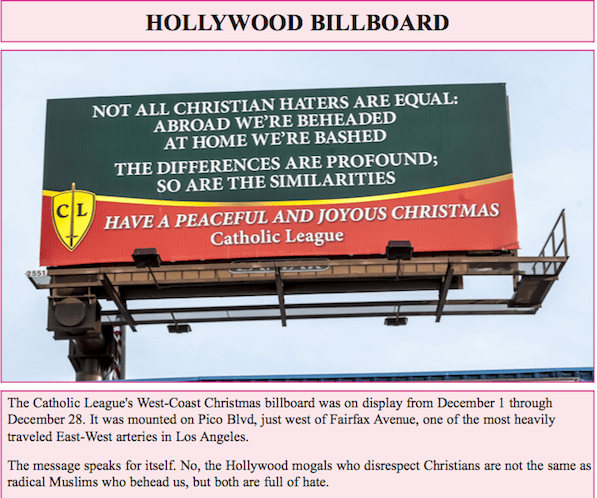
The Catholic League made a splash in Los Angeles with its billboard: we called attention to hate speech directed at Christians at home and abroad. From the media response, we know we provoked a discussion. 

We also drew attention to the extent that militant secularists are terrified about Christmas. For example, their censorial response reached absurd heights when some sought to ban candy canes. That was the initial response of the University of Maine; it changed its policy once the media exposed its madness. Why did it seek to censor candy canes? Because, they said, the candy canes reminded people of Christmas. Evidently, that is not something that an institution of higher learning should be expected to tolerate.  

Cambridge, Massachusetts, we pointed out, wouldn’t blink an eye about welcoming terrorists to speak at any venue, but when it came to having Santa appear at a local school winter concert, the open-minded bigots decided to disinvite him.

It never ceases to amaze us that all of those seeking to silence the Christian voice at Christmastime boast of their unwavering commitment to freedom of speech, diversity, and tolerance. Their real political stripes are totalitarian; they are a menace to freedom. But the good news is that they keep running up against people like us.

September 9 – October 14
Marshfield, MA – On September 9 the School Committee of the Marshfield School District voted 3-2 to change the name of the annual December break to “Holiday Break” from its original designation of “Christmas Vacation.” The matter was considered because one parent complained to the superintendent that using Christmas was “slightly archaic.”

Outraged residents and parents collected over 400 signatures and launched a campaign to convince the School Committee to change the name back. On October 14 the committee considered a motion to restore “Christmas Vacation” to the calendar, but it too was defeated 3-2.

November 24
Rusk, TX – The American Humanist Association sent a letter to Cherokee County officials objecting to the placement of a nativity scene on the lawn outside the county courthouse. Texas State Attorney General Greg Abbott expressed his support for, and legal assistance in defending the display.

November 25
Piedmont, AL – The theme of the city’s annual Christmas parade was “Let’s Keep Christ in Christmas” until the Freedom From Religion Foundation (FFRF) sent officials a letter claiming that the theme “alienates non-Christians.” City officials responded to FFRF the following day that the theme had been changed to simply the “City of Piedmont Christmas Parade.”

December
Tallahassee, FL – The Florida Department of Management Services approved a number of displays for the State Capitol, some of which are meant to mock Christians and Christmas. A pro-Christmas group would be erecting a nativity; the Satanic Temple, who was being represented by Americans United for the Separation of Church and State, was approved for a falling angel display; American Atheists displayed a placard mocking the true meaning of “X-mas” including friends, fun and Chinese food; local blogger and activist Chaz Stevens displayed a pole made out of beer cans for the fictional holiday Festivus; and the Freedom From Religion Foundation once again displayed its secular Winter Solstice banner in the capitol. The banner included a “bill of rights nativity” scene.

December
American Atheists launched a series of billboards in St. Louis, Milwaukee and Ft. Smith, Arkansas. The billboards featured an image of a young girl and her letter to Santa. It read, “Dear Santa, All I want for Christmas is to skip Church! I’m too old for fairy tales.”

December 2
Madison, WI The Freedom From Religion Foundation (FFRF) installed a “Natural Nativity Scene” in the Wisconsin state capitol. The display, which is meant to mock Christmas, celebrates the rebirth of the sun and includes Charles Darwin, Thomas Jefferson, Emma Goldman and the Statue of Liberty. Jesus is represented by a female doll and Mary by Venus. FFRF also installed a Winter Solstice sign imploring readers to “Keep State and Church Separate.”

December 4
Columbia, TN – Maury County’s Commissioners voted not to install a nativity on their courthouse lawn this year. The county attorney and local mayor both warned the commissioners against approving the display citing the likelihood of lawsuits.

December 4
Coral Gables, FL – Vandals sprayed statues of Mary and Joseph with blue and yellow paint and stole the statue of baby Jesus from the nativity scene outside an office building. Police recovered the missing statue on December 6 and returned it to the business owner. The Jesus statue is valued at $2500.

December 4
Portsmouth, NH – The ACLU objected to the decision made by Sheriff Bill Watson to display Christmas trees, a nativity scene and a menorah inside the city’s courthouse. Sheriff Watson spent his own money to buy three trees for display at each entrance to the courthouse, as well as a nativity set and a menorah that were displayed inside the sheriff’s office. City policy prohibits religious displays and the ACLU protested the inclusion of the religious symbols. As a result, the city’s chief judge asked Watson to voluntarily remove the religious displays. Watson, who initially rebuked the ACLU, complied with the judge’s request in order to avoid a legal directive.

Screen shot 2015-05-27 at 12.35.58 PM

December 4
Rockaway Township, NJ – The baby Jesus figures were stolen from two nativity scenes on the lawns of private homes. Both figurines were taken after 9 p.m. from the houses that were 3 miles apart. Police were investigating whether the same person was responsible for both thefts. One of the figures was later recovered.

December 5
American Atheists unveiled billboards in Memphis and Nashville, TN that targeted Christians. The atheists admit that their billboard was aimed at “in-the-closet atheists who are pressured to observe religious traditions during the holidays.”

December 5
Mountain Home, AR – The American Humanist Association complained that a crèche on the lawn of the Baxter County Courthouse violated the First Amendment. The display also included a 10-foot Christmas tree, Santa Claus, and a reindeer. It had been installed for over 30 years. After complaints were made in 2013, the county included a sign with a disclaimer that the display was privately funded.

December 6
Killen, TX – Vandals struck the home of a disabled veteran who displayed dozens of inflatable Christmas decorations as well as over 1900 lights and other decorations. The inflatable decorations were slashed and wires were cut. Over $800 in damage was inflicted.

December 7
The season finale of “Family Guy” on Fox, was titled “The 2000 Year-Old Virgin,” and featured the characters meeting Jesus in a mall. Jesus discloses that he does not have a good relationship with his father, God. God spends Christmas at a time-share with a girl-friend, which leaves Jesus home alone for his birthday.

The characters learn that Jesus is a virgin and does not know anything about sex. They embark on a mission to find Jesus a girlfriend for his birthday. The remainder of the episode mocks Jesus, Christians and the Christmas story.

December 7
Franklin, IN – A two-foot statue of Jesus was removed from the nativity at the Indiana Masonic Home. The retirement community moved the nativity to a more prominent location this year so that it would be visible to passing traffic. The missing statue was later found elsewhere on the property.

December 9
North Augusta, SC – A nativity display was removed from the Nancy Carson Library. After the library received complaints, including from the County Council, the nativity was returned as part of a display that included other religious and non-religious symbols.

December 11
Jay City, FL – After receiving a letter from the Freedom From Religion Foundation (FFRF), the Jay City attorney advised against installing a crèche at city hall. FFRF claimed the display would be illegal and the city feared incurring legal costs defending the crèche. Instead the city gave the crèche to a private organization to display.

December 11
North Ogden, UT – A complaint was filed by a local resident against a nativity that was set up in front of the city’s offices. Additionally a Facebook page for the city’s mayor became a forum for debate between those residents who wanted the display and those that did not. A spokesperson for the Utah chapter of the ACLU said the city needed to install secular symbols such as reindeer or candy canes next to the nativity. The mayor supported keeping the nativity.

December 12
Cambridge, MA – Santa Claus was disinvited from his traditional appearance at the winter concert at Andrew Peabody School because one parent complained. The annual concert for first through fourth grade students would normally include a visit from Santa. The school describes itself as an “inclusive community” and said Santa would make an appearance at a different event for families at the school. That event was not part of the school day and attendance was optional.

December 12
Grand Haven, MI – Americans United for the Separation of Church and State threatened to sue the city over the installation of a nativity scene on city owned Dewey Hill. The location is already subject to controversy because of a cross on the property.

Note: See the Activists section for more information about those protesting the cross.

December 12
Utica, NY – The Freedom From Religion Foundation sent a letter to the Utica Fire Department demanding that a “Happy Birthday Jesus – We Love You” sign be removed from outside fire station 4. The handmade sign was installed outside the station by the local chief.

December 13
Dallas, NC – After being threatened with a lawsuit from the Freedom From Religion Foundation, the town decided to remove a nativity from town property. The nativity had been placed outside the courthouse every Christmas for 40 years.

December 15
Lansing, MI – The Satanic Temple was approved for a display outside the state capitol. According to Capitol rules the display had to be removed each night. The display was meant to counter a nativity scene which was installed later in the month.

Screen shot 2015-05-27 at 12.36.11 PM

December 15
Orono, ME – An administrator at the University of Maine, Auxiliary Services Executive Director Daniel Stirrup, emailed other employees advising them not to display any “decoration that could be perceived as religious” including “xmas trees, wreaths, xmas presents, candy canes, etc.” The email continued that “plain trees without presents underneath, decorative lights, but not on trees, snow flakes, etc.” were allowed.

Once students complained and the local media covered the story, the school’s Dean of Students issued a statement revoking the earlier policy and stating “we welcome every faith tradition, and we welcome displays of those faith traditions.”

December 16
Brookville, IN – The ACLU filed a lawsuit on behalf of the Freedom From Religion Foundation against a nativity scene that was on display outside the Franklin County Courthouse. The display was paid for with private donations.

December 16
Chicago, IL – A series of 11 billboards were installed by the Freedom From Religion Foundation. The advertisements featured members of the group with quotes meant to mock people of faith. That the billboards were installed shortly before Christmas showed they were targeting Christians.

December 18
Lincoln, NE – An application by the Thomas More Society to install a crèche in the Nebraska state capitol was approved, but not without controversy. However a state senator, Ernie Chambers, protested the decision to grant the group permission. “Except for the fact that I am a man who believes in using legal processes to address inappropriate use of state facilities, I would dismantle it and remove it myself” Sen. Chambers said.

December 21
Lockhart, SC – A vandal slashed inflatable Christmas decorations at two homes.

December 22
Louisville, KY – At least 25 homes were vandalized when a group of teenagers went around breaking Christmas decorations, stealing lights and slashing air-filled displays.

December 22
Statesboro, GA – The Freedom From Religion Foundation set up a freethought solstice banner to counter the nativity outside the Bulloch County Courthouse. The banner said there is no God and that religion is a myth.

December 24 – 25
American Atheists’ internet based television channel, AtheistTV, promised “original programs proclaiming the truth about Christmas.” The scheduled programs included a de-bunking of Christmas, anti-Christmas shows, and a selection titled “Is Christmas a Religious Holiday?”

December 25
Haverhill, MA – When a priest arrived at Sacred Heart Parish to celebrate Christmas Mass he noticed the baby Jesus figure was missing from the church’s nativity scene. Upon closer inspection he discovered that the infant was replaced with a severed pig’s head.

Police arrested a suspect and charged her with destruction of a place of worship. The same homeless woman also vandalized the nativity on December 31 when she stole a large metal crucifix from the crèche.


The War on Christmas

October 30
Olympia, WA – The director of the Department of General Administration signed rules that dictated no religious or other nongovernmental displays would be allowed inside any building on the State Capitol campus. But the new rules did allow for a state sponsored “Holiday Tree” to be displayed in the Capitol rotunda. Although the new rules did not allow religious displays inside the Capitol buildings, Annie Laurie Gaylor, co-president of the Freedom From Religion Foundation, believed the rules were not strict enough because they allowed for displays outside of the buildings. She said, “I don’t think the public will be any happier about it on the outside than they would be on the inside. I encourage the state to avoid the entire debacle.”

November 2
Seattle, WA – The Freedom From Religion Foundation launched an ad campaign featuring Santa Claus saying, “Yes, Virginia, there is no God.” Foundation co-president Dan Barker said, “People have been celebrating the winter solstice long before Christmas. We see Christianity as the intruder, trying to steal the natural holiday from all of us humans.” The other co-president, Annie Laurie Gaylor, said, “We nonbelievers don’t mind sharing the season with Christians, but we think there should be some acknowledgement that Christians really ‘stole’ the trimmings of Christmas, and the sun-god myths, from pagans.”

November 11
Clarksville, TN – The ACLU asked the City of Clarksville to “end the unlawful endorsement of religion,” claiming that the city paid for the animals used in its Nativity scene. The organization had no issue with the menorah erected in Nashville’s Riverfront Park.

November 19
West Chester, PA – New rules were issued for holiday displays in front of the Chester County Courthouse. Under the new rules, four displays were allowed in front of the Courthouse for a limited period of time, provided they were “content-neutral” in terms of their message. But symbols—religious or secular—are by their very nature content-specific, thus making the request positively oxymoronic.

November 23
The American Humanist Association launched an ad campaign to celebrate “a new kind of holiday tradition.” The ads proclaimed, “No God…No Problem!” The group ran the ads on buses in Washington, D.C., New York City, Chicago, Los Angeles and San Francisco.

November 24
Manchester, MA – A woman hoped that her parish could have a live nativity scene on Christmas Eve, but was told by the town’s board of selectmen that it wasn’t an option.

The reason the board gave her was the church sits on the town common and the board was worried about the legal ramifications of allowing a crèche on public property.

November 29
Chambersburg, PA – A nativity scene that had been displayed in Memorial Square for almost 50 years was taken down following a request from Carl Silverman of PA Nonbelievers to put up a sign, saying, “Celebrating Solstice—Honoring Atheist War Veterans,” to accompany the manger.

November 30
Leesburg, VA – The grounds committee at the Loudon County Courthouse decided to ban the traditional display of the crèche, menorah and Christmas tree. A couple of weeks later, the county officials overturned the ban.

November – December
Around Thanksgiving, People for the Ethical Treatment of Animals (PETA) launched a Christmas campaign that exploited Christian symbols. The ads featured Playboystarlet Joanna Krupa: the ad showed a side angle of her naked from the waist up holding a dog and a rosary; she was adorned with angel wings and a halo. The inscription below read, “Be an angel for Animals: ALWAYS ADOPT. NEVER BUY.”

In December, PETA bared Krupa on another billboard in Los Angeles. Only this time, Krupa appeared fully naked as an angel holding a carefully-placed crucifix. Again, the target of the ad was pet stores.

December
For whatever reason, there were more raunchy Christmas plays in 2009 than ever before. Not surprisingly, many were gay-themed, most were confined to the east and west coasts, and all were loved by art critics. The plays ran the gamut from the irreverent to the extremely vulgar.

In New York City, naked performers were seen in “Naked Holidays NYC ‘09” and “Filthy Lucre: A Burlesque Christmas Carol”; the latter is the work of the anti-Catholic homosexual Christopher Durang. Gays also flocked to see “The Gayest Christmas Pageant Ever!” and “Santa Claus is Coming Out.” Those who wished to see Baby Jesus electrocuted went to see “Hot Babes in Toyland,” while those who wanted to see a fetal rabbit morph into Baby Jesus attended “A Very Sandwich Christmas.”

“XMAS!” was hosted by Columbia University; the play depicts the Virgin Mary begging for sex. “The Eight: Reindeer Monologues” was performed in Philadelphia and featured a discussion of Santa raping Vixen.

On the west coast, “How the Drag Queen Stole Christmas” was shown in Oakland, and Seattle was home to “Ham for the Holidays: Lard Potion No. 9,” a play that sparkles with a “teeny-tiny Sequin Gay Men’s Chorus.” Also in Seattle was “It Came from Under the Tree!: A Pickled Puppet Christmas Special” that featured nudity and a Michael Jackson character who envies Santa’s way with children.

Playing on both coasts was Mimi Imfurst’s “Madonna’s Christmas Celebration,” one that featured a sexual deviant dressed as the Blessed Virgin: he/she talks about the difficulty of having sex with God, and that he/she coined the phrase “Oh, my God” while having sex with Him.

December
Springfield, IL – The Freedom From Religion Foundation placed a sign at the State Capitol. Here is what the sign said:

There are no gods,
No devils, no angels,
No heaven or hell.
There is only our natural world.
Religion is but
Myth and superstition
That hardens hearts
And enslaves minds.

The Foundation’s co-president, Annie Laurie Gaylor, said, “This sign is a reminder of the real reason for the season, the Winter Solstice.”

December
There was a Christmas tree inside Cary, North Carolina’s town hall, but the town officials couldn’t bring themselves to call it by its proper name; instead they relabeled it the “Community Tree.”

In Madison, Wisconsin they used to have a “Holiday Tree,” but even that was deemed too improper this year, so they opted for “The State Capitol Tree.”

American Atheists threw a party and decorated what they called their “Solstice Tree.”

December
Just like in years past, we were flooded with reports from across the nation about nativity scenes being vandalized. Here is a sample of the stories that came to our attention:

• In Manchester, New Hampshire a five-foot tall figure of one of the Wise Men was stolen from a nativity scene that had been set up for 40 years.

• In a neighborhood near the University of Central Florida in Orlando, five statues of the Baby Jesus were stolen from residential nativity scenes.

• Two drunk men damaged figures of St. Joseph, one of the Wise Men, a donkey and the Baby Jesus in Pearl River, NY. The estimated damage was between $5,000 and $6,000.

• Vandals armed with machetes damaged a Christmas display in front of a home in Las Vegas, Nevada.

• In Johnston City, Illinois a nativity scene was stolen and $1,000 worth of damage was caused in a residential neighborhood.

• Half of a nativity scene, including the Baby Jesus and manger, was stolen from a Baptist church in Danville, Virginia.

• In Woodland, California a nativity statue of St. Joseph was knocked over and its staff was missing inside Holy Rosary Catholic Church. A week later, the parish priest discovered someone broke off a head of a shepherd from the same nativity scene.

• Figures of St. Joseph and the Baby Jesus were stolen from a $500 nativity set in front of a home in Visalia, California.

• Two women stole the Wise Men from a crèche outside of Town Hall in Stony Point, New York.

• In Sandusky, Ohio, figures of the Baby Jesus and the Virgin Mary were stolen from a church’s nativity scene valued at $35,000.

• A nativity set was stolen from a Chick-Fil-A restaurant in East Point, Georgia.

• A figure of the Baby Jesus was stolen from a home in Beaverton, Oregon. The following day the homeowner discovered that the rest of the figures were missing and only the wooden stable was left.

• A drive-through nativity scene at a Christian church was vandalized in New Bern, North Carolina. The vandals painted satanic symbols and vulgarities on some figures and tore the other ones down.

• A sheep and camel were stolen from a nativity scene worth over $1,000 in Clinton Township, New Jersey. The vandals also damaged or stole Christmas decorations from at least six homes.

• Eleven figures of the Baby Jesus were stolen from front yards in Floresville, Texas.

• In Daytona Beach, Florida a nativity scene was broken and strewn about a yard and street in front of a home.

• A few nativity sets were stolen from a neighborhood in Port Chester, New Jersey.

• Handmade figures of a Wise Man, a lamb and a shepherd were stolen from a home in Farmington, New Mexico.

• At the mayor’s home in Suffern, New York, statues of St. Joseph and the Baby Jesus were stolen.

• The figures of the Baby Jesus, St. Joseph and a small lamb were stolen from the Holy Name Catholic Church’s nativity scene in downtown Steamboat, Colorado.

• Vandals destroyed over $1,000 worth of Christmas decorations, including a nativity scene at the Rockhill Trolley Museum in Rockhill Furnace, Pennsylvania.

• Figures of the Baby Jesus were stolen from homes or churches in Orange, California; Monroe County, Indiana; Chesterton, Indiana; Fairfield, Illinois; Ada, Oklahoma; Palmer, Massachusetts; Gastonia, North Carolina; Chesapeake, Virginia; Surprise, Arizona; Hopkinton, Massachusetts; Duboistown, Pennsylvania; Vineland, New Jersey; Folkston, Georgia; Glenview, Illinois; Ridgewood, New Jersey; Emporia, Kansas; Juneau, Wisconsin; Arkadelphia, Arkansas; Howell, Michigan; and Naperville, Illinois.

December 1-4
Chelmsford, MA – The Byam Elementary School asked parents to donate holiday gifts to the school’s holiday gift shop. Shopping guidelines informed that “Seasonal items such as snowmen, mittens, snowflakes are a big hit.”   But the school also had a list of “Items NOT Permitted.” The school was very specific about which items it considered taboo: “No Christmas, Chanukah, or religious items,” and “No Santa, candy canes or stockings.”

December 3
Waterbury, CT – The staff at Walsh Elementary School was under strict orders from principal Erik Brown not to employ secular, as well as religious, Christian symbols when they enjoyed their “winter celebration” on December 21. Among the symbols forbidden were Santa Claus and Christmas Trees. Yet Christmas carols were sung at the event, as were Hanukkah songs. Although the students were given gifts, Frosty the Snowman replaced Santa as the gift-giver.

Although there is no law banning the display of secular holiday symbols in Connecticut schools, Brown said, “It is state law that a public school can’t knowingly exclude children.” This was not true. If that had been the case, than no Christmas or Hanukkah songs would have been sung in fear that a Buddhist child would be excluded.

December 4-8
Ashland, OR – Belleview Elementary’s principal, Michelle Zundel, said that one family made a complaint about the “Giving Tree” that was displayed in the school lobby, and had it removed. “The decision to remove the tree was a very difficult one because the important constitutional issues for a school are to maintain neutrality.” According to one news report, Ashland Superintendent Juli Di Chiro said that school officials were working on developing district-wide rules to address such issues.

This was all based on ignorance: (a) a Christmas tree—never mind a “Giving Tree”—is not a religious symbol, (b) there are no constitutional issues involved in displaying secular symbols in the schools, and (c) they have had a policy governing such matters since 1989.

Ashland School District 5 school officials ought to have read their own policy, “Teaching about Religion.” Guideline #7 explicitly states: “No public school funds shall be used for an intended devotional display or religious symbols such as a Star of David, cross, crucifix, Christmas nativity scene or a Buddhist statue of sacred monkeys.”

Note that the policy mentioned absolutely nothing about banning secular symbols, such as a Christmas tree.

A few days later, after hearing from angry parents at a school meeting and being pounded with e-mails from Catholic League members and supporters, Zundel decided to restore the tree to the school’s lobby. But there was still one condition: the tree had to be modified to avoid favoring any religion.

December 7
In the New York Times, there was an article about White House social secretary Desirée Rogers. In it, reporter Sheryl Gay Stolberg wrote: “When former social secretaries gave a luncheon to welcome Ms. Rogers earlier this year, one participant said she surprised them by suggesting the Obamas were planning a ‘non-religious Christmas….’”

This same participant said that “the Obamas did not intend to put the manger scene on display” (this was confirmed by the White House). Indeed, as Stolberg wrote, “there had been internal discussions about making Christmas more inclusive and whether to display the crèche.”

In the end, the crèche was displayed.

December 9
Kokomo, IN – Lighted displays of various animals including a whale and the Loch Ness Monster were placed on the lawn of the Howard County Courthouse, rather than the usual holiday fare. Commissioner Tyler Moore defended the decision by offering up this explanation: “If we put the religious or Christmas decorations up, we’d be offending a whole other group of citizens and taxpayers.”

December 10
Vineland, NJ – In an article in the Daily Journal about changing the name of Vineland’s Christmas Parade to the Holiday Parade, a letter to the editor from Vineland officials was referenced. In the letter, Vineland Downtown Improvement District/Main Street officials said they were “precluded from calling it the Christmas parade because the city uses government revenue in the form of Urban Enterprise Zone dollars to fund the parade.”

December 14
Slatington, PA – Santa was banned from his gift-giver role in the Northern Lehigh Valley School District in Pennsylvania; instead the district mascot, the Bulldog, got the job. Superintendent Mike Michaels stated, “We’re trying to make sure it’s every child, no matter what their religion is, that they can feel that this season is for them.”

December 18-19
Benton, AR – In the children’s play “Christmas Hang-Ups,” a character of a hula girl was ridiculed for not being “Christmasy.” The woman in charge of the play announced that the hula girl represented the reason for the season: “The meaning of Christmas is to not judge each other.”


The Christmas Wars

Activist Organizations

November 28
The Anti-Defamation League advised government officials on the placement of religious symbols on public grounds. One of the matters explained by ADL was “Choosing appropriate holiday symbols to decorate school grounds—among them Christmas trees, menorahs, reindeers, and snowmen.” Christian displays did not make the cut.

December
Section, CT – The Connecticut Valley Atheists erected a ten-foot-tall sign of the World Trade Center’s Twin Towers with the words “Imagine No Religion” next to a nativity scene in a public park.

December 
Columbus, OH – The Freedom from Religion Foundation asked for an investigation on Governor Ted Strickland to see whether or not he violated his oath of office to uphold the constitutions of Ohio and the United States by allowing religious displays on public property. Strickland had resisted erecting non-seasonal pagan displays.

December 18
Madison, WI – The Freedom from Religion Foundation objected to the nativity scene on the lawn of the Manitowoc County Courthouse. Because the nativity scene was owned by a Catholic organization, the Foundation argued that the government was endorsing Catholicism.

December 19
Racine, WI – Atheists were upset that a crèche was erected on the city’s Monument Square. They said that the local church groups that sponsored the nativity scene were, “shoving [religion] into the face of the entire population.”

December 19
Webster, MA – Americans United for Separation of Church and State urged the town to remove a nativity scene from the Town Hall lawn. Americans United claimed that the crèche was a government endorsement of religion.

December 24
Green Bay, WI – The Freedom from Religion Foundation filed a lawsuit challenging the city’s display of the crèche on the roof of the City Hall.

The Arts

December 8
Los Angeles, CA – The “Merry Titmas” exhibit opened. The display included sacrilegious artwork such as a large-breasted Blessed Virgin Mary wearing a Hooters tank-top with chicken wings on the blanket where the Baby Jesus should be. The curator commented on the painting saying, “I really feel that if the Virgin Mary found herself knocked up today that she would have to go work at Hooters to support the baby Jesus.”

Business/Workplace

November 13
Lowe’s, the nationwide home improvement chain, apologized for referring to Christmas trees as “family trees” in its holiday catalog. A spokeswoman called the use of the term “family trees” a “plain old error.”

Education

October 9
Oak Lawn, IL – The Oak Lawn School District voted to include Ramadan as well as Christmas on the school calendar. Christmas had previously been removed from the school calendar as had Easter and secular holidays such as Halloween. Christian holidays were removed from the calendar because of complaints made by Muslim parents and students which make up one-third of the district’s enrollment.

December
A public elementary school in the Maryland suburbs of Washington, D.C. held its “Winter Concert” with various secular songs. During the concert a class performed the song “The Twelve Days of Christmas” but the word “Christmas” was replaced throughout the song with the word “winter”.

December 19
Moore, OK – The Moore, Putnam City, and Midwest City-Del School Districts did away with Christmas parties in elementary schools. They replaced the Christmas parties with “Winter” parties. District administrators said that moving away from Christmas parties reflects the changing demographics of the area.

December 20
Weatherford, OK – The word “Christmas” was banned from Southwestern Oklahoma State University. Decorations in the registrar’s office containing the words “Christ” or “Christmas” were covered up and there could be no use of “Merry Christmas” in e-mails.

Government

November 15
Oklahoma City, OK – The City Manager e-mailed a memo to the department and division heads of the city government concerning “Holiday Decorations.” In the memo the City Manager bans nativity scenes, cherubs, crosses, menorahs, etc. The memo also lists acceptable displays such as snowmen, reindeer, and evergreen trees.

November 27
Larimer, CO
 – A county sheriff was under investigation because he publicly expressed his frustration with the political correctness of Christmas.

December 13
New York City – A press conference was called at City Hall to discuss the topic of religious discrimination in the New York City schools. The schools allow the display of Jewish and Islamic religious symbols, but neglect to display Christian religious symbols. Bill Donohue spoke at the press conference along with Councilman Tony Avella, Rabbi Yehuda Levin of Jews for Morality, and Martin Kelly of the Ancient Order of Hibernians.

The press conference followed months of correspondence between Donohue and the New York City Department of Education (DOE). On June 24, a press conference was called at City Hall to announce Councilman Avella’s resolution to allow the display of nativity scenes in public schools during the Christmas season. In October, Donohue wrote to New York City Schools Chancellor Joel Klein, “There is no constitutional prohibition or court ruling that disallows the display of nativity scenes in the New York City public schools.” The DOE responded that they permit “the display of holiday secular decorations with secular dimensions.”

On November 21 Donohue responded to the DOE stating that the 2nd Circuit U.S. Court of Appeals ruled that it was constitutional for religious symbols to be displayed in the schools, and stated that the federal district court erred by declaring the menorah and the star and crescent secular in nature. So by displaying the menorah and the star and crescent, the DOE is denying Christians parity by not allowing a crèche to be displayed.

The DOE’s General Counsel, Michael Best, replied to Donohue that the courts have upheld the DOE’s policy and that there is nothing wrong with it. On December 4, Donohue responded to Best stating, “It is plain to see that although New York City is not barred from permitting a crèche alongside the menorah and star and crescent, it has elected not to do so. This is not a matter for the courts, but for the legislature.” At the December 13 event, Donohue discussed Councilman Avella’s resolution that would grant parity to Christians.

Vandalism

November 22
Kearney, MO – A large portion of a man’s Christmas display was destroyed Thanksgiving night.

November 28
Schaumburg, IL – Two plastic figures of the Baby Jesus were stolen from two homes in a neighborhood. The homeowners had placed the figures on their front lawns only days before they were stolen.

November 28
Westbury, NY – A 72 year-old man was attacked as he was hanging Christmas lights in his front yard. The attacker, a 21 year-old man, followed the older man and smashed his nativity scene during the attack.

November 28
Lattimore, NC – A life-size Baby Jesus figure was stolen from a daycare. The figure was stolen a day after the children of the daycare, all under the age of 5, assisted the staff in setting up the display.

November 28
Windham, NH – Two 18”x 24” signs were stolen from the Windham Bible Chapel. The signs directed visitors to the chapel’s Journey to Bethlehem presentation, a live play with a cast of 100 telling the birth of Christ.

November 29
Elyria, OH
 – Vandals destroyed a man’s inflatable Christmas decorations and stole the Baby Jesus from his nativity set.

November 30
Hoffman Estates, IL – A man woke up to find seven or eight boys smashing his decorations and attempted to stop them from leaving. When he stepped in front of their car; he was hit and dragged, running over his foot in the process. The man valued his losses at over $1000.

December 1
Rogers, AR
 – Figures of St. Joseph and a donkey were stolen from a front yard. A few years prior the homeowner had an angel stolen from the set.

December 3
Marlowe, WV – A complete set of nativity figures was stolen, save the angel, from a nativity scene at a Christian retreat center.

December 3
Bozeman, MT – A full nativity set, except for the stage and hay, was stolen from a yard near Montana State University. Other outdoor decorations including a church, candy-cane lights, and a wreath were not vandalized.

December 4
Bal Harbour, FL – A figure of the Baby Jesus was stolen from a nativity set about an hour after it was displayed. In the park where the figure was stolen, a Christmas tree and menorah were untouched.

December 6
Glastonbury, CT
 – Figures of the Mother Mary and a sheep were stolen from a church’s nativity scene. The Baby Jesus was stolen last year from the same display. The stolen pieces would take $2000 to replace.

December 8
Tampa, FL – A 13-piece nativity scene was stolen from a front yard only hours after it had been put up.

December 8
Greensboro, NC – A nativity scene at Greensboro College was destroyed. Every figure of the scene was either ripped apart or smashed to the ground. The vice president of the school said that the set was an antique and was very valuable.

December 8
Longwood, FL – Two teenage girls, who were caught on the surveillance camera, vandalized The Walk Through Bethlehem attraction.

December 8
Sylvania Township, OH – A Baby Jesus figure was stolen from a nativity scene outside of a priest’s home. The priest was out of town for the week and returned to find only the Infant Jesus missing from the crèche.

December 8
Marietta, GA
 – A public school coach drove several middle-schoolers in his pickup truck and damaged Christmas displays with them. The coach and students placed lawn figures in sexual positions as well as trashed Christmas displays.

December 9
Manchester, NH – Figures of a Baby Jesus and a Wiseman were stolen from a nativity scene along with the nativity star.

December 11
Ft. Walton Beach, FL – Figures of Mary, Joseph and the three wise men were stolen from the front yard of a disabled lady’s home. The woman, who is confined to a motorized cart and had a figure of the Baby Jesus stolen in 2006, was only left with a couple of animal figures left in her nativity scene.

December 13
Sulpher, LA – A statue was stolen from a nativity set in front of Our Lady of Prompt Succor. The statue was valued at $1200.

December 14
Middlebury, CT – Vandals broke through a Plexiglas window vandalized the figure of St. Joseph from a nativity scene.

December 17
Antioch, CA
 – Two men smashed a hand-carved nativity into pieces and destroyed other Christmas decorations in a front yard.

December 18
Ft. Walton Beach, FL
 – A few figures were stolen from a nativity scene a day after they were erected. A week later the rest of the homeowner’s Christmas decorations were stolen and vandalized.

December 18
Nyack, NY – Figures of the Baby Jesus and a lamb were stolen from a town’s manger scene. It was the third time in four years that the Infant Jesus was stolen from this crèche.

December 18
Santa Clarita Valley, CA – A dozen Baby Jesus figures were found at a Church. A prankster had stolen them from various homes in the area and dropped them off in the grotto.

December 18
Ashton, ID – A life-size statue of the Infant Jesus was stolen from the city’s nativity set. The week before a sheep and shepherd figure were stolen from the scene. The shepherd was found damaged in a residents yard.

December 18
Mason, OH – A figure of the Baby Jesus was stolen from a nativity scene in a family’s front yard. The figure is a forty year-old family heirloom.

December 18
Sagamore Beach, MA – Figures of the Baby Jesus and Mary were stolen from a nativity scene from a deacon’s front yard.

December 18
Green Bay, WI – The mayor placed a moratorium on all religious displays until the City Council could draft new guidelines for displays. This came as a result of a Wiccan wreath that was damaged on top of City Hall.

December 19
Bangor, PA
 – The figures of the Baby Jesus and a lamb were stolen from a funeral home’s nativity scene. The nativity scene had been displayed for 21 years.

December 19
Eugene, OR – Baby Jesus figures were stolen from two homes and were replaced by pig’s heads.

December 19
Hartford, CT – A nativity scene was destroyed overnight outside of a Baptist church. The figures of Mary, Joseph, and the Wisemen were smashed and the Baby Jesus was knocked from the manger.

December 25
West Springfield, VA – Homemade figures of Baby Jesus, Mary, and Joseph were stolen from an elderly couple on Christmas morning. The figures were over forty years old.

December 25
Concord, NH
 – The figure of the Baby Jesus was stolen from a church’s nativity scene. The thieves broke into the Plexiglas shield that protected the set.

December 26
Sioux Falls, SD – For the second year in a row, vandals robbed and destroyed Christmas decorations at a home in Sioux Falls. The homeowner stated that none of the secular decorations were destroyed, only the ones with sacred value. This year they stole a Baby Jesus figure from the manger and ripped the lights that spelled “Jesus” from the fence that read, “Happy Birthday Jesus.” The display benefits two charities: Habitat for Humanity of Greater Sioux Falls and the Make-a-Wish Foundation.

December 29
Minneapolis, MN – A Baby Jesus figure was stolen from St. Olaf’s Church. The nativity scene, which was carved from the wood of an olive tree four to six hundred years ago, is valued at around $30,000.

December 29
Queens, NY
 – The nativity scene that is setup by the Bayside Business Association was stolen.

December 29
East Lampeter Township, PA – A figure of the Baby Jesus was stolen from the front yard of a local homeowner.


The War on Christmas

November
We sent all 50 governors a manger scene to be displayed during the Christmas season, and most did not have the courtesy of even replying. As you can see from the list below, we received the best regional response from the South; the worst came from the West Coast. New York returned the crèche, though the letter we received was respectful: because of new ethics rules, it could not be accepted as a gift.
The strong response from the South is important: that was the area of the country which was once considered the most unfriendly to Catholics. The lack of response from the West Coast was predictable: for a very long time, Washington and Oregon have been the two most heavily agnostic/atheistic states in the nation. California, at least as far as the elites are concerned, has a secular reputation.
We are happy we did this: had we not done so, many states would not have displayed a nativity scene on public grounds. Moreover, because many decided to display them—and they did so without triggering a constitutional crisis—it just goes to show how utterly flatulent is the argument that the governors are restrained by law from doing so.
The following governors displayed the crèche donated by the Catholic League on public property this past Christmas season: Alabama: Gov. Bob Riley; Alaska: Gov. Sean Parnell; Arkansas: Gov. Mike Beebe; Idaho: Gov. C.L. “Butch” Otter; Kansas: Gov. Mark Parkinson; Kentucky: Gov. Steve Beshear; Maine: Gov. John Baldacci; Mississippi: Gov. Haley Barbour; Montana: Gov. Brian Schweitzer; Nevada: Gov. Jim Gibbons; New Hampshire: Gov. John Lynch; North Carolina: Gov. Bev Perdue; Rhode Island: Gov. Donald Carcieri; South Dakota: Gov. Mark Sanford; Tennessee: Gov. Phil Bredeson; Texas: Gov. Rick Perry; Utah: Gov. Gary Herbert; and Virginia: Gov. Bob McDonnell.
December
New York, NY – The big battle this Christmas season was the showdown between the Catholic League and American Atheists. In early November we learned that the atheist group would be erecting a billboard at the New Jersey entrance of the Lincoln Tunnel that would read, “You Know It’s a Myth. This Season Celebrate Reason!” We effectively checkmated their  message on the Manhattan side with a billboard of our own funded by an anonymous donor that read, “You Know It’s Real. This Season Celebrate Jesus!” (See the competing billboards on page 68.) The media love conflict, so it was no surprise that our response generated big news.
What meant a lot to us was the enthusiastic response we received from Protestants: they wrote letters of thanks, sent checks, called to congratulate us, etc. we even heard from Jews who were happy with our riposte.
The militant response this Christmas season on the part of atheists was disturbing: they will stop at nothing in their crusade to eradicate Christmas.
On December 21, Bill Donohue appeared with American Atheists president David Silverman on the Fox News Channel to discuss a study which showed that those who do not celebrate Christmas often suffer emotional harm in the workplace. Donohue told Silverman “to get over it” and stop the whining.
Pope Benedict XVI has spoken eloquently about the twin evils of our time—radical secularism and religious fundamentalism. While religious extremists are a threat to our national security, radical secularists are a threat to our Judeo-Christian culture. Our billboard was designed as an appropriate cultural response to secular militancy.
December
The Christmas season was marked by relentless attacks on Catholics and Christians by atheists and non-believers. They campaigned to neuter Christmas with billboards, bus ads, banners and posters. Here is a list of the atheist campaigns from this Christmas season:
The American Humanist Association erected billboards stating, “Why believe in god? Just be good for goodness; sake” and “Want a better world? Prayer not required.” The group also ran a television commercial contrasting words from various religious texts such as the Bible with quotes from different humanists.
Every year in Loudon County, Virginia atheists and Christians compete for 10 spots on the front lawn of the county courthouse.  This year atheists ended up with 6 out of the 10 spots.  Where a Nativity scene once stood for 4 decades was replaced this year by a banner that read “Celebrating our Constitution: Keeping Church and State Separate since 1787.” A billboard was also erected saying, “Religion is but myth and superstition that hardens and enslaves minds.”
The group NY Atheists ran bus ads saying, “You Don’t Have To Believe In God To Be A Moral Or Ethical Person.”
The Seattle Atheists ran a billboard saying, “Question with boldness even the existence of God; because, if there be one, he must more approve of the homage of reason than that of blindfolded fear.—Thomas Jefferson”
The group also erected a “Tree of Knowledge” on the Capitol campus in Olympia. What looked like a Christmas Tree was decorated with pictures of Albert Einstein, Charles Darwin and other famous atheists. It had a sign next to it that reads: “At this winter Solstice, as people embrace light and hope, Seattle Atheists celebrates human knowledge: Inquiry and discovery, invention and exploration, the investigation of mysteries subatomic to astronomic ever growing, ever reaching, ever striving.”
Iowa Atheists and Freethinkers ran a bus ad that said, “Don’t believe in God? You are not alone.”
The Washington Coalition Of Reason placed ads on bus shelters with the message, “Don’t Believe in God? Join the Club.”
The Freedom From Religion Foundation erected several billboards throughout the country. Among the messages were: “Imagine No Religion”; “I don’t believe in God because I don’t believe in Mother Goose”; and “Atheism is OK in Oklahoma. Saluting Gore—First Atheist Senator.”
FFRF also placed a Winter Solstice placard in the rotundas of the Wisconsin and Mississippi Capitols stating:
“At this season of the Winter Solstice,
may reason prevail.
There are no gods, no devils, no angels,
no heaven or hell.
There is only our natural world.
Religion is but myth and superstition that hardens hearts and enslaves minds.”
In Brookville, Indiana the FFRF attempted to remove a Nativity scene on court-owned property saying that it “steps over the line separating church, and state.”
The Triangle Freethought Society placed a billboard stating “Reason’s Greetings” in Raleigh, North Carolina.
The Florida Atheists and Secular Humanists ran an ad campaign on buses and billboards saying, “Being a good person doesn’t require God. Don’t believe in God? You’re not alone.”
Metroplex Atheists placed ads on buses in Fort Worth, Texas with the message “Millions of people are good without God.” Believers in the area responded with an ad campaign of their own with the message, “I still love you—God.”
The United Coalition of Reason and the Freedom From Religion Foundation teamed up to place ads on buses and billboards in the following cities: Detroit, Fayetteville, Philadelphia, Washington, Austin, Des Moines, Louisville, New Orleans, Oklahoma City, Jacksonville, St. Augustine, St. Petersburg, Tampa, Tucson, Sacramento, St. Louis and Seattle. The ads read: “Millions of Americans are Good without God” and “Don’t believe in God? You are not alone.”
In Denver the Colorado Coalition of Reason erected three billboards responding to a nativity scene on government property. The signs said, “Stop government support of religion. MOVE this Denver Nativity scene to a church.”
Christmas Vandalism
 
During each Christmas season, we are loaded with stories on Christmas vandalism. Here is a list of incidents that came to our attention this year:
November
Chicago, IL – A van used by Kidz Korna—a charity that gives away thousands of presents to needy children at Christmas—was torched by vandals.
November 9
Mount Laurel, NJ – Vandals caused over $500 worth of damage to the crèche at Fellowship Baptist Church.
November 29
Columbia, MO – Two fraternity brothers from the University of Missouri stole Christmas decorations from homes near campus. Among the decorations were figures of the Baby Jesus and other nativity scene statuary, wreathes, Christmas trees, etc.
December 3
Hastings, MO – A 19-year-old man was arrested in connection with vandalizing homes and Christmas decorations covering the displays with swastikas, pentagrams and satanic messages.
December 6
Middleboro, MA  The town’s police chief said he had received more reports of theft and vandalism to Christmas decorations than ever before.
December 15
Birmingham, AL – Vandals burned the City of Birmingham’s Christmas tree from its downtown display.
December 19
Chicago, IL – A driver plowed through a residential Christmas display running over the Baby Jesus and decapitating figures from the nativity scene.
December19
Grenada County, MS – The stable used to house a live nativity for the Hardy Baptist Church was torn down by vandals.
December 24
Frankenmuth, MI – Vandals damaged a historic nativity scene at a Christmas store causing $40,000 worth of damage.
December 29
Fort Lauderdale, FL – Vandals toilet-papered Baby Jesus and a nativity scene at a private home around Christmas.
Figures of the Baby Jesus were stolen from homes, businesses or churches in the following locations: Red Lion, Pennsylvania; Taylorsville, North Carolina; Atlantic Beach, Florida; Lynchburg, Virginia; Redford Township, Michigan; Riverton, Utah; Elon, North Carolina; Easthampton, Massachusetts; Dublin, New Hampshire; Kirksville, Missouri; Fort Collins, Colorado; Middletown, Pennsylvania; Downers Grove, Illinois; Fayetteville, North Carolina; Waterloo, Missouri; Cookeville, Tennessee; Arkansas City, Arkansas; La Marque, Texas; Cranston, Rhode Island; Rochester, New York; Jacksonville, Florida; Lake of the Ozarks, Missouri; Lathrop, Missouri; Greeneville, Tennessee; Standish, Michigan; Yakima, Washington; Omaha, Nebraska; Alexander County, North Carolina; Pocatello, Idaho; Frankenmuth, Washington; Middleburg, Florida; Kansas City, Kansas; Phoenix, Arizona; Columbia, Missouri; Oklahoma City, Oklahoma; Saint Louis, Missouri; and Nikiski, Alaska.


VICTIMS’ LAWYERS LOVE TO SUE CATHOLIC CHURCH

Catholic League president Bill Donohue comments on how law firms are reacting to changes in New York State law affecting the statute of limitations:

The Catholic League has been fighting discriminatory state legislation for many years, particularly when it entails the suspension of the statute of limitations for crimes involving the sexual abuse of minors.

Typically, proposed changes in law do not apply to the public sector, leaving public school victims with only 90 days to file a claim (as opposed to a year or more when the victim is a Catholic school student). We have not fought legislation that treats public entities, such as the schools, the same way it does the Catholic Church.

In New York State, the Child Victims Act was passed last year that covers all institutions, private and public: victims were given one year to file claims, no matter how long ago the alleged offense took place; it was signed by Gov. Andrew Cuomo in February. The evenhandedness in law, however, has not resulted in an evenhanded approach on the part of law firms seeking clients.

There is no way to tell exactly how many Catholic students and public school students in New York State have been victimized by predators over the last half century. But common sense tells us that given the sheer size of the public schools, the latter number would overwhelm the former. Yet there appears to be very little interest in soliciting clients who were abused in the public schools.

Here is a list of some law firms that are currently advertising on the internet or in the media seeking clients. As you will see, their interest is quite selective.

www.andersonadvocates: Anti-Catholic lawyer Jeff Anderson is running radio ads advertising his services to Catholic victims. On his website, it says, “If you were sexually abused by a priest or other Catholic clergy in New York, we want to help.” In other words, victims of ministers, rabbis, public school teachers, et al. can go elsewhere.

www.churchfundlawyers.com: On its website, it opens with, “Lawyers Helping You With the Catholic Church Compensation Fund.”

www.fightforvictims.com: Its online posting says, “Sexual Abuse by Priests—A Victim of Child Sex Abuse?”

www.sexabuseclaimscenter.com: This is the website of Levy Konigsberg. Its heading reads, “Sexual Abuse By The Catholic Church.”

www.consumersafety.org: It reads, “Sexual Abuse Claims—Priest Abuse—You Have Rights.”

www.meneolawgroup.com: It flags, “Priests and Clergy Sexual Abuse in New York,” offering information on “New York Dioceses Where Documented Abuse Occurred.”

www.lauraahearn.com: In large letters it says, “New York State Catholic Church Priest Sexual Abuse Settlement Programs and Bringing a Civil Claim Don’t Miss Deadlines.”

www.hermanlaw.com: It advertises itself as “A Law Firm for Victims of Sexual Abuse.” In reality, however, it focuses heavily on the Catholic Church. It boasts, “Decades Of Cover Up By the Roman Catholic Church Ends Now.” It even has a “Predator Priest Index” of accused priests (there is no “Predator Teacher Index” for the public schools). It also asks the public to sign a petition demanding the Church release “Secret Predator Priest Files.” What secret files? This is pure bunk. The Catholic dioceses have been more transparent than any other institution, religious or secular. They even have their own compensation programs.

There are many other law firms that, while they do not concentrate on the Catholic Church, they nonetheless list the Church right up front.

Why, if there are that many more public school victims are these law firms concentrating so heavily on the Catholic Church? One principal reason is that the Church has a record of settling claims with dispatch, something that is not true of the public schools. For some lawyers, there is also the prospect of settling scores—the anger displayed against the Catholic Church is palpable.

What is going on is religious profiling. We know that African Americans commit more street crime, disproportionately, than whites do. If law firms advertised their services to those victimized by blacks, it would be called racial profiling. Indeed, it would be called bigotry. Bigotry is also in play when the target of sexual offenses is priests.