Business / Workplace

January
Clayboys, a Canadian business that specializes in homosexual greeting cards, produced one called, “Yoga. Anywhere. Anytime.” The accompanying picture is of Jesus on the Cross with his feet in a yoga position; another card showed a man dressed as the Blessed Mother with the caption, “Our Lady of the Cross dressers”; and another included the Blessed Mother with the caption, “Holy Mary, Mother of God another birthday!”

March 24 
Philadelphia, PA—After a complaint from the Catholic League, Urban Outfitters, a company that sells T-shirts and an array of merchandise targeted at young people, discontinued its magnetized figure of Jesus on the Cross; the figure of Jesus wearing underwear could be altered by putting various clothing items on it (e.g., a devil’s outfit and a hula skirt).

April
Mount Kisco, NY—An anti-Catholic flier was posted on the bulletin board in an exercise room of the Northern Westchester Cardiac Rehabilitation Center. The Catholic League wrote to the director of the center who responded by taking the flier down and writing a letter of apology.

July
Kentucky—A Safe Auto Insurance Company television commercial broadcast here (and in some parts of Pennsylvania) depicted a priest listening to a woman drone on and on in a confessional until he puts on headphones and ignores her. The Catholic League informed the company that the ad trivialized an important sacrament for Catholics. The company then pulled the ad.

August 31
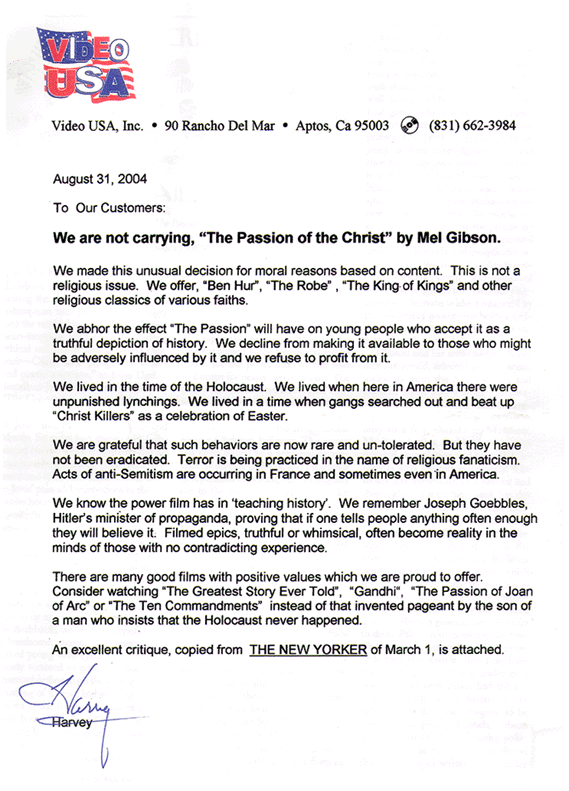
Aptos, CA—The following letter was distributed to patrons of Video USA, a movie rental store:
 

October
Long Island, NY—Easter Unlimited, Inc./Funworld sold Halloween costumes of a man dressed as a priest shown with an erection, and a nun shown in full habit holding her pregnant stomach. The inscription on the ad for the priest costume said, “Keep Up The Faith”; the nun ad said, “Thank You, Father!” The costumes were sold in stores across the country.

Harvey Cohen, a store official, said he would not comment on whether the company, run by Stanley Geller, carried offensive rabbi or imam costumes. After a member of the Catholic League called the store to complain, Cohen said the item would not be sold next year.

October 31
California—A store employee of Safeway dressed as a pregnant nun for Halloween. The Catholic League made a formal complaint to the CEO of Safeway, Inc. We received an apology and a pledge that this would not happen again.

October 31
Amarillo, TX—At a Halloween workplace party in a health facility, a woman employee came dressed as a pedophile priest and another came dressed as a pregnant nun. The latter won the prize for “best costume.”

December
American Greetings was once again found selling a series of “rude” Christmas cards, while choosing not to offer any disrespectful cards for Hanukkah or Kwanzaa. Of over 200 Christmas e-cards, 39 were found in the “religious” category and 18 were “rude” (most featuring flatulence and urine jokes). All of the 35 “Happy Hanukkah” cards, the nine “family” Hanukkah cards, and the 14 “funny” Hanukkah cards were respectful. There were no disrespectful Kwanzaa cards among the 24 listed. There was also no “rude” section for Hanukkah or Kwanzaa among American Greetings’ Create and Print cards, just for Christmas (some of which included oral sex jokes).

Of Hallmark’s 104 Christmas cards, nine were religious, one mentioned Jesus and none featured a nativity scene. In its “humor” category, three had mild scatological references and one had sexual overtones. Of th

e five Hanukkah cards, four featured menorahs, even the one “humor” card. Of the six Kwanzaa cards, all were respectful and none was humorous.

Yahoo offered 31 categories of Christmas cards, one of which was “religious.” There were seven e-cards dubbed “risqué” and replete with sexual gags. In the “rude” category, there were 17 scatological-oriented cards. All of the 12 Hanukkah cards were respectful, most of which pictured a menorah or Star of David. All of the 24 Kwanzaa cards were respectful.

December
The Committee to Save Merry Christmas was formed. It started a boycott of Macy’s and Bloomingdale’s because parent company Federated Department Stores shunned “Merry Christmas” in ads and decorations. Federated soon placed a red and green “Merry Christmas” greeting on its corporate website with a message claiming that its divisions were free to use “Merry Christmas” in its advertising. Federated’s statement added, however, that the terms “Season’s Greetings” and “Happy Holidays” are “more reflective of the multi-cultural society in which we live today.”

December

Manhasset, NY—A Barnes & Noble store featured displays for Hanukkah, Kwanzaa, and “Holiday Gift Ideas”—but left out Christmas.

December
Minneapolis, MN—The diversity consulting firm ProGroup advised employers that the way to deal with what it called the “December Dilemma” (a term used by the ADL) is to “Keep holidays inclusive and informative.” The firm suggested, “Try using a seasonal theme rather than a holiday one. Establish new traditions around parties and end-of-year gifts.”
December
Pittsburgh, PA—Downtown retailers began calling Christmastime “Sparkle Season” ten years ago, claiming it was an attempt to be inclusive. After complaints from Christians, they changed it to “Downtown Pittsburgh Sparkles”—sparking even more complaints. This year, for the third time, the Pittsburgh Downtown Partnership called it “Downtown Pittsburgh, a Holiday Tradition With a New Twist.”

December
Albany, CA—Simma Lieberman Associates, a “multicultural” consulting company, bluntly told clients in a “Note for Employers”: “Make sure your holiday party isn’t a Christmas party in disguise. Decorations and food should be general, and non-specific to any religion.” Several lines later, the firm took the advice a step further: “Consider having a New Year’s Party instead of a holiday party.”

DecemberNew York, NY—For the third year, Time magazine CEO Ann Moore banned its decades-long tradition of throwing an employee Christmas party. The company still gives Christmas bonuses, but it refuses to use the “C-word” in referring to them. According to a Time, Inc. spokesman, “It’s not really a Christmas bonus…It’s just a nice gesture that Ann Moore started three years ago.”

December
New York, NY—Instead of the large, traditional green wreath with a red bow displayed in years past, New York City’s Bar Building placed over its exterior foyer window a big bundle of twigs shaped like a diam

ond. According to one tenant’s written complaint to the owner of the Bar Building, “A red sash, similar in substance to sheer red pantyhose, adorns the white bundle of twigs.” One Bar Building worker commented: “What are they trying to celebrate—the Blair Witch Project?” Tenant complaints finally spurred management to put up a Christmas Tree in the lobby. The building also continued its tradition of placing a Jewish menorah with a prominent Star of David on public display.

December 10
Cincinnati, OH—In an interview with the Detroit News, an attorney with Strauss & Troy in Cincinnati warned that “if the workplace is permeated with religious symbols—presumably of another religion—to the extent that the employee feels intimidated, ridiculed or insulted, he or she could make the claim that the company has allowed or created a hostile environment.”

December 10
San Francisco, CA—Littler Mendelson, the country’s largest employment and labor law firm, warned that “Renewed interest in moral values—as evidenced by the recent presidential election—and increased religious activity in the workplace can lead to clashes during the holiday season.” The firm recommended “a generic greeting card option” for employees sending cards to clients and contacts.

December 10
Riverhead, NY—An attorney with the Legal Aid Society of Suffolk County in Long Island placed a crèche next to a menorah that was on display in her office. Her boss moved it away from the menorah the next day and told her it did “not belong there.” When she asked why the menorah was on display, he replied, “that’s different.” After faxing a complaint to her main office, she was given permission to display the nativity scene where she had first placed it.

December 11
Plantation, FL—Fifty protesters demonstrated at Broward and Fashion malls against a policy of displaying a menorah but no nativity scene. They called for a boycott of Federated Department Stores, which owns Bloomingdale’s, Burdines and Macy’s, for removing references to Christmas from its advertising and store displays.

December 14
The Associated Press reported that “major corporations [are] barring religious music from cubicles and renaming the office Christmas bash the ‘end of the year’ party.”


LET’S HAVE A PARTY—BUT NOT A CHRISTMAS ONE

Catholic League president William Donohue today addressed what’s been happening to Christmas parties in the workplace:

“For decades, employees at Time magazine had a Christmas party and looked forward to receiving a Christmas bonus.  But starting three years ago, the party was banned and so were the Christmas bonuses.  This is not to say that bonuses are no longer given—they are—it’s just that the dreaded ‘C-word’ is no longer associated with them.  This is progress.

“The mayor of Somerville, Massachusetts recently apologized for calling the city’s Christmas party a Christmas party.  It’s now a Holiday party.

“ProGroup diversity specialists advise that one way around the ‘December Dilemma’ is to ‘keep holidays inclusive and informative.’  So they suggest, ‘try using seasonal themes rather than a holiday one.’  Good idea—holiday themes remind people of Christmas.

“Simma Lieberman Associates bluntly advises, ‘make sure your Holiday party isn’t a Christmas party in disguise.’  Off with the red and green!

“The Tanenbaum Center for Interreligious Understanding is not too understanding of Christmas this year, and that is why it wants a ‘Seasonal’ or ‘Winter’ party and a ‘Seasonal’ or ‘Holiday’ exchange.

“Matt Cherry of the Institute of Humanist Studies also favors ‘Holiday’ parties over Christmas parties and advocates secret ‘Snowflakes’ instead of secret ‘Santas.’

“An AP story says corporations are ‘barring religious music from cubicles’ and are calling their Christmas parties ‘end of the year’ parties.

“If you’re looking for an explanation for all this, consider what Arlene Vernon of HrxInc says: employers need to be ‘sensitive to the fact that holidays don’t make everyone happy.’  If she had any guts, she’d advocate banning Christmas altogether, but that may affect her profits.”


ANTI-CHRISTMAS ANIMUS EVIDENT NATIONWIDE

The culture war that has gripped the nation is nowhere more clearly evident than in the annual attempt to stamp out Christmas. Things got out-of-hand this year, in particular. Some thought the events of 9-11 would bring us together, but as the following examples demonstrate, there are some who are absolutely determined to divide us.

· Government officials in Las Vegas banned a display of the nativity scene as McCarran Airport and at the Fremont Street Experience downtown.

· In Kensington, Maryland, the Town Council unanimously voted to ban Santa Claus because two persons complained. Interestingly, Karen Libman, who led the fight against Santa, had earlier pushed for the display of a menorah on public property. After much publicity and turmoil, Santa was allowed to be displayed. University of Southern California law professor, Susan Estrich, defended the censorship of Santa on Fox News Channel’s “Hannity and Colmes.”

· In Minnesota, red poinsettias were banned by Ramsey County Manager Paul Kirkwood from the annual display in the county’s St. Paul courthouse.

· All religious symbols were banned from display in buildings run by the Portland Housing Authority in Maine.

· The superintendent of schools in Silverton, Oregon, ordered all religious symbols removed from students’ lockers.

· “Christmas” was deleted from school calendars all over America. In some cases, the Catholic League was able to get a pledge from the principal that this will not happen again.

· In Frederick County, Maryland, the principal banned Christmas cards from being given out because he said that those with a Christian message may not be a legally protected right.

· A fourth-grader in Ephrata, Pennsylvania, was forbidden to pass out Christmas cards.

· Wearing red and green scarves in a Christmas skit was enough to get two middle school students disciplined in Rochester, Minnesota.

· A teacher in Plymouth, Illinois, was admonished by her principal not to read a book about Christmas to her second-grade students.

· Icicle lights were banned from display by government officials in Northdale, Florida.

· A teacher at Sable Point Elementary School in Seminole County, Florida, was threatened with her job if she did not remove a pin that said, “Jesus is the Reason for the Season.”

· Complaints reached gossip columnist Liz Smith to the effect that the nativity scene following the Christmas Spectacular at Radio City Music Hall was religious in nature.

· A school in Oyster Bay, Long Island, allowed Jewish religious songs at the holiday concert but prohibited Christian songs.

· Public housing officials in Vincennes, Indiana, banned all religious symbols from its complex.

· The ACLU threatened to sue St. Martin Parish Catholic churches in Louisiana because they put a nativity scene in a public park.

· The Melbourne Square Mall in Melbourne, Florida, allowed Jewish religious symbols but banned Christian ones. A local rabbi defended the placement of the menorah saying it wasn’t religious.

· The display of a Christmas tree led to an uproar on the campus of Bradley University.

· Officials who work for Wisconsin Governor Scott McCallum defended their decision to call the Christmas tree in the Wisconsin Capitol the “Holiday Tree.”

· Menorahs were placed in student housing units at Harvard University without a word of protest. But there were no nativity scenes. Indeed, the display of Christmas trees became a contentious issue on campus. Some Jewish students complained that the Christmas tree was divisive. One compared it to “a Trojan horse,” saying it opened the door to placing other offensive symbols on campus. He specifically mentioned the swastika. The Catholic League offered to buy nativity scenes if students were interested in displaying them but there were no takers.

· In Lebanon, Pennsylvania, Rabbi Louis Zivic of Beth Israel Synagogue complained that the Holiday Concert at Cedar Crest High School was too Christian in emphasis. As a result, school officials decided to no longer ask visitors to stand while the chorus sings the “Hallelujah Chorus” from Handel’s “Messiah.” An official from the local chapter of the ADL, Gerrie Greene, agreed saying that it appears previous holiday concerts were “pervasively religious.” Greene noted that the concert “was almost entirely of Christmas carols, most of which were sacred in nature.” Progress was made, however, in one city. The policy that prohibited C-TRAN employees in Vancouver, Washington, from wearing religious symbols on their clothing or from having religious decorations in the workplace was lifted. The victory belongs to Catholic League member Douglas Wolverton.


Just for Christmas…

Several groups are waging campaigns to salvage Christmas from the denizens of multiculturalism who seek to downplay the birth of Jesus as just another day in the “holiday season.” The low-priced items described below are a great way to let others know you wish them a very Merry Christmas..

The Catholic Daughters of the Americas, Court John Paul II, are offering car magnets and pins reading “It’s OK to say Merry Christmas to Me!” Proceeds from these items will be donated to charity. To reach the Catholic Daughters, call 845-893-6368 or email [email protected].

Parishioners at Our Lady of Victories in Harrington Park, NJ are not only offering Christmas bumper stickers, but they came up with the novel idea of “calling cards.” Customers bothered by a retailer’s decision not to recognize Christmas in their “holiday” advertising can leave behind a card stating “In response to the secularization of Christmas; we choose to support Christmas friendly vendors. See you next year? Merry Christmas!” Contact the members of OLV at 201-244-5130 or 201-895-4456.

Operation: Just Say Merry Christmas has designed rubber wristbands that boldly let others know what words they can say to acknowledge the true meaning of this Holy Season. Visit OperationJustSayMerryChristmas.com or dial 513-608-7608.

Lastly, a coalition called the Pilot Program to Keep Christ in Christmas is offering car magnets depicting a silhouette of the Nativity scene and the words “Keep Christ in Christmas.” Log on to www.kcnativitysets.com or leave a message at 847-380-2404.

Merry Christmas!


CHRISTMAS COPS ON THE BEAT; BIZARRE TACTICS USED

Just as the sun sets in the morning, we know that every December the anti-Christmas folks swing into high gear. And as evidenced by the articles in this issue of Catalyst, 2009 was no exception. Save, perhaps, for one thing: the tactics this time around were noted for their novelty.

Nothing gained the Catholic League more publicity this past Christmas season than our criticism of PETA’s (People for the Ethical Treatment of Animals) campaign to exploit the religious holiday for profit. It featured an almost totally nude Playboy pinup “dressed” with Catholic symbols. Bill Donohue debated a PETA spokeswoman on CNN, making swift dispatch of her arguments.

Atheist organizations were up to their old tricks of seeking to criminalize Christmas by suing municipalities. Because of the bad economy, all it took were a few threats to scare budget-weary officials from challenging the intimidators in court. The anti-Christmas foes know this, and shamelessly exploited it to their advantage.

Dumb is the only way we can characterize some of what happened. By erecting a lighted Loch Ness Monster in lieu of a manger scene in Howard County, Indiana, officials got blasted from all sides. In some cases, school districts had policies in place that were sensible, but were never invoked. Hence, some of the silliest decisions were made, like changing the Christmas tree to the “Giving Tree.”

More bizarre tactics included gay-themed Christmas plays and the banning of secular symbols like Frosty the Snowman and candy canes. Over and over again, we heard the refrain that censoring Christmas was being done to protect non-Christians (from what we still don’t know). It is one thing to complain about the effects of second-hand smoke, quite another to sound the alarms over the effects of second-hand Christmas cheer.

The White House had fewer ornaments and wreaths than usual, a fact that was nicely explained by First Lady Michelle Obama: this was done intentionally, she said, to show compassion for those who were hurting at Christmastime. We don’t understand the logic, but neither do we understand why an ornament featuring the genocidal maniac Mao Zedong was hung from one of the White House Christmas trees.

Perhaps bizarre is too kind a word to describe such events. In any case, if there was one hero, it was Colorado’s Larimer County Sheriff who advised all the Christmas cops to simply “Lighten Up. Just say ‘Merry Christmas’” and “Wishing You a Loud and Politically Incorrect ‘Merry Christmas.’” Touché.


CHRISTMAS VICTORIES

The anti-Christmas censors started early this year, both at home and abroad. Fortunately, they are off to a lousy start.

City employees in Wauwatosa, Wisconsin were told not to put up Christmas decorations. They even banned the colors of red and green. But after a huge outcry and a threatened lawsuit, they backed down.

Placerville, California officials wanted to change the name of their Christmas holiday celebration from Festival of Lights to Hometown Holidays—from lame to worse—and take down the [Christmas] tree two weeks before Christmas. After the public protested, it was renamed Hometown Christmas and the tree will stay through Christmas.

K-mart in Australia was selling a bag to put a ham in for Christmas with the inscription, “Merry HAM-MAS.” Because it looked like a shout-out for Hamas, they pulled it.
Santa’s village at Pacific Werribee, near Melbourne, had a huge sign behind Santa’s chair that read, “Merry Everything.” After a backlash, it was renamed, “Merry Christmas.”

The British retailer Marks & Spencer was forced to apologize after a Christmas ad showed red and green paper hats in a burning fireplace (some even compared it to a Palestinian flag).

Shoppers at the English supermarket, Sainsbury’s, were not happy with a Christmas card that featured two snow-covered pigs. It was shelved.

Some of these are minor infractions; others are not. No matter, there is no other holiday that is targeted for censorship like Christmas. That’s why victories are so sweet.


SAN JOSE’S CHRISTMAS TREES UNDER FIRE

Catholic League president Bill Donohue discusses a controversy over this year’s San Jose Christmas tree display:

Every year since the 1950s, San Jose has had a proud record of honoring Christmas with a grand display of Christmas trees. This year, however, a controversy has arisen over some trees.

San Jose’s Plaza de Cesar Chavez is the site of approximately 500 Christmas trees, an event organized by a non-profit organization, Christmas in the Park. Last year, it drew over 650,000 visitors. In addition to the display of Christmas trees, there are many Christmas-themed events for families. Unfortunately, some have politicized the annual celebration

This year there is a tree erected by the Satanic Temple, and one that celebrates Colin Kaepernick kneeling on the field. There is also a section of the park set aside for LGBT activists: they placed a Barbie doll alongside an image of Bruce Jenner from the Olympics.

Offensive as these displays are, the origin of the problem can be traced to the event’s organizers. According to the ABC affiliate, KGO, they invited schools, businesses and non-profit organizations to “bring awareness to issues or causes they care about.”

While the motives may be noble, invitations to promote issues and causes that people care about ineluctably dilute the meaning of Christmas.

Would the organizers honor Black History Month by asking the public to participate in celebratory events that “bring awareness to issues or causes they care about”? Would this not ensure an attenuation of the respect due African-American achievements? Worse, it may even beckon white supremacists to promote their agenda.

There are those who, unlike the well-meaning people of San Jose, intentionally create faux competition with Christmas so as to neuter its essence.

For example, Freedom From Religion Foundation, a militant atheist anti-Christian group from Madison, Wisconsin, released a statement saying it would provide “free secular displays to erect in public forums.”

Why? “One reason to counter religious displays on public property is to ensure your point is represented at this time of the year.” In other words, the purpose is to “counter” Christmas displays. It is not an oversight that the atheists could care less about countering Hanukkah—it’s Christians they really hate.

City in the Park organizers need to get back to their roots, lest their goodwill be exploited by those with their own agenda. This event started in the 1950s with a nativity scene built by Don Lima in front of his family mortuary—it did not start with an invitation to promote any issue or cause that the public fancied.

There are plenty of opportunities to advance all sorts of political, economic, social, and cultural causes. They should not be held coterminously with Christmas celebrations.


BANNING CHRISTMAS IN THE SCHOOLS

There is much ignorance about the state of the constitutional law as it applies to Christmas celebrations in the public schools. To cut to the quick—they are permitted.

A Christmas play by the Minden Junior Service League, performed at Minden High School in Webster Parish, Louisiana, was recently the source of much controversy. Two of the 35 minutes of the play discussed Jesus, and some objected, including the Webster Parish School Board.

The Superintendent Johnny Rowland was sympathetic to those who wanted the play, but insisted that there is a “federal court order [that] clearly spells out what is allowable and what is not.” Despite attempts to censor the play, it was performed anyway, and was greeted with a standing ovation.

Officials at Manchester Elementary School, which is part of the Elkhorn Public Schools in Nebraska, got all ginned up over Christmas and decided to ban displays of Santa Claus, Christmas trees, Christmas songs, and the colors red and green. Candy canes were also banned. Thanks to Liberty Counsel, the decision was reversed and sanity prevailed.

What is permissible at Christmastime in the public schools?

In 1995, Secretary of Education Richard Riley issued a directive on this subject at the behest of President Bill Clinton. Here is the language of how the operative paragraph begins:

Official neutrality regarding religious activity. Teachers and administrators, when acting in those capacities, are representatives of the state and are prohibited by the establishment clause from soliciting or encouraging religious activity, and from participating in such activity with students.”

This first part makes good sense: it is not the business of school officials to lead students in religious activities. But the second part also makes good sense, yet it is frequently ignored.

“Teachers and administrators are also prohibited from discouraging activity because of its religious content, and from soliciting or encouraging anti-religious activity.”

In other words, school officials cannot ban voluntary, student-led religious activity at Christmastime. Students cannot be punished for singing Christmas carols, distributing Christmas cards, wearing red and green, giving Christmas presents, writing Christmas poems, giving speeches paying tribute to Jesus, etc.

No federal court has ever ruled that Christmas must be censored in the public schools. It’s about time the superintendents and their lawyers got up to speed and stopped listening to cultural fascists bent on banning Christmas: they know nothing about the First Amendment provisions regarding freedom of religion and freedom of speech.