Photos







 November 20
Alsip, IL – The Freedom From Religion Foundation used the threat of a lawsuit to force the Village of Alsip to cancel the display of a cross on its water tower, which had been a tradition going back decades.
November 27
Madison, WI – The Freedom From Religion Foundation placed its “Natural Nativity Scene” in the Wisconsin State Capitol Rotunda for the second year in a row. It featured Emma Goldman, Darwin, Jefferson, Mark Twain, Einstein, the Statue of Liberty, the goddess Venus and an African American baby girl in the manger. This was done in response to The Wisconsin Family Action’s nativity scene in the Rotunda.
November 29
Little Rock, AR – The Arkansas Society of Freethinkers put up its “Winter Solstice” display on the state capitol grounds for the fourth year in a row to protest the nativity scene, which has been displayed on the grounds for more than fifty years.
November 30
Providence, RI – To avoid any dissent, Governor Lincoln Chafee cancelled the tree-lighting ceremony before re-instating it with only 30-minutes notice. In the run-up to the annual Christmas tree lighting, protestors were expressing their dismay with Gov. Chafee, who persisted in calling it a “holiday tree.” Critics were vocal in their dissent over last year’s “holiday tree” lighting and flooded the governor’s office with thousands of telephone calls in protest, thanks in no small part to the efforts of the Catholic League. Local residents also went to the ceremony to express their outrage.
November 30 – December 19
West Milford, NJ – The Township Council decided to disallow religious holiday displays on public grounds, referring to the “holiday tree” as secular symbol. The mayor said she did not want to “interject faith onto municipal property.” In a ruling at a December 19 council meeting, the Township Attorney declared the displayed tree a “Christmas Tree.”
November 30
Cottondale, FL – At Cottondale Elementary School, a nativity scene was replaced with Frosty the Snowman in compliance with the Florida Department of Education, which had sent an official to the school to talk about “the legalities of religion in the school systems and the separation of the two.” The decision sparked outrage and controversy. Residents in the community threatened to sue.
November 30
The website, tamponcrafts.com, offered instructions on how to construct nativity scenes out of tampons, including Jesus, Mary, Joseph, and the Three Wise Men. The opening line of the website carried these words: “Have a holly, jolly, bloody good Christmas with these tampon crafts.” It advised the reader: “Gather ‘round the manger for the Christmas Miracle. These three kings come bearing gold, frankincense, and…fresh-scented feminine hygiene products.”
December
Century, FL – A short article appeared on NorthEscambia.com in July about the Century Town Council’s plans to budget funds for new Christmas decorations, including a manger scene at town hall. Three days after the article appeared, they received a letter and fax from a Freedom From Religion Foundation attorney claiming a local resident tipped them off about the nativity on public property. The town decided not to put up a scene and instead sold the old nativity scene to the highest bidder.
December 3
Milwaukee, WI – For the second year in a row, the Freedom From Religion Foundation placed their “Winter Solstice” sign in the Milwaukee courthouse to protest what they refer to as an “inappropriate nativity scene.”
December 3
Honolulu, HI – The Hawaii Department of Education caved into the demands of a local atheist activist affiliated with the Freedom From Religion Foundation when it cancelled Moanalua High School’s annual Christmas charity concert. The students in the award-winning orchestra have raised more than $200,000 over the past six years for Mercy Ships, a charity which houses doctors on missions in Africa.
December 4
Little Rock, AR – Students at Terry Elementary School were invited to see the play, “A Charlie Brown Christmas,” at a local church. Seeking to avoid controversy, no students were required to attend, and bus service was scheduled for those who wished to go. A controversy ensued when one atheist complained, enlisting the help of the Arkansas Society of Freethinkers. In the aftermath of the controversy, the pastor cancelled its student matinee performances of the play.
December 5
San Angelo, TX – The Freedom From Religion Foundation sent a letter of complaint on behalf of a local member demanding the removal of the cross which the San Angelo Police Department places on top of its building as part of its annual Christmas display.
December 6The Atheist Pig website published its official war on Christmas list, advertising “goals of this year’s campaign against the sanctity of Christmas.” There were five goals, the first two of which were notable. The first goal was to shop for “Holiday presents” and advocated the atheism of Richard Dawkins against the pope’s Christmas message. The second goal was “not to give hate groups money,” labeling the Salvation Army as a “hate group” for its defense of traditional marriage.
December 10
Anchorage, AK – As part of its anti-Christmas campaign, the Freedom From Religion Foundation ran four signs on ten buses: 1) “Yes, Virginia… There is no God” 2) “Imagine No Religion” 3) “Sleep in on Sundays” 4) “Enjoy Life Now. There is no Afterlife.”
December 10
The homosexual lobby waged its own War on Christmas this year by attacking the Salvation Army for its support of traditional marriage. An organized effort to boycott the organization was promoted by the gay website, watermarkonline.com, which asked its readers nationwide not to give to the Salvation Army. Gays in Chicago launched their own campaign to withhold donations. The net result is that more of the needy went without during the Christmas season, due to the efforts of these homosexuals.
December 10
The War on Christmas became particularly vulgar this year when Urban Outfitters issued its seasonal catalog targeting teens. The catalog contained a mug and wrapping paper stating “Merry Christmas bit***s.” Several clothing items and gifts displayed the F-word. Among the Christmas gifts was a candle with the F-word on it.
December 10
Niles, IL – The Freedom From Religion Foundation placed a “Winter Solstice” sign in the Village of Niles Plaza to protest the town’s life-size nativity scene. It featured the Bill of Rights in a manger surrounded by the Statue of Liberty and three Founding Fathers.
December 11 – January 10
New York, NY – American Atheists attacked Christians with a giant billboard in New York’s Times Square. The message read: “Keep the merry! Dump the myth!” The billboard also depicted Santa as well as Jesus with a Crown of Thorns on the Cross. To see a photograph of the billboard [click here.]
The decision by American Atheists to exploit Jesus crucified as part of its annual attack on Christmas was not hard to explain. In 2010, it ran a billboard on the New Jersey side of the Lincoln Tunnel that said, “You Know It’s a Myth: This Season Celebrate Reason.” The Catholic League answered with a billboard on the New York side of the Lincoln Tunnel which read, “You Know It’s Real: This Season Celebrate Jesus.”
In 2011, the American Atheists billboard outside the Lincoln Tunnel featured a picture of a statue of the Roman god Neptune, a classical portrait of Jesus, a depiction of Santa, and a guy in a devil’s mask. It said they were all myths. Bill Donohue described it as “inane” to the New York Times.
In 2012, American Atheists decided to make a big splash. American Atheists and its supporters do not want to be left alone—they want to inflame the passions of those with whom they disagree. Unlike Christians who do not provoke, harass or otherwise mock atheists, American Atheists wants nothing more than to stick it to Christians at Christmastime.
December 12
In 2012, there were instances of denial from many quarters as to the very existence of the War on Christmas. An editorial in the Duluth News Tribune questioned, “There’s Still a ‘War on Christmas’?” Atheist Jeff Sorensen flatly declared in the the Huffington Post that “There is no war on Christmas.” Statesman Journal columnist Dick Hughes wrote a piece about the “phony and irrelevant War on Christmas.” MSNBC madman Lawrence O’Donnell said the War on Christmas had a “body count” of “zero.” Frank Bruni of the New York Times said there could hardly be a War on Christmas given that “We have God on our dollars, God in our pledge of allegiance, God in our Congress.” The Boston Globe editorialized that “Ignoring the ‘war on Christmas’ is the best way to eliminate it altogether.”
December 12
On NBC’s “Today” show, the network’s chief medical editor Nancy Snyderman disparaged the religious aspect of Christmas during a panel discussion. A co-panelist asserted that she focused on the religious meaning of Christmas. Snyderman responded, “I don’t like the religion part. I think religion is what mucks the whole thing up.”
December 13
Missoula, MT – Parents sent an unsigned letter to the superintendent of the Missoula County Public Schools claiming that the songs chosen for the Christmas concert at Chier Carlo Elementary School were not secular. The letter stated: “We have no problem with it being called a Christmas concert, it’s just the fact the material should be secular. Frosty the Snowman, Santa Claus, Rudolph the Red-nosed Reindeer. These are things that offend no one, but when the children are singing about their lord and savior, Jesus Christ…public school is not the place.”
December 19
New Braunfels, TX – A utility company removed two giant “Keep Christ in Christmas” banners owned by the Knights of Columbus after receiving complaints about the religious nature of the signs. Their removal sparked outrage in the community.
December 21
Cheboygan, MI – The Freedom From Religion Foundation (FFRF) made a request to the city manager to place their “Winter Solstice” banner in Washington Park to protest the Kiwanis Club’s nativity scene. After the Cheboygan City Council called for a special meeting to give it further consideration, it was decided to move the nativity off of public property instead of giving equal time to FFRF.
Grassroots Rebellion against the “War on Christmas”
When the “War on Christmas” began in the 1980s, everyone knew our side was on the defensive. In recent years, what began as a battle of advocacy groups has evolved into a true grassroots rebellion. This year, it was all too apparent that we had the militant atheists on the run. The following are stories that indicate this:
September 18
Faribault, MN – Last year, the Freedom From Religion Foundation (FFRF) sent a threatening letter to the city on behalf of a local resident and members of FFRF. The letter complained about a nativity that was set up at Buckham Memorial Library each year at city expense. This year, the Faribault City Council voted unanimously to display the nativity on public land. It was an emphatic, grassroots reaffirmation of a local Christmas tradition. One Councilor said, “This really bugs me. I mean, one person complained. There are 17,000 members [of FFRF] in the whole nation. That’s really a minority. We’re the majority here.”
October 26
Athens, TX – Henderson County officially denied the Freedom From Religion Foundation’s (FFRF) request to display an atheist banner at Christmastime on the grounds of the Henderson County Courthouse, where a nativity scene is displayed every year. In 2011, FFRF also tried to display a banner, but it was promptly removed by Henderson County deputies. This was a victory for religious liberty.
November 15
Leesburg, VA – This year the Loudoun County Board of Supervisors approved “a county-sponsored Christmas display which included a nativity scene and menorah—but banned any other unattended religious displays on the property.” Rick Wingrove, director of the local chapter of American Atheists, received a permit to have an attended display featuring banners with quotes from famous atheists and readings from Darwin’s The Origin of Species.
November 28
Warren, MI – A nativity scene on a public median on Mound Road was removed in 2008 because the Road Commission capitulated to a complaint by the Freedom From Religion Foundation. In what was a victory for religious liberty thanks to the Thomas More Law Center, the nativity returned to its location after a four-year absence. The nativity belongs to a 76-year old citizen, whose family had been setting up the manger scene for over 60 years.
November 28
Crockett, TX – A nativity scene outside a courthouse incited the Freedom From Religion Foundation to send a letter to the Houston County Judge’s Office in protest. A Houston County judge said, “We have a long standing tradition here. We want the nativity scene; we feel it’s within our rights to have it and we’ll keep it for the holiday period.”
November 28
Morganton, NC – When officials at Western Piedmont College replaced “Christmas” with “holiday” in a student club’s announcement of a Christmas tree sale for charity, the Alliance Defending Freedom sent a letter condemning the prohibition of “Christmas” as unconstitutional. In a clear victory for religious liberty, officials at the college changed “holiday” back to “Christmas.”
November 29
Woodcliff Lake, NJ – What was originally advertised as a “Community” or “Holiday” tree lighting was renamed a “Christmas” tree lighting. It was reported in the Cliffview Pilot that the New Jersey chapter of the ACLU was contacted. But, the mayor stood firm: “There’s no controversy. There’s no story. It is a Christmas tree and a Menorah lighting.”
November 29 – January 5
Santa Monica, CA – In 2011, atheists were driven to display their hate-filled message alongside religious symbols in Palisades Park. In order to avoid controversy in 2012, local officials practiced their neutrality by censoring all displays equally. A federal judge agreed with city officials and ruled that displays of any kind would destroy the turf and obstruct the ocean views in Palisades Park, though this apparently never happened for the 60 years that a crèche had been displayed there.
An attorney representing nativity scene advocates said, “The city, on the advice of its city attorney, has abdicated its duty to protect the First Amendment’s guarantees of free speech and the free exercise of religion within a traditional public forum, a city park. The City Council members surrendered to the angry mob and in the process have announced to the world that religious freedom can be sought elsewhere but not in Santa Monica.”
In response to the ban on unattended permanent nativities in public spaces, church organizations exploited a loophole and responded with live displays of people reenacting the Christmas story. In addition, a private business stepped forward and donated space on private land nearby for the permanent nativities.
December 3 – 6
Ellwood City, PA – A First Amendment lawsuit threatened by the Freedom From Religion Foundation resulted in the removal of a nativity scene from the front of the Ellwood City municipal building, ending a fifty-year tradition. Where there had been a nativity at the municipal building, there now stood a snowman and Santa Claus. Grassroots pushback took two forms: A new, larger nativity was put up on private property at a former church a few blocks away, thanks to the owner, a local attorney. Citizens circumvented the ban when members of Ellwood City Moose Lodge No. 93 took the initiative and put a nativity on a trailer attached to a truck and drove it in front of the municipal building to display it there.
December 6 – 7
Newhall, CA – Residents at a senior citizens’ apartment complex were told by the management company, JB Partners Group Inc., to remove their Christmas tree because it is a religious symbol. The residents, including those who were not Christian, wanted the Christmas tree. The Catholic League responded decisively by asking members to e-mail the Human Resources department at JB Partners. The e-mail campaign worked; the Christmas tree was returned.
December 8
Tulsa, OK – For the second year in a row, the Tulsa Christmas Parade took place in opposition to the “Holiday Parade of Lights,” a parade which originally had Christmas in its name. A group opposing the “sensitive” name change formed their own parade and restored the word “Christmas.” Grassroots resistance yielded crowds showing support for the Christmas parade.
December 14
Chicago, IL – The Arlington Heights Park District approved the display of a nativity scene on public property after intervention by the Thomas More Society when a donated nativity was initially rejected by Park District officials. The display was finally set up apart from the annual seasonal lights display in the same park and the nativity display was marked private.
December 12
Woodbridge, NJ – After the Freedom From Religion Foundation objected to the display of a nativity on town hall property in 2011, the display was late in being set up in 2012. When a local media outlet noted that the nativity was still missing from town hall on December 10, there was an outpouring of comments on the outlet’s Facebook page. The nativity was erected after the city council ruled that the nativity could be put up again so long as it is accompanied with other non-secular decoration.
December 12
Oskaloosa, IA – In a special meeting that overflowed with concerned residents, the Oskaloosa City Council voted to keep a nativity scene in the city’s square after the city manager was contacted by a local resident who was offended by the nativity. After the city manager received the letter, the nativity was removed the next day. The city council then voted to add a group of decorations to the city square that would then also include the nativity.
December 28
Pitman, NJ – The Freedom From Religion Foundation (FFRF) placed a banner saying “Keep Saturn in Saturnalia” in response to the Knights of Columbus banner saying “Keep Christ in Christmas” that was hung between a privately-owned building and a privately-owned utility pole in the heart of the business district. FFRF claimed that they were given the “runaround” by borough officials and were not allowed to display their banner. A militant atheist group known for bullying Christians at Christmastime was now claiming to be victimized.
December 29
McDowell County, NC – More than 50 people rallied in defense of a courthouse nativity scene after Americans United for Separation of Church and State asked that the county remove the crèche or make it part of a larger, more secular display. “We have got to stop being the silent majority,” said one local resident.
Christmas Vandalism
During each Christmas season, our desks are loaded with stories on Christmas vandalism. This year was no different. Here is a list of incidents that came to our attention:
November 22
Ulster, NY – Thieves stole 60 Christmas trees from the Boy Scout tree lot. The trees were being sold to raise money for the local Boy Scout camp and amounted to a loss of about $3,000.
November 23
Nederland, TX – The nativity display of a Wesley United Methodist church was vandalized when it was run over by a car in a drive-by attack.
November 25
Spartanburg, SC – Christmas decorations were stolen from several front yards of homes within a two-mile radius.
November 28
Portland, OR – Vandals damaged and decapitated statues of baby Jesus, Joseph and Mary located at “The Grotto,” the popular name of The National Sanctuary of Our Sorrowful Mother.
November 29
Beloit, WI – Vandals cut the light cords to Christmas decorations on four separate occasions in a six-week assault on the elaborate Christmas decorations of a local resident.
November 30
Huntington, WV – A hand-painted antique baby Jesus figurine was stolen from a nativity scene set up on the porch of a local business office. It was defaced with sexual obscenities, anti-religious statements, anarchy symbols, an upside down cross, and the numbers 666, along with other offensive markings. The figurine’s eyes were blackened. Horns were drawn on each side of the head.
December 3
Shrewsbury, MA – At St. Anne’s Parish, thousands of dollars in Christmas presents and gift cards were stolen by a thief who kicked in the storage unit behind the church. The gifts were collected for the Giving Tree, a project that provides gifts for 300 impoverished children.
December 4
Madison, AL – An entire nativity scene was stolen from the front yard of a home. It reappeared in a local high school classroom and was later returned to its rightful owner.
December 5 – December 12
Granger, IN – In a rash of incidents, thieves stole Christmas decorations and presents from homes all over town.
December 7
Warren, MN – Thieves broke into a church and stole a Christmas tree containing ornaments, a gold cross and statues of Jesus, Mary and Joseph.
December 10
Forest, VA – Thieves stole and destroyed 12 nativity scene figures from Shiloh United Methodist Church, amounting to an estimated $2,000-$2,500 in property damage.
December 11
Angus, MN – A Bible, a Christmas tree, Christmas ornaments, a baby Jesus sculpture, and sculptures of Mary and Joseph were stolen during a burglary at a rural church.
December 12
Brooklyn, NY – A four-foot white porcelain statue of Jesus was stolen from its pedestal outside Saints Peter and Paul Church in Williamsburg.
December 14
Staten Island, NY – A vandal shattered a one-foot-tall statue of Jesus and broke a five-foot statue of the Blessed Mother inside Our Lady of Good Counsel Roman Catholic Church.
December 19
Burlington, OH – Vandals broke lights and stole a Santa Clause figure and a baby Jesus figure at the playground of an apartment complex.
December 22
Huntington Beach, CA – At St. Bonaventure Catholic Church, vandals defaced a nativity scene. The damage included drawings of the numbers 666, a swastika, phallic symbols, “Heil Hitler” and curse words on nativity figures. Vandals also inscribed “Hail [sic] Hitler” on the forehead of a baby Jesus figurine outside a home elsewhere in town and drew a Hitler mustache on its face. A statue of one of the wise men was also defaced with a swastika.
December 23
Federalsburg, MD – Two men drove a truck through the Federalsburg Historical Society’s Christmas nativity. Five of the thirteen figurines in the illuminated nativity were decimated.
December 24
Tacoma, WA – During Christmas Eve Mass at Holy Cross Catholic Church, six windows were broken. Police were investigating the indicident as a possible hate crime.
December 30
Pearl River, NY – The community manger in Braunsdorf Park was vandalized when someone spray-painted the face of the baby Jesus figure brown.
January 2
Clearwater, FL – Just after Christmas, Clearwater Central Catholic High School was vandalized. Anti-Christian symbols were spray-painted on school buildings, vehicles, and a statue of the Virgin Mary. The symbols included pentagrams, upside-down crosses and the number 666.
November-December
Figures of the baby Jesus were stolen from homes, businesses or churches in the following locations: Birmingham, Alabama; Antelope, California; Live Oak, California; Torrington, Connecticut; Frostproof, Florida; South Bend, Indiana; Quincy, Massachusetts; Menominee, Michigan; Mt. Pleasant, Michigan; Dover, New Hampshire; Burlington, Ohio; Carlisle, Pennsylvania; Chambersburg, Pennsylvania; Schuylkill Haven, Pennsylvania; West Manchester Township, Pennsylvania; Moundsville, West Virginia; and Clintonville, Wisconsin.
 Activists:
Education:
Equal Opportunity Offenders:
It is not just Christmas displays and celebrations that are stifled. Often, curmudgeons are opposed to public displays of any faith.
Government Bodies:
Private Groups/Companies:
Vandalism:
Vandals and thieves struck nativity scenes in the following cities and towns during the Christmas season:
Tucson, AZ; Concord, CA; Millbrae, CA; Mission Viejo, CA; San Francisco, CA; Moorpark, CA; Vista, CA; Naugatuck, CT; Southington, CT; Stratford, CT; Waterbury, CT; Beverly Hills, FL; Fort Walton Beach, FL; Wellington, FL; Ammon, ID; Weiser, ID; Chicago, IL; Edwardsville, IL; Jackson County, IL; Tinley Park, IL; Floyd County, IN; Fort Wayne, IN; Montgomery County, IN; Portage, IN; Des Moines, IA; Newell, IA; Sioux City, IA; Wichita, KS; Hardin, KY; Lafayette, LA; Youngsville, LA; Portland, ME; Unity, ME; Winthrop, ME; Calvert County, MD; Towson, MD; Brookline, MA; Fitchburg, MA; Hopkinton, MA; Norwell, MA; Southborough, MA; Three Rivers, MA; Gladwin, MI; Milford, MI; Portage Township, MI; Hastings, MN; Neosho, MO; Columbus, NE; Plaistow, NH; Galloway Township, NJ; Hopewell Junction, NY; Rockland County, NY; Fayetteville, NC; New Bern, NC; Raleigh, NC; Dover, OH; Utica, OH; Artemis, PA; Belle Vernon, PA; Bucks County, PA; Greenfield, PA; Monessen, PA; Hilton Head, SC; Sioux Falls, SD; Grand Prairie, TX; Halom City, TX; Houston, TX; Santa Fe, TX; Salt Lake City, UT; Fairfax County, VA; Blue Lake, WA; Seattle, WA; Whidbey Island, WA; Winfield, WV; West Allis, WI; Stevens Point, WI.
Although all of these acts were inexcusable, some stood out among the crowd:
WAR ON CHRISTMAS
November
Bellevue, WA – Shortly after Thanksgiving, Bob McLean, a United States Postal Service letter carrier, was taken off his route by his supervisor because someone complained about his Santa Clause uniform. “The government is shutting me down because it’s a non-postal regulation uniform,” said McLean, a USPS employee since 1971. In past years, he had donned the uniform for a few days while delivering mail during the Christmas season. His, a source of local Christmas cheer, had been tolerated for over a decade.
November
Springhill, LA – The Springhill Branch Library banned a living nativity scene that was to be portrayed by a First Assembly of God youth group because library officials disallowed anything with “religious tones” on library grounds. As a result, the living nativity scene was moved to elsewhere in town.
November-December
Freedom From Religion Foundation sought to counter the display of a nativity scene in Athens, Texas with one of its mocking statements.. Similarly, hundreds of residents in Ellwood City, Pennsylvania turned out to rally in support of their crèche.
The bottom line was unmistakable. In every instance when the people got mobilized, they did so in support of Christmas. There was not a single example to the contrary: the anti-Christmas folks amount to nothing more than a few atheist organizations and their lawyers.
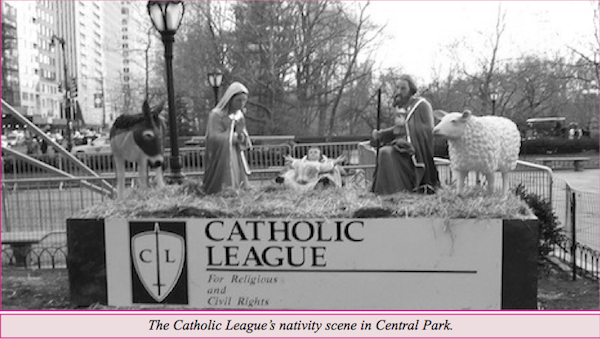
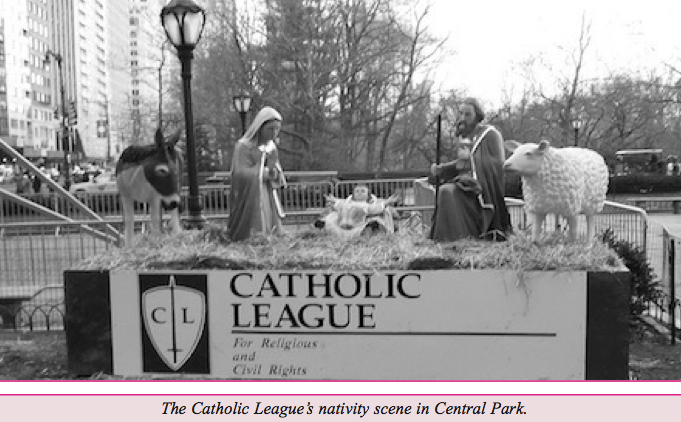
The Catholic League Nativity scene in Central Park.
November 3
The Air Force apologized after being accused of religious intolerance by the Military Religious Freedom Foundation for promoting Operation Christmas Child. Sponsored by Samaritan’s Purse, a Christian group, it sends Christmas gifts to impoverished children worldwide.
November 30
In Wisconsin, for the first time in years, they reverted back to calling the Capitol Rotunda Christmas tree a Christmas tree: it was called a Christmas tree for 70 years until it was renamed a Holiday tree in the mid-1980s.
In Rhode Island, Governor Lincoln Chafee decided to continue the politics of intolerance by calling the Capitol Rotunda Christmas tree a Holiday tree
Annie Laurie Gaylor of the Madison, Wisconsin-based Freedom From Religion Foundation explained why the Christmas tree in Wisconsin was rebranded the Holiday tree: “Calling it a Holiday tree was meant to be inclusive.” Ironically, it has proven to be divisive—the uproar was in Rhode Island, not Wisconsin.
According to the Providence Journal, 87 percent of the people in Rhode Island prefer to call the Christmas tree a Christmas tree; only 8 percent think it should be called a Holiday tree. In Wisconsin, there was no discord: calling the Christmas tree a Christmas tree has brought people together. This is why Rhode Island should learn a lesson in civility and community by calling its Christmas tree a Christmas tree.
We asked: By the way, what holiday does the Holiday tree represent?
December
Newburyport, MA – Principal Lorene Marx banned fourth and fifth graders at Edward G. Molin Upper Elementary School from participating in “Secret Santa.” Parents were upset the tradition was being banned. Marx said her decision was based on the fact that not every student celebrates Christmas and that some might not be able to afford to take part. Marx commented, “No student needs to feel they need to give a certain amount, to feel left out or to feel unable to participate. This also ties in with the district’s inclusionary practices.” Superintendent Marc Kerble said, “Everybody has good intentions, and I think that in the spirit of giving, we need to move forward and do what’s best for the community.”
December
Fairfield, CA – The Military Religious Foundation wrote to authorities at Travis Air Force Base asking that the Nativity scene and menorah in the base’s holiday display be moved to a chapel nearby. The group claimed that the displays constituted an endorsement of religions by the military. Lawyers for the base determined that the symbols do not violate religious freedom of the troops. The Air Force judge decided that the displays at the base were part of a more general, secular holiday display, which includes images of Santa Claus, airplanes, and Christmas trees.
December
Lincoln, NE – A flashing message reminding passersby to “Remember the Reason for the Season” was removed from the electronic sign at Lincoln Southeast High School. Principal Patrick Hunter-Pirtle commented: “It shouldn’t have been up there. That phrase is associated with Christianity. We have Jewish students here, and we have Muslim students here. I don’t want anybody to feel like we’re favoring a religion. I don’t want to exclude anyone, and we work hard at that.” Hunter-Pirtle had not noticed the message until receiving a phone call from the ACLU-Nebraska Executive Director Laurel Marsh.
December
The Freedom From Religion Foundation (FFRF) launched its atheistic billboard campaign against the Christmas season. The billboards read “Imagine No Religion” and “Reason’s Greetings.” For the first time, billboards went up in Salt Lake City, Utah. Brookville, Indiana also saw atheist billboards in response to a crèche controversy from the preceding year, in which FFRF disputed the placement of a Nativity scene on public property.. This year, the Nativity was displayed again on courthouse grounds, but in a different location by the street. New York City was also included in the billboard campaign.
In Warren, Michigan “”FFRF tried to put up a “Winter Solstice” sign next to a crèche inside Warren City Hall. The sign was to include the statement that religion is a “myth and superstition that hardens hearts and enslaves minds.” Warren Mayor James Fouts responded against the sign with a letter to FFRF in which he wrote, “I cannot and will not sanction the desecration of religion in the Warren City Hall atrium.”“” On December 23, FFRF sued the Warren mayor for “government censorship of nonreligious views and unlawful endorsement of religion.”
December
Portland, Ore. – A former church, now a small arts venue, displayed a local artist’s take on the nativity scene. It was called “alien nativity.” The exhibit, entailed 3D special effects, included four extraterrestrial magi as well as a portrayal of Santa Claus as shaman bedecked with an antlered deer’s skull.
December 4
Leesburg, VA – A life-size crucified skeleton wearing a Santa Clause outfit appeared on the grounds of the Loudon County courthouse. According to the application for the display, the skeleton Santa was meant “to depict society’s materialistic obsessions and addictions and it is killing the peace, love, joy and kindness that is supposed to prevalent during the holiday season.”
December 8
We launched our “Adopt an Atheist” campaign in response to David Silverman’s remarks: “We want people to realize that there may be atheists in their family,” he told the New York Times, “even if those atheists don’t even know they are atheists.”Approximately 80 percent of Americans are Christian, and 96 percent celebrate Christmas. Of the 20 percent who are not Christian, non-believers make up the largest segment, though the number of self-identified atheists is tiny. David Silverman, president of American Atheists, knew this to be true, which is why he was frantically trying to inflate his base.
We thought that there was some merit in Silverman’s idea, even if he had things backwards, as usual. So, in response to him, we launched our “Adopt an Atheist” campaign, the predicate of which was, “We want atheists to realize that there may be Christians in their community, even if those Christians don’t even know they are Christian.”
Here is what our campaign entailed. We asked everyone to contact the American Atheist affiliate in his area, letting them know of his interest in “adopting” one of them. We asked our members to let the atheists know of their sincere interest in working with them to uncover their inner self. We said that the atheists may be resistant at first, but eventually they may come to understand that they were Christian all along.
Bill Donohue discussed the urgency of this campaign, “If we hurry, these closeted Christians can celebrate Christmas like the rest of us. As an added bonus, they will no longer be looked upon as people who ‘believe in nothing, stand for nothing and are good for nothing.’”
December 12-30
“The Gayest Christmas Pageant Ever!” made its premier on the West Coast at the Avery Schreiber Theatre in North Hollywood, California and ran through December 30. On the East Coast, the play was a success off-Broadway in New York and ran from November 14 through December 31.
Director Paul Storiale said, “We have lots of different characters. There’s a narcoleptic with Tourette’s, over-the-top gay, over-the-top black, a gay Mexican Jesus. This show is filled with every stereotype; no group goes untouched.”
Music director Geo Santini described the character of Jesus as “silly” and “deviant.”
An actress played a lesbian angel in bow tie and suspenders, “butching up” the Nativity. She said: “The underlying message is one of visibility, and those of us who are gay and lesbian struggle with that. The hope is that some day [this play] won’t be a big deal because it’s gay. It will just be another Christmas pageant people will want to see because it’s well-written and because it’s funny.”
December 13
The following are some of the positive and negative stoires that cross our desk leading up to Christmas.
On the positive front, the residents of Ellwood City, Pennsylvania turned out by the hundreds on December 2 to rally in support of their nativity scene. There is a live nativity scene on city property in Minden, Louisiana, and after some initial resistance, a church hand bell group will soon take command of the Springhill library’s courtyard. After a nativity scene was banned for years on the grounds of the Muskingum County Courthouse in Zanesville, Ohio, the county commissioners voted unanimously to put it back. Similarly, Wisconsin reverted back to its display of a Christmas tree at the state capitol. “Keep Christ in Christmas” was the banner that stretched across the street in Pitman, New Jersey, and attempts by atheists to censor it have failed. And, in Athens, Texas, 5,000 people took to the streets in support of the crèche on the grounds of the Henderson County Courthouse after the Freedom From Religion Foundation called for its removal.
On the negative front, a school counselor at an Arkansas elementary school was told that she must remove her posting of a nativity scene on her billboard; her decoration was permitted for more than 20 years. Tulsa, Oklahoma long had a Christmas parade, but in recent years it was renamed the Holiday parade.
But just as the people in Rhode Island sang Christmas songs at their secularized “Holiday” event, the people in Tulsa countered with their own Christmas parade.
Indeed, we saw more examples of the pro-Christmas side not settling for a secular outcome than its obverse. More important, when the anti-Christmas side pushed back, those doing it were activist atheists. When the pro-Christmas side pushed back, it was a grassroots effort. In short, “Power to the People” never sounded so good.
December 15
We issued a press release on the anti-Christian tactics of atheist groups.
“If we can’t censor, then compete.” That’s the preferred modus operandi of many atheists out to smash Christmas. Their first instinct is to ban nativity scenes wherever they can. If that doesn’t work, then they lay claim to the same spot seeking to display their anti-Christmas message.
The Freedom From Religion Foundation (FFRF) was the most active atheist group using this two-prong strategy in 2011. In the Mississippi State Capitol, FFRF displayed a sign mocking religion; it did the same in the Wisconsin State Capitol. It also waged war in small towns such as Athens, Texas and Prineville, Oregon.
Sometimes the efforts of radical atheists yield really ugly fruit: in Santa Monica, city officials used a lottery system to sort out all the requests for display on public property, the result being that atheists won most of the spots.
Unfortunately, some government officials took the easy way out by electing to ban all displays. For example, in 2010 the Catholic League protested the display of the menorah, a religious symbol, and the banning of a nativity scene, also a religious symbol, at the St. George Staten Island Ferry Terminal and in Boca Raton, Florida. This year the courageous souls who run things in both places chose to ban all displays.
December 19
We issued a press release addressing intolerance at Christmastime at home and abroad.
North Korea is putting South Korea on notice, warning of “unexpected consequences” if Seoul displays Christmas lights near the border. In China last week, government officials and the police smashed the sound equipment of Christians who were about to celebrate Christmas in a village outside Beijing.
In a South Carolina cancer center, a 67-year-old volunteer Santa was evicted because of the “different cultures and beliefs of the patients we care for”; it later reversed its decision. In an elementary school in Stockton, California, poinsettias were banned but somehow snowmen were permitted; they justified their censorship by saying there was a Sikh temple in the city (note: there is no evidence that Sikhs are offended by poinsettias.)
A homosexual group on the campus of Washington and Jefferson College succeeded in getting the Dean to approve a condom-decorated Christmas tree.
Most atheists are not intolerant, but rare is the atheist qua activist who is not. Unfortunately, we don’t have to look overseas to Communist nations to witness this verity. That they show up at Christmastime, as well as at Easter, is proof that their real hatred is of all things Christian.
December 21
Holyoke, MA – Parts of the Nativity from the closed Mater Dolorosa church were moved to the Holy Cross Church. This sparked outrage from protesters occupying the closed church. They claim they set up the manger scene to set up the Christmas holiday. However, a diocesan spokesman said workers went to retrieve the Nativity for a nearby open parish and found that the protestors had set it up without permission.
December 23
Tarrytown, NY – A Christmas tree was veiled with a black curtain in the lobby of the Doubletree Hotel Tarrytown at the request of Jewish guests who were scheduled to stay at the hotel for a Hanukkah celebration, occupying 180 of the hotel’s 250 rooms. The general manager said guests were concerned that the tree would be a safety hazard to the large number of children in the hotel: “We did it more to protect a lot of children…from a safety perspective.”
The only report on this incident in the Journal News did not mention how the manager justified his claim that a tree with a curtain would be less of a safety hazard to children than a tree without a curtain or why the curtain, itself was not a safety hazard.
One Roman Catholic patron staying at the hotel said, “I think it’s a slap in the face. The whole purpose of the holiday season, whether it’s Christmas, Kwanzaa or Hanukah, is everybody celebrating their beliefs. If I went in and put a cover on a menorah, I’d probably have lawyers calling me.” He may no longer give his business to the hotel, saying: “Why should I have to go in there and look at a black curtain instead of a Christmas tree?”
Christmas Vandalism
During each Christmas season, our desks are loaded with stories on Christmas vandalism. This year was no different. Here is a list of incidents that came to our attention:
November
St. Paul, MN – Copper thieves cut and stole heavy and light duty electric cords from lighted Christmas displays in Phalen Park.
November 11
Indiana, PA – A 4-foot Christmas tree decorated with multicolored lights was uprooted and stolen from the backyard of the rectory of St. Thomas More Roman Catholic Church, home to priests at the parish serving Catholic students at Indiana University of Pennsylvania.
November 22
Moreno Valley, CA – A family had its outdoor Christmas decorations stolen after just setting them up. The thieves took most of the expensive decorations. The stolen items were worth $1600.
November 28
Antioch, IL – Toys, coats, and other items intended for Open Arms Mission Charities were stolen from St. Stephen Lutheran Church. The stolen items were worth $700.
December
Philadelphia, PA – The Salvation Army had three of its red kettles stolen from bell ringers at two grocery stores in the Northeast part of the city.
December
Golf Hammock, FL – Inflatable lawn decorations, including a Frosty the Snowman display as well as two Santa displays, were destroyed by vandals in a rash of incidents. One resident claimed that she knew of five vandalized inflatable decorations and that four homes were hit.
December
Lonaconing, MD – Christmas decorations were damaged throughout the town, resulting in up to $800 in costs to replace damaged or stolen displays.
December
Meridian and Lauderdale Counties, MS – In a series of incidents, decorations were stolen or vandalized within the span of a few weeks. Some had their decorations vandalized multiple times. One citizen remarked, “But I honestly believe that is more a breaking down of society. I think that we don’t value things like we used to and we don’t value hard work like we used to.”
December
Ramsey, NJ – Presents, toys, and gift cards for the needy, valued at $3,000, were stolen from St. Paul Roman Catholic Church.
December 3
Sacramento, CA – A family’s Christmas decorations were a neighborhood staple until this year, when vandals slashed an inflatable Santa, ripped off Rudolph the reindeer’s head, and made off with an oversize Grinch figure.
December 10
Milton, GA – In the Gates Mill subdivision, residents were hit with a rash of vandalism hitting up to five homes. The damage included: a baby Jesus figure tossed from its Nativity scene, knocked over reindeer lights, a deflated Santa Claus, a Santa Claus lawn decoration hanging from a tree. According to authorities, yards were strewn with broken, bent, and beheaded Christmas decorations.
December 17-18
Yonkers, NY – Religious statues at six homes and two churches—one Episcopal, the other Catholic—were desecrated by vandals. Statues of the Virgin Mary were spray-painted black and some stolen.
December 19
Fairhaven, MA – According to police, a pickup vehicle deliberately crashed head-on through a Nativity scene in Benoit Square, dragging wreckage including the infant Jesus, Mary and Joseph. The crèche was repaired by volunteers from the North Fairhaven Improvement Association, which maintains and decorates the square for the season.
December 20
Oildale, CA – A were defaced by vandals with spray-paint who drew an upside-down cross and the numbers 666. Among the decorations defaced were a Nativity scene, a Bible verse and a sign that said “Happy Birthday Jesus.”
November-December
Figures of the Baby Jesus were stolen from homes, businesses or churches in the following locations: Fayetteville, Arkansas; Monmouth, Illinois; Worcester, Massachusetts; Detroit, Michigan; Macon County, Missouri; St. Louis, Missouri; Pearl River, New York; Chambersburg, Pennsylvania; Fredericksburg, Virginia; Port Angeles, Washington
January 2
Bangor, PA – Towards the end of the Christmas season, this defaced baby Jesus (see above) was found hanging in a tree outside of Trinity Evangelical Lutheran Church. The Baby Jesus was part of its outdoor crèche before it was stolen.
The front side of the figure was marked with the message, “I am the Antichrist,” on the loincloth, an anarchy sign on the chest, horns on the forehead, and stigmatic dots on the hands and feet.
The back of the figure was marked with the number “666” down the spine as well as the message, “Demonization is religious oppression.”
Bangor Borough Council authorized an award of up to $500 for information leading to the apprehension of the perpetrators.
January 14
Quinter, KS – Two Baby Jesus figures were stolen from a United Methodist Church as well as a painting of Jesus. One of the figures was hand-crafted by church members.
The following article by Bill Donohue was published by Newsmax on December 18, 2013:
There are signs that the “War on Christmas” is abating. In 1994, a year after I took over as president of the Catholic League, we successfully pressed Barneys, the upscale clothier on Madison Avenue, to remove an obscene manger scene from its storefront window. We erected a nativity scene in Central Park a year later, something we’ve done every year since. In subsequent years, we’ve been actively engaged in scores of skirmishes, winning some and losing some. Now it seems that things are calming down.
An examination of Catholic League activities in the “War on Christmas” is not dispositive, but it is an index of what has been happening in the dominant culture. Our records show that our involvement peaked in the years 2005-2007. Those were the years when we took on Wal-Mart, exacting an apology after we threatened a boycott following revelations that the mega-store was discriminating in its treatment of Christmas. Things got so bad that Jackie Mason and other Jewish leaders joined with us in protesting anti-Christmas attacks. TV shows and movies also featured assaults on Christian sensibilities during those years.
This year we have seen a clear downward tick in attempts to bash Christmas. Indeed, even vandalism is down: the number of nativity scenes being trashed is relatively low. But not all is well.
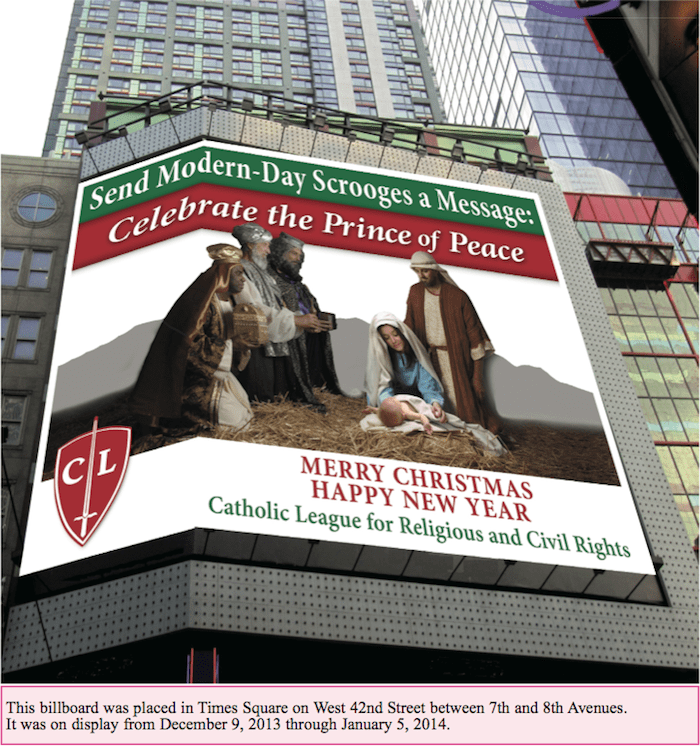
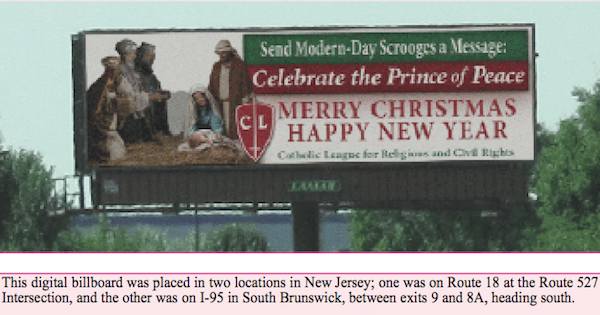
In 2013, as compared to previous years, the “War on Christmas” is being led more by national organizations, and less by local activists, than ever before. American Atheists, Freedom from Religion Foundation, and various humanist organizations are leading the way. Their weapon of choice is an array of billboards designed to denigrate Christmas. The Catholic League answered by erecting an enormous pro-Christmas billboard in Times Square, and two digital ones in New Jersey.
Militant atheists have also targeted the schools, seeking to deny any religious component to classroom celebrations, and Christmas-themed events. But there is a decided pushback, and it is not being led by the Catholic League or any other national organization: The good news is that Christians are taking things into their own hands, pressuring local authorities to accede to their reasonable demands.
Contrary to those who sell the bogus idea that the “War on Christmas” is not real, Christians who are fighting back are not obsessed with who is saying “Happy Holidays,” and who is saying “Merry Christmas.” On the contrary, they are engaged in serious efforts to stop those who want to censor Christmas. The evidence is clear that a small minority are hell bent on banning, trashing, and diluting the public expression of Christmas.
Nearly 80 percent of Americans are Christian, and 96 percent celebrate Christmas. Of the remaining four percent, most are indifferent, but are not hostile, to Christmas. That leaves a small, but dogmatically extreme, band of secularists (many of whom are ex-Christians) who are seeking to impose their agenda on the rest of us. It is up to decent Americans of all faiths, and indeed no faith, to see to it that the cultural fascists do not win the day.
September
Bar Harbor, ME – The City Council voted not to extend a lease that allowed a lighted evergreen tree to remain on town property year round. The tree was installed as a memorial to veterans who gave their lives and was accompanied by a plaque that read in part “The Christmas They Never Had.” The group which had sponsored the tree was ordered to remove it.
October
Wausau, WI – The school board issued a notice to the Music Department of the Wausau West High School that the song list for their Master Singers concert had to be edited to reduce the number of proposed religious songs for their annual holiday shows. A ratio of one religious song for every five secular songs was proposed, as was the suggestion that the concert be postponed or not include any holiday music at all. In response, music director Phil Buch disbanded the Master Singers.
On October 15, the school board reversed its decision, instead deciding to hold off on making any decisions surrounding holiday musical selections. The Master Singers immediately began practicing for the holiday shows.
October 16
Deerfield Beach, FL – The city banned all holiday displays on public property that were not installed by the city itself. As a result of this new ban, a nativity scene that was traditionally placed in front of the local fire station was not displayed this year because it was provided by a private business. The new rule is in response to a protestor, who last year installed a “Festivus” pole made out of beer cans next to the nativity.
October 18
Alton, IL – Vandals caused damage at the town’s Christmas Wonderland display in Rock Spring Park before the volunteer tradesmen known as the “Grandpa Gang” could even finish setting up. The Christmas Wonderland is one of the region’s most popular Christmas attractions and helps raise money for local charities.
November 1
Bordentown, NJ – Constance Bauer, superintendent of the Bordentown Regional School District banned religious songs from their schools’ annual “winter” concerts. “Religious music should not be part of the elementary program(s),” Bauer wrote. The decision was reached after two families complained and the school district’s legal firm recommended removing the songs.
After a public outcry, and the intervention of Alliance Defending Freedom, Bauer changed her mind and lifted the ban on November 5th. Bauer said, “In reviewing additional legal considerations and advice taken on this matter and the expressed sentiments of the community at large, I have reconsidered the decision on the musical selections for the upcoming winter programs.”
November 13
The Freedom from Religion Foundation (FFRF) launched a series of gifts and cards to celebrate the winter solstice, but also aimed at mocking Christmas. Cards include designs such as “Keep Saturn in Saturnalia” and “Yes Virginia …There Is No God.” FFRF also offers a “Heathen’s Greeting” musical selection.
FFRF’s president said “people have been celebrating the winter solstice long before Christmas. We see Christianity as the intruder, trying to steal the natural holiday from all of us humans.”
November 14
College Park, GA – Students at the Main Street Academy, a charter school, were given permission slips to begin rehearsing “popular American holiday music.” The permission slip also stated “religious songs will not be included.” The principal did not respond to numerous attempts by the media to ask him to explain his decision.
November 15
West Columbia, SC – The American Humanist Association threatened to sue the East Point Academy charter school over its annual Christmas toy drive. The American Humanist Association says that the toy drive violated the constitution, “because the purpose and effect of Operation Christmas Child is to induce impoverished children to convert to Christianity.” The school cancelled the toy drive because it did not have the funds to fight a legal battle.
November 16
Avon Park, FL – Businesses were asked to decorate more than 40 Christmas trees that lined Main Street in advance of the city’s annual Christmas parade. The flier for the event said that trees must be “tastefully decorated” with “no religious decorations.” A standing-room-only crowd turned out for the next City Council meeting and the ban on religious decorations was reversed before anyone needed to speak.
November 21
Highlands Ranch, CO – The American Humanist Association threatened to sue the Skyview Academy charter school over a student organized and student run Christmas toy drive to help needy children. The American Humanist Association says that the toy drive violated the constitution because it was sponsored by an evangelical Christian organization. While the school officially canceled the drive, concerned parents and students continued to collect toys and packaged them on the sidewalk in front of the school.
November 21
Rock Hill, SC – Fearing a lawsuit from the ACLU or other similar groups, the principal at York Preparatory Academy supported a decision made by the band director to ban all religious music from their upcoming concert. The ban even included instrumental versions of “Joy to the World” and “O Come All Ye Faithful.” After being contacted by the Alliance Defending Freedom, which offered to represent the school against any lawsuit free of charge, the school reversed its policy and permitted the inclusion of the religious music in the concert.
November 23 – 24
Seattle, WA – All nine Christmas trees at the Seattle-Tacoma International Airport were removed after a Rabbi threatened a lawsuit if a menorah was not displayed too. Officials at the airport decided that it would be easier to remove the trees.
November 26
Reno, NV – The city announced it would celebrate the lighting of their “holiday tree.” Reno Creative Services Manager, Sharon Spangler, stated “we really want to be respectful of everyone’s beliefs and their forms of celebration.”
November 29
Louisville, KY – A teacher at Brandeis Elementary School was asked to take down a paper Christmas tree made up of paper hands cut out to represent all the students. Above the tree was a caption that read “Santa’s Helpers.” The school principal ordered the caption to be removed after another teacher, who was Jewish, complained about it. After the teacher removed the entire display, it was pointed out that removing Christmas entirely counteracted the goal of being “multi-cultural.” The teacher was then permitted to repost the display with a new caption that read “Happy Holidays.”
December
“Judith Owen & Harry Shearer’s Holiday Sing Along” kicked off its irreverent five city tour through New York, Chicago, Los Angeles, Philadelphia and New Orleans. The show is described as an “antidote to the holiday frenzy” and according to reports includes songs such as “F*** Christmas” “Christmas with the Devil” and “Jesus was a Dreidel Spinner.”
December
Arlington Heights, IL – The Freedom From Religion Foundation installed an anti-religion sign in a public park as a protest against a privately funded nativity that was on display in the park.
December
Claremont, CA – The Claremont United Methodist Church, known for using the Holy Family to make provocative social commentaries, installed a nativity scene that replaced the baby Jesus with a bleeding Trayvon Martin figure. Martin, the African American teen who was shot in Florida, was depicted sitting hunched over in place of the manger with blood dripping from his chest. This was the sixth year that the church has allowed local artist John Zachary to use the nativity to comment on social policy.
December
Somers, NY – A group of residents petitioned the Town Board against a plan to install a crèche in front of the Town House. The Town House’s front lawn has long been the site of a Christmas Tree and a Hanukkah menorah but the petition suggests these are “non-religious” symbols.
December
Tallahassee, FL – A nativity scene in the State Capitol has been the source of protest from several atheists. The Freedom From Religion Foundation (FFRF) placed a banner in the capitol building, which is self described as a “light-hearted nativity scene parody.” The banner depicts Benjamin Franklin, Thomas Jefferson, James Madison and the Statue of Liberty huddled around a manger with the Bill of Rights in it. FFRF calls the display the “Bill of Rights Nativity.”
Additionally, Chaz Stevens, an atheist from Deerfield Beach, FL received permission to install a “Festivus” pole in the capitol to celebrate the fictional holiday made up by the television show “Seinfield.” Stevens’ pole was 6 feet tall made up of empty beer cans and was displayed next to the nativity. Stevens admits the idea is ridiculous, but installed the display as a protest against the nativity. Stevens had installed a similar pole in his hometown last year, which led to a ban on any holiday display.
The displays in the Statehouse also included a “provHerb” from the Church of the Flying Spaghetti Monster meant to mock Christians. A proposed diorama from The Satanic Temple was rejected because it was “grossly offensive.”
December 2
Buffalo, NY – Business owners were ordered to remove Christmas lights that had been placed in trees along the popular Elmwood Village shopping district. According to the city, the lights were illegal unless they had been installed by a licensed contractor and had a $1 million insurance policy.
December 3
Brooklet, GA – For as long as anyone can remember, teachers at Brooklet Elementary School have posted Christmas cards in the hallways outside their classrooms – until this year. When students returned from Thanksgiving break, they discovered that their teachers’ Christmas cards had been removed – under orders from the Georgia school’s administration. The Christmas card censorship took place as the Bulloch County Board of Education began to crack down on religious expression in their schools. Teachers were ordered to remove any religious icons or items from their classrooms – ranging from Bibles to Christian music.
December 3
New York, NY – American Atheists launched a campaign titled “Nobody Needs Christ at Christmas.” The ad campaign includes a series of electronic billboards across midtown Manhattan that cross out the word “Christ” and encourage people to “Celebrate the true meaning of Xmas.” The advertisement then flashes several suggestions for celebrating including “Chinese food,” “Rockettes” and “parties.”
December 3
Providence, RI – After two years of lighting a “holiday tree,” Gov. Lincoln Chafee agreed to refer to the State Capitol’s annual lighting celebration as a “Christmas Tree.” However, Gov. Chafee was not available to attend the actual lighting event and instead delegated the Christmas tree lighting responsibilities to the Secretary of State.
December 5
Chicago, IL – The Freedom from Religion Foundation unveiled a large illuminated “A” for atheists in the city’s Daley Plaza. The plaza has long been home to a privately maintained crèche and menorah. The atheists’ display also included a banner meant to mock Christians by depicting the Founding Fathers standing around a crib that contained the Bill of Rights.
December 5
Frisco, TX – Students who attend Nichols Elementary School’s “Winter Party” have been banned from talking about Christmas or any other religious holiday. Christmas trees have also been banned along with traditional holiday colors – red and green. The principal defended the policy saying that she “didn’t want to offend any families.”
December 5
Nashville, TN – Two shoppers were asked to leave the Opry Mills Mall because they were dressed in Christmas costumes and wishing people a Merry Christmas. Mall security indicated that they were interfering with the mall Santa and asked them to leave. A mall spokesperson later apologized and invited the shoppers back.
December 5
Quincy, MA – Statues of Jesus, Mary, Joseph and a lamb were stolen from a nativity scene in Quincy Square. The statues of the Holy Family were later recovered but the lamb was still missing.
December 5
St. Joseph, MN – Several figures from the nativity scene outside the Church of St. Joseph were stolen. Originally just a shepherd was missing, but then thieves also stole Mary, Joseph and some of the animals. During the following week, on December 11, Mary, Joseph, the shepherd and some of the missing animals were returned.
December 6
Ellsworth, ME – The Downeast Humanists and Freethinkers sponsored a float in the town’s Christmas parade. They claim the purpose of the float was to educate parade goers about the pagan roots of the evergreen tree.
December 9
Mt. Pleasant, PA – The baby Jesus figure was stolen from two nativity scenes.
December 10
Sumter, SC – Shaw Air Force Base removed a nativity scene that was displayed on the base after being contacted by the Military Religious Freedom Foundation (MRFF). MRFF bragged that it took the Air Force only 2 hours and 15 minutes to remove the nativity after a complaint had been filed. Officials at the base later revealed that they had not received any complaints about the nativity from Airmen stationed at the base, and that the only complaint was from MRFF. The nativity was later reinstalled outside the Base’s chapel.
December 10
Valencia, CA – A baby Jesus figurine was stolen from the nativity scene outside the Westfield Valencia Town Center. The statue was returned later in the week.
December 11
Vancouver, WA – Children singing Christmas carols were booted from the front of a WinCo grocery store over fears that they might offend patrons who did not celebrate Christmas. A corporate official later said he “did not see any harm” in the girls singing, and granted them permission to return.
December 12
Kings Park, NY – Officials at the Ralph J. Osgood Intermediate School decided that 5th grade students would perform “Silent Night” during the school’s concert. However all religious references were removed from the song, resulting in the children singing a version of “Silent Night” that omitted lyrics such as “Holy infant,” “Christ the Savior,” and “Jesus Lord at thy birth.” The school district has since apologized.
December 13
West Covina, CA – A 6 year old student brought candy canes with short messages attached that included a reference to Jesus Christ to Merced Elementary School as gifts for his teacher and first grade classmates. The teacher confiscated the candy canes, and after conferring with the principal told the student that “Jesus is not allowed in school.” The messages were ripped off the candy canes and discarded in the trash.
After a lawyer from Advocates for Faith & Freedom contacted the school on the student’s behalf, he was permitted to hand out the candy canes with the messages, but it had to be done off campus and on the last day before the students left for winter break. The school superintendent said the teacher’s intention was to “maintain an appropriate degree of religious neutrality in the classroom.”
December 17
Fairfield, CT – When students at Fairfield Ludlowe High School suggested using Santa and Christmas trees to decorate the classroom door as part of a school-wide contest, the teacher told them that no reference to Christmas would be permitted. The school’s headmaster said the school policy is decorations “should have no direct religious meaning.” The headmaster suggested using a wreath, candy canes or holly because they have no direct religious meaning.
December 17
Pitman, NJ – The Freedom from Religion Foundation rented a billboard that reads “Keep Saturn in Saturnalia,” a reference to an ancient celebration of the Roman God Saturn. This billboard was erected in protest to a Knights of Columbus banner that read “Keep Christ in Christmas.”
December 19
Guantanamo Bay, Cuba – Two nativity scenes were removed from dining halls at the U.S. Naval base following a complaint from the Military Religious Freedom Foundation (MRFF). According to MRFF, they received an email signed by 18 active-duty service members protesting the crèches. A spokesperson for the base said there had been no complaints from personnel stationed at the base about the displays. The nativity scenes were moved to a courtyard outside the base chapel.
December 19
Temecula, CA – First grade students at the Temecula Valley Unified School District were given an assignment that required each student to bring in something that represented a family holiday for a one-minute presentation. One young student brought in a star of Bethlehem and began to recite a Bible verse, when her teacher interrupted her and told her to take a seat. The student was reportedly told that “she’s not allowed to talk about the Bible in school.”
December 21
Lincoln, NE – A lighted baby Jesus figure was stolen from the front yard of a private home.
December 24
Augusta, GA – A group of high school students were banned from singing religious Christmas carols at the Charlie Norwood VA Medical Center. The hospital, which is run by the federal Veterans Administration, said it had a responsibility to “represent people of all faiths.” According to the hospital, the policy on “spiritual care” is set by the Veterans Administration to protect veterans from “unwelcome religious material.” The students who had performed without any problems in 2011 and 2012 were given a list of 12 approved secular Christmas songs that they could sing. The students did not have enough time to rehearse the approved songs and instead decided not to perform at all.
December 24
Dallas, TX – Christmas cards that were made by students for local veterans were not accepted by the VA North Texas Health Care System because the federal Veterans Administration has a policy that limits the distribution of cards containing religious references. The cards were instead donated to other private veterans’ facilities.
December 25
Erie, PA – Someone broke into a church after Christmas Eve services and stole the baby Jesus statue from the church’s narthex. Nothing else in the church was stolen or damaged.
December 27
Basking Ridge, NJ – A statue of baby Jesus was stolen from a nativity scene on the front lawn of a private home.
Catholic League president Bill Donohue commented today on the Catholic League’s latest Christmas campaign:
“Several weeks ago, we sent a booklet, Religious Expression at Christmastime, to every county administrator in the nation; there are 3,100 of them. The booklet encourages these officials to erect a nativity scene on public property. ‘There is no law which says you must do so,’ we said, ‘but it is also true that there is no law which prohibits you from doing so.’ Indeed, we stressed that for the past ten years, the Catholic League has received a permit from the New York City Parks Department that allows us to put a crèche in Central Park.
“As we pointed out, in 1995, the Supreme Court ruled in Capitol Square Review Board v. Pinette that privately sponsored religious displays must be allowed on public property if other forms of expression are permitted in the same location. Our booklet is replete with guidelines on this issue that should prove to be helpful to county administrators.
“There is much ignorance in this area. For example, in Wellesley, Massachusetts, town officials tentatively approved a policy that allows religious groups to display holiday decorations. That’s great, except that their idea of fairness is to put a Jewish religious symbol, namely the menorah, alongside such secular Christian symbols as a Christmas tree and wreaths. Equity demands that a crèche be put alongside a menorah.
“It’s even worse in Lansing, Michigan. Town officials recently erected a state ‘Holiday’ tree there. Jerry Lawler, executive director of the Michigan Capitol Committee, boasted that the ‘Holiday’ tree was meant to be inclusive. So he said it was okay by him to call it a ‘Kwanzaa tree’ or the ‘Hanukkah tree’ or the ‘solstice tree.’ In other words, he said it was okay to call it anything but what it is—a Christmas tree.
“The National Christmas Tree Lighting will take place on Thursday in D.C. We would like to hear from all those who might be offended, and why.”
|
 October 26
New York, NY—In 2005, the Children’s Museum of Manhattan honored holidays for Hispanics, Jews, Muslims and African Americans, but not for Christians. In October the museum featured Hispanic Heritage Month, as well as a Ramadan in New York City Festival; the latter event meant that children were read stories about Islamic traditions. There were no Columbus Day events for the city’s Italian Catholic community. In November, there was an Eid in New York City Festival for Muslims, but Christians got nothing for Thanksgiving. Jewish and African-American holidays were celebrated in December when the museum honored Hanukkah and Kwanzaa, respectively, but there was nothing for Christians at Christmas, save for a “Fruity Fondue” event.
November 3
San Diego, CA—The regional director of the Anti-Defamation League announced his distain for “Christmas programs” and his support for “winter programs.” Morris S. Casuto explained his reasoning by saying, “School and public events should be designed to enable diverse communities to participate without feeling left out or marginalized.”
November 3
Huntington, WV—Marshall University instituted a decoration contest emphasizing non-Christmas symbols. “The main idea in our contest is to enrich [the] campus according to the winter tradition,” explained Christina Burgueno, associate professor of modern languages and a member of the contest committee. “There is such an amount of diversity now at our campus. We want to celebrate the traditions of other people, people from other places.”
November 9
The Catholic League started a boycott against Wal-Mart, citing discrimination against Christians. Two days later, Wal-Mart folded, yielding to the league’s three demands. Ergo, we called off our boycott.
Our troubles with Wal-Mart began when a woman e-mailed the company complaining about its policy of encouraging its employees to say “Happy Holidays” instead of “Merry Christmas.” The response she got, from a Customer Service employee called Kirby, was astounding. Here’s what Kirby said (we are reproducing his statement exactly as it was sent, errors and all):
Walmart is a world wide organization and must remain conscious of this. The majority of the world still has different practices other than ‘christmas’ which is an ancient tradition that has its roots in Siberain shamanism. The colors associated with ‘christmas’ red and white are actually a representation of the aminita mascera mushroom. Santa is also borrowed from the Caucuses, mistletoe from the Celts, yule log from the Goths, the time from the Visigoth and the tree from the worship of Baal. It is a wide wide world.
The woman then e-mailed Kirby’s statement to us. Our first reaction was that this was obviously the work of some underling. Wal-Mart, being a behemoth of an organization, could not possibly police everyone in every department. But we decided that Wal-Mart’s top public relations person should know about this; we were curious to see what he or she might say. So we e-mailed Kirby’s remark to Dan Fogleman, Wal-Mart’s senior manager in public relations. To our surprise, Fogleman not did not disagree with Kirby, and even proceeded to give us a lecture on diversity. Here is part of what he told us (again, we are not correcting the errors):
As a retailer, we recognize some of our customers may be shopping for Chanukah or Kwanza gifts during this time of year and we certainly want these customers in our stores and to feel welcome, just as we do those buying for Christmas. As an employer, we recognize the significance of the Christmas holiday among our family of associates…and close our stores in observance, the only day during the year that we are closed.
After being insulted again, we decided to do one more thing: to see how Wal-Mart treats Hanukkah, Kwanzaa and Christmas. What we found was revealing. By typing Hanukkah into the search engine of its website, 200 items appeared. Typing Kwanzaa yielded 77 items. But when Christmas was entered, here’s what appeared on the screen: “We’ve brought you to our ‘Holiday’ page based on your search.”
That was it. On November 9, we issued a news release titled, “Wal-Mart Bans Christmas; Boycott Launched.” In it, we said that when we initially read Kirby’s statement, we assumed “he might be drunk.” We also said, “It’s nice to know that Wal-Mart is closed on a federal holiday.” We immediately contacted 126 religious groups spanning seven faith communities asking them to join with us in the boycott.
On November 10, Worldnetdaily.com flagged this story on its website as the lead news story. This led to a string of interviews on talk radio around the nation. In every case, listeners were livid: they felt betrayed that the “family-friendly” retailer would do this. So they e-mailed Fogleman to let him know what they thought. Bill Donohue e-mailed Fogleman his own missive: “Now that Wal-Mart is standing by its position, I hope you’re ready for our next move. Don’t forget, we have the next six weeks to pull out all the stops, and we will.”
Meanwhile, Wal-Mart spokeswoman Jolanda Steward told the press that the store was just trying to help its customers “celebrate their individual needs and wants.” To which Donohue said, “I thought Wal-Mart was a department store—not a Wellness Center.” Then Donohue got hold of the e-mail address of a senior Wal-Mart official, Ryan Loken, and sent him the following note:
Wal-Mart has made a huge mistake taking us on just at the start of the Christmas buying season. Why you are keeping Fogleman on as your PR man is mind-boggling. Have you seen worldnetdaily.com? Are you aware that our staff has been doing one radio talk show interview after another all day, with many more scheduled? Ask Fogleman how many e-mails he has received and what people are saying.
The Left has unfairly attacked Wal-Mart for years. But now you’ve angered your base—conservative Christians.
To put an end to our boycott, read the news release I wrote today. I’m not asking for the moon. But I will tell you this much: we have the money, time and determination necessary to keep this up for the next six weeks. In other words, the ball is in your court.
The November 10 news release listed three demands: “We want a) an apology for insulting Christians by effectively banning Christmas b) a withdrawal of its insane statement regarding the origins of Christmas and c) a revision on its website.”
When Donohue got to work early on November 11, news reports were carrying the Wal-Mart apology, saying that Kirby had been fired. Then Donohue checked Wal-Mart’s website and found that by typing Christmas in its search engine, customers were taken to the Christmas site. We thus declared victory and an end to the boycott.
November 28
Olympia, WA—Public school teachers in three districts (North Thurston, Olympia and Tumwater) were no longer permitted to engage in activities that promote any particular religious holiday. Instead, students were encouraged to participate in “change of season” activities. “We can’t promote one belief over the other,” said Paula Quinn, principal at Lydia Hawk Elementary in Lacey. “At Lydia Hawk, we have a very, very, diverse population, and I try to be very sensitive to that.”
November 29
Wellington, FL—A Wellington Village Council member withdrew his request to include a nativity scene in the annual holiday display after getting little support from village and business officials. The holiday display included a Christmas tree and a menorah.
November 29
Jefferson, GA—The Jackson County School System sent a letter to teachers prohibiting them from wearing “any pins, angels, crosses, clothing” with any religious connotation or affiliation, and from referring to any party as a “Christmas” party. Christmas songs with religious wording were removed from the winter concert.
November 29
After a public outcry, Lowe’s home-improvement stores were forced to change banners that referred to Christmas trees as “Holiday Trees” in English and “Christmas Trees” in Spanish. The store decided to call all Christmas trees by their proper name.
December 1
The Catholic League contacted Lands’ End clothing store about the use of “holidays” instead of Christmas in its catalog. Printed below is part of the reply we received from Merlin W. Gorsline in the Customer Relations Department:
We find ourselves in a difficult position with this issue. As a result, we have adopted the “holiday” terminology as a way to comply with one of the basic freedoms granted to all Americans: freedom of religion. We recognize that Christmas is a Christian holiday, and one of the foremost teachings of the Christian faith is a love for one’s fellowman—no matter what [sic] his race, religion or creed. If we knew which customers feel as you do, we would be delighted to send them catalogs with “Merry Christmas” splashed throughout the pages. However, we don’t.
After fielding our complaint, Jackie Schutty, an executive from Lands’ End, told us on December 7 that “the information that was recently shared by one of our Lands’ End representatives does not accurately reflect our company’s position.” She also said, “We apologize for any confusion and appreciate the opportunity to clarify our position.”
December 1
Auburn, AL—Auburn University’s Student Government Association renamed the university’s annual Christmas tree a “Holiday tree” in a press release announcing the tree-lighting event.
December 1
South Florida—Florida Atlantic University called an “EMERGENCY” meeting about the controversy surrounding the school’s “Finals Week” tree. For the past six years, the “Finals Week” tree—adorned with lollipops, Fritos, etc. (courtesy of the faculty)—had been on display at the end of each semester. Mark Tunick, a professor and interim dean, made the mistake of e-mailing 57 employees encouraging them to support “the traditional finals week Christmas tree with snack.” Professor Martin J. Sweet said religious symbols don’t belong on campus. Student government officials and faculty members pledged to hold “multiple meetings” to deal with this issue.
The Catholic League could not resisting noting that the same university made headlines following Hurricane Katrina: condoms were promiscuously distributed to students. This is the same school that caught our attention in 2001 when it hosted the anti-Catholic play, “Corpus Christi.”
December 3
Chula Vista, CA—Six girls were barred from performing their hip-hop dance routine at the city’s “Holiday Festival” show because they wore “Jesus Christ Dancers” shirts at the event. A city official prevented them from performing because of the message on their shirts and the Christian music that accompanied the routine. An attorney for the American Family Association stated that “The city allowed a Hawaiian prayer dance, a belly dancer and other ‘holiday’ performers, and there was a tree-lighting ceremony afterward where a rabbi lighted a menorah.”
December 6
Glendale, WI—The Glendale-River Hills School District had a written policy stating that songs with “dogmatic religious statements” were banned from concerts. But this didn’t stop the school’s concert from including Hanukkah songs.
December 7
Shawnee, KS—Deputy City Manager Carol Gonzalez barred Joseph and Mary actors from the town’s annual Christmas celebration because she felt it crossed the line between the separation of church and state.
December 7
Federal Way, WA—A nutrition services employee mistakenly placed the words “Merry Christmas” on lunch menus for all 23 elementary school. In response, the district recalled and reprinted them with the greeting “Happy Holidays.” A school spokeswoman for the district said “Merry Christmas” on the menus violated the school system’s policies because “it has a religious connotation for some people.”
December 7
Medina, WA—Medina Elementary School removed a “Giving Tree” with mittens labeled with gift ideas for the poor after a parent complained that it had religious connotations.
December 7
Bartlett, TN—The Memphis Library system erected a nativity scene that included just three farm animals and a shepherd boy. The presence of Jesus, Mary, and Joseph, along with the Three Wise Men, were deemed “inappropriate” by school officials.
December 8
Manhasset, NY—At a Christmas tree lighting celebration, Town of North Hempstead supervisor Jon Kaiman became frustrated when the Rev. Nick Zientarski gave a traditional Catholic blessing. In the midst of the blessing, Kaiman was overheard saying, “This is nonsense,” “We’re not doing this next year,” and “I can’t believe this.” When Rev. Zientarski finished his blessing, Kaiman immediately took the microphone and told the crowd, “I just want to make it clear that this is in no way a religious ceremony. We’re here to celebrate the holiday tree lighting. This is no place for a religious ceremony.” After public outrage, Kaiman apologized to Fr. Zientarski and the people of North Hempstead for his behavior.
December 12
Sacramento, CA—Patricia Sonntag, director of the Office of Services to Students with Disabilities at California State University, Sacramento, banned 4th of July celebrations, along with Christmas, from her office. Here is her directive:
With the new year, we will now celebrate the seasons and holiday without decorations in the public areas and hallways. This is a secular university and we are a public service area that has a diverse employee and student populations [sic] even in our private offices. In order to avoid offending someone else, we will not display celebratory reminders. This specifically includes Christmas, Thanksgiving, Halloween, Valentines, 4th of July, St. Patrick’s Day and Easter, off the top of the list. I, for one, am the worst offender and celebrant. Time has come to recognize that religious discrimination, as well as ethnic insensitivity to certain holidays, is forbidden. I am sorry if this offends anyone, but it is time to start the new year differently.
December 13
New York, NY—Condo board members at Donald Trump’s luxury 220 Riverside Blvd. building refused to allow a tenant to put a nativity scene in the lobby of the building, even though they displayed a menorah.
December 14
Chicago, IL—The Theatre Building Chicago hosted the play, “The Eight: Reindeer Monologues,” by Jeff Goode. The play is about sexual harassment by Santa and an abused reindeer.
December 19
Mine Hill, NJ—An elementary school changed the title and lyrics to the Christmas carol “Silent Night, Winter Night” at its “X-mas Files” concert. Children were also banned from writing “Merry Christmas” in class but were allowed to write Feliz Navidad. For the concert, students were encouraged to bring in musical selections but were told not to bring any religious songs.
December 19
Centennial, CO—Heritage Elementary School officials banned a student from bringing a nativity scene to school and telling the story of Christmas. The school also barred candy canes that contained a story about their religious symbolism, and cookies shaped like traditional Christmas symbols.
December 19
Texas public school teachers were told that they could not mention the word “Christmas” or tell the nativity story.
December 29
Holliston, MA—The Central Street fire station was forced to remove an illuminated cross and menorah after a resident complained it violated a new town policy.
Politically Correct Trees:
The following venues replaced Christmas trees with “Holiday Trees”: Hagerstown, Maryland; Duffy Square in Times Square, New York; Overland Park, Kansas; Roanoke, Virginia; Bangor, Maine; Westminster, Maryland; and Auburn University (a vote by the Student Senate to change the name to ‘Christmas tree’ lost 22-4). In lieu of a Christmas tree, the following venues had a “Giving Tree”: the Naval Academy; Lousiana State University; University of New Mexico; Madison, Wisconsin; and West Hollywood.
In place of a Christmas tree, there was a “Grand Tree” in Atlanta; a “Union Tree” at Purdue University; a “Peace Tree” in Washington Park, Illinois; and a “Friendship Tree” was found in Hoffman Estates, Illinois and Manchester, Massachusetts.
The display of secular “Holiday Trees,” alongside the Jewish religious symbol, the menorah, was commonplace, ranging from places like San Diego Hospice & Palliative Care to Langley Air Force Base in Virginia to the Village Hall in Gurnee, Illinois.
Christmas Vandalism:
From nativity scenes to secular Christmas displays, vandals hit the following places: Birmingham, AL; Homewood, AL; Montgomery, AL; Bella Vista, AR; Eureka Springs, AR; Little Rock, AR; Van Buren, AR; Campbell, CA; Covina, CA; Fremont, CA; Glendale, CA; Martinez, CA; Newport Beach, CA; Fresno, CA; Los Angeles, CA; Walnut Creek, CA; Westminster, CO; Cape Coral, FL; Delray Beach, FL; Longboat Key, FL; Miami Springs, FL; Medley, FL; Port Saint Lucie, FL; St. Lucie West, FL; St. Petersburg, FL; Belleville, IL; Galesburg, IL; West Frankfort, IL; Olathe, KS; Marrero, LA; Brockton, MA; Cohasset, MA; Londonderry, MA; Quincy, MA; Glen Burnie, MD; Greenbelt, MD; Severn, MD; Port Huron, MI; Waltz, MI; Bay Port, MN; Marquis Point, MN; West St. Paul, MN; Woodbury, MN; Asbury Park, NJ; Branchville, NJ; Hamilton, NJ; Howell, NJ; Old Bridge, NJ; Prospect Park, NJ; Sayreville, NJ (police found 27 baby Jesus statues in the car of a suspected thief); Trenton, NJ; Holbrook, NY; Larchmont, NY; Pearl River, NY; Troy, NY; Hilton Head, NC; Wilmington, NC; Cheviot, OH; Dayton, OH; Fremont, OH; Hamilton, OH; Whitaker Park, OK; Medford, OR; New Kensington, PA; Watsontown, PA; Wilkes-Barre, PA; South Kingstown, RI; Lexington, SC; Allen, TX; Grapevine, TX; Houston, TX; Killeen, TX; Murfreesboro, TN; Draper, UT; Logan, UT; Fredricksburg, VA; Eatonville, WA; Seattle, WA; Madison, WI; New Berlin, WI; Oak Hill, WV.
A large blindfolded Santa was found hanging from a tree in Miami Beach, FL; in Boston, vandals decapitated Santa; Santa’s throat was cut in Lincoln, NE; a dead Santa turned up in Oklahoma City, OK; a bloody Santa holding a severed head was displayed in New York City (this was done intentionally by the homeowners); and in Orlando, FL, a bloody Rudolph the Red-Nosed Reindeer was found swinging from a tree.
Guidelines of the Catholic League
Christmas 2003
This booklet was prepared by Gerard Bradley of the University of Notre Dame School of Law and Robert Lockwood of the Catholic League. It is a guide that we hope will be of use to Catholics, as well as to the general public, regarding what kinds of religious expression are permissible at Christmastime.
William A. Donohue
President
Catholic League for Religious and Civil Rights
Guidelines from the Catholic League for Religious and Civil Rights on the proper means for the religious celebration of Christmas in the public arena
Introduction
Each year during the Christmas season, there are reports that the religious aspects of Christmas are being banned or omitted from the public arena. These stories can involve anything from threats of legal action over the placing of traditional nativity crèches on public property, to various directives from administrators that eliminate the very mention of the religious aspect of the season from public schools. Such stories can reach ridiculous proportions, as when a city manager in Eugene, Oregon, banned the display of decorated trees on public property. In Vancouver, Washington, transit authorities cited the constitutional separation of church and state in forbidding employees to wear seasonal ties or jewelry that displayed a religious symbol.
There is a tendency to either treat these seasonal stories as something to be laughed at, or to respond to them by assuming that the constitution and court decisions mandate the elimination of the spiritual aspects of Christmas from public life. In many cases, activist organizations employ bullying tactics and threats of lawsuits to attempt to force their private interpretation of the role of religion in public life, particularly within the public school environment. Those who are unaware of the actual legal precedents in these matters and the proper interpretation of the constitution find themselves cowed into submission.
The purpose of this booklet is to outline not only what is permissible, but also what is proper in acknowledging and recognizing the religious aspects of the Christmas season in the public arena. The booklet will provide an overview of the issues involved, and guidelines for civic groups, private organizations and individuals, as well as public school administrators, teachers, and parents.
Overview
Christmas is at its roots a religious celebration. Yet, within American culture there has been a long accretion of secular customs and traditions surrounding the feast, so much so that non-Christians and avowed non-believers celebrate the holiday. At the same time, there has been a growing diversity within American culture. While 86 percent of Americans identify themselves as Christian, there is a growing non-Christian cultures.
In discussing how to recognize and allow for appropriate celebration of the Christmas season in the public arena, there has always been a certain tension among the religious significance of the celebration, the overwhelming secular traditions of the season, and respect for those for whom Christmas is not a part of their culture or religious faith. In the public arena, there needs to be an understanding of the difference between accommodation of religious belief, and giving the appearance of the establishment of religious belief.
At the same time, there needs to be a sensible understanding of the right to freedom of religious expression, and the right of religious groups, civic organizations and private citizens to use public property in the same fashion allowed to secular organizations. Finally, it must be clearly understood that within a public school environment, the religious aspects of the Christmas season have no less right to expression and recognition than the secular aspects of the season, or non-Christian faiths and cultural celebrations that are recognized and explained within the school year.
The issue of recognizing Christmas in the public arena generally arises in two forms: 1) the display of secular and/or religious seasonal symbols on public property at the expense of either government or private groups; and 2) the treatment of the Christmas season within public schools. Yet, as noted above in Eugene, Oregon, and Vancouver, Washington, the issue can also come up in a host of different ways where the action that is taken is decidedly hostile to religion, or even to the secular observance of the Christmas season. These issues are sometimes raised by administrative fiat resulting from an individual complaint, or under threat of legal action.
Even well meaning people attempting to avoid alleged controversy, or under threats, give in to a view that holds that there is a constitutional requirement that the government be hostile to religion in the public arena, rather than neutral. Such was the case when a public school system in Georgia responded to threats of legal action by ceasing any reference to a “Christmas break” for the traditional period when schools close around the holidays. Though it defied logic and common sense—the break has always been associated and timed for the Christmas season, and will continue as such—this kind of intolerance and censorship of speech have been common. And the response is often complete surrender to the complaint.
There is the unfortunate aspect to much of this discussion about Christmas in the public arena that certain elements within society consider religion—particularly Christianity—to be a divisive, if not dangerous force, in society. Their campaigns are built on intolerance, restriction of free speech and hostility toward religion. They believe that people need protection from religion and religious expression. While they have a right to such views, they do not have the right to treat Christian religious expression as in and of itself a secondary right. Unfortunately, the Supreme Court has allowed private religious expression to be limited when it could appear to the “reasonable” observer that the government is “endorsing” that expression—meaning that the government appears to agree with or affirm a particular view of religion. (County of Allegheny v. ACLU, 492 U.S. 573 (1989)). Although four members of the Supreme Court have disagreed with use of this “endorsement test” against privately sponsored religious free speech, that test—derived from Allegheny—has not yet been explicitly overruled. (Capitol Square Review & Advisory Board v. Pinette, 515 U.S. 753 (1995)).
The publicly sponsored display of religious symbols in the public arena, however, is a different matter. Worried that publicly sponsored religious displays could reasonably be seen as an endorsement of religion or a particular religion, the Supreme Court has applied a more exacting standard to publicly sponsored displays than private ones. The focus of the guidelines given in this booklet, however, will be on privately sponsored religious expression in the public arena, and religious expression by students or teachers in public schools during the Christmas season.
The display of religious Christmas symbols in the public arena certainly involves a greater understanding and tolerance for different religious traditions within the United States. It is also an opportunity to see that First Amendment rights of religious expression and free speech be guaranteed to all on an equal basis. Openness to religious expression, recognition, and speech in forums that are traditionally open to secular speech is not a violation of separation of church and state, or government seal of approval for any particular religious sect.
State Constitutions
Keep in mind that the guidelines presented in this booklet are based on the First Amendment to the Constitution of the United States. Most state constitutions also contain, like the First Amendment, guarantees of non-establishment and free exercise of religion. The non-establishment clause of a state constitution may be more specific in defining what constitutes an “establishment” of religion than the non-establishment clause in the First Amendment. Theoretically, what might be permissible under the First Amendment might also be expressly prohibited by a state constitution. At the same time, a state constitution may not limit or burden the free exercise clause guaranteed by the First Amendment. Whether the two ever conflict is a state-specific determination beyond the scope of this pamphlet. While it is highly unlikely that any state constitution could successfully prohibit a nativity scene that satisfies the federal First Amendment, the concern is one to be kept in mind if litigation might arise.
Forums
In relation to expression or free speech, all public property generally falls under the classification of one or another types of forums: the traditional or open public forum, the limited or designated use forum, and the non-public forum. The classification of a forum critically affects how much the government may limit expression or speech in that forum. As one can see after reviewing the guidelines, the question of whether a court will uphold any given nativity scene display is not easily predictable, nor does it depend on any formulaic rule. Therefore, the guidelines in this booklet are not a sure formula for winning litigation. Rather, they are principles applied by the courts in determining such litigation. By considering these principles, one can erect a nativity display where it is most likely to be upheld and least likely to be struck down.
Guidelines for Private Groups or Individuals Erecting Nativity Scenes on Public Property
I. In which kind of forum will the nativity scene be erected?
A. Traditional/Open Public Forum
1) A traditional/open public forum provides the best protection for nativity scenes.
2) The traditional/open public forum is characterized by being an open public thoroughfare with an objective use of open access (examples: streets, sidewalks, and parks).
3) The government may place objectively reasonable time, place, and manner regulations on the display of the nativity scene so long as the regulations are content-neutral (example: limiting the amount of electricity a display can use for safety reasons).
4) In order to subject a nativity scene to content-based regulations (example: no nativity scenes are allowed because they are religious), the government must show a compelling interest in having the regulations and must show that the regulations are narrowly tailored to that interest.
a) Governments may have a compelling interest in avoiding a situation where a reasonable observer of the situation would conclude that the government was endorsing religion over non-religion, one religion over another, or several religions over others.
b) If a nativity scene or other religious display stands alone in front of a public building, especially a seat of government (example: a courthouse or city hall), courts have often found that such a display would impermissibly give the reasonable observer the impression that the government was endorsing religion—even though the scene was privately sponsored.
c) Secular symbols, such as Christmas trees, Santa Claus, reindeer, and candy canes, if placed prominently around a nativity scene, can downplay what a reasonable observer would otherwise see as a government endorsement of religion.
d) Merely grouping together religious displays (example: a crèche and a menorah) does not solve the endorsement problem. Without secular symbols present, the reasonable observer might still conclude that the government was endorsing several religions over others (example: Christianity and Judaism).
e) Nevertheless, governments may not from the beginning subject a nativity scene or the permission to erect one to more unique rules or a more restrictive application process than the rules or process applicable to any display in the open public forum.
B. Limited/Designated Use Forum
1) The limited/designated use forum is one that the government purposefully makes available to a particular class of persons or for a particular class of uses. (example: the government may open a government-owned area to use by military veterans, or for religious and cultural displays).
2) The limited/designated use forum is just like a traditional/open public forum for all those falling within the class to which the forum was opened. Apply the traditional/open public forum guidelines.
3) The government’s ability to limit use of the forum to a particular class is not unlimited, but the courts have not defined what the limits are. The courts have said that once a limited forum has been created, entries of a similar character to those allowed access may not be excluded. (example: if the forum has been opened to religious displays, nativity scenes may not be excluded).
4) Note that the government simply allowing some speech or expression on public property that is not an open/traditional public forum does not created a limited/designated use forum. The government can keep the forum non-public by allowing selective, permission only access that depends upon non-discretionary judgments (example: x amount of insurance coverage)
C. Non-Public Forum
1) Non-public fora are generally all those government properties that are not traditional/open public fora and have not been made designated/limited use fora.
2) The government can refuse to allow a nativity scene display in a non-public forum when that display would interfere with the objective use to which the property has been dedicated (example: the government may refuse to allow a nativity scene near the runway of an Air Force base because it would distract landing pilots).
Public Schools
Most people are surprised to discover that the courts have issued few guidelines at all for public schools concerning seasonal religious displays. When the Supreme Court has touched on the issue, it has generally found in favor of religious expression and displays, for example, in favor of allowing the performance of religious music in public school choral performances during the Christmas season, and the performance of public school choirs at religious institutions. While some administrators of public schools—and activist organizations that attempt to bully public schools—will often cite vague references to separation of church and state, there is no legal precedent in this area that bans the display of religious symbols at Christmastime. The reason for this is that courts will not interfere in the educational process. Display of religious symbols, when done even-handedly and without devotional intent, is perfectly legitimate as part of the school’s mission to educate.
Some Christmas symbols—reindeer, Santa Claus, and candy canes, for example, have been viewed by the courts as secular rather than religious symbols of Christmas, and their display is legitimate. Other symbols have been viewed as secular or religious depending on the context. When the Supreme Court has dealt with Christmas trees it has generally viewed them as a secular symbol. Even so, in the specific context of public schools, a lower court has treated a Christmas tree as a religious symbol when it was placed next to religious items from non-Christian faiths. That court seemed to feel that the very name of the Christmas tree evoked the Christian meaning of Christmas when the Christmas tree was placed next to a menorah and Kwanzaa symbols. Menorahs are viewed as mainly religious, but have been considered secular when surrounded by largely secular items. It seems unclear in the courts whether Kwanzaa symbols are religious or secular in nature. Whether the display of these secular-religious symbols is legitimate depends, like the display of nativity scenes, largely on rules of context.
Unfortunately, too many public school authorities have become convinced that any recognition of Christmas violates the separation of church and state, to the point where the use of the word “Christmas” is effectively banned, traditional Christmas carols silenced, and both religious and secular Christmas symbols prohibited. In many areas of the country, there is the imposition within public schools of an essentially pagan “winter solstice” and “winter holiday” celebration while banning all reference to the traditional Christmas celebration. While the display of religious symbols in public schools obviously cannot involve school-sponsored religious ceremonies, the courts have never banned a basic recognition of Christmas—with songs and seasonal activities and displays—within public schools. There is no basis for such a ban in law, and it could quite possibly be interpreted as actively hostile to religious freedom of expression, which hostility is illegal.
Following are guidelines and recommendations for the proper recognition of the religious aspects of the Christmas season within public schools:
Christmas in Public Schools
– Most courts view Santa Claus, reindeer, and candy canes as secular symbols
– Menorahs can be considered either a secular or religious symbol, depending upon the context in which they are placed. For example, a menorah placed next to a crèche and Kwanzaa symbols would likely be considered a religious symbol. A menorah placed next to a Santa and candy canes, however, would probably be considered a secular symbol.
– Christmas trees are a predominately secular symbol, but might be considered religious in certain contexts. For example, one court found that a Christmas tree placed next to a menorah and Kwanzaa symbols acted as a Christian symbol. Therefore, the court held, the school display did not discriminate against Christianity and the school could not be compelled to display a crèche.
In many cases, bans against the mention of Christmas or the use of Christian Christmas symbols within public schools are explained as a means to respect “diversity.” Unfortunately, this term is too often used as a club wielded intolerantly. It is used not to respect diversity, but to restrict free speech and religious expression.
“Diversity” means recognizing the diverse cultures and faith traditions within America. It does not mean banning recognition of a part of that culture and faith tradition within public schools. Most of all, “diversity” does not mean hostility toward Christian religious expression and recognition. It means a balanced, fair, and even-handed treatment that does not exclude the religious significance and meaning of the Christmas celebration.

