KENTUCKY WEIGHS RELIGION IN SCHOOL

Bill Donohue comments on two bills before the Kentucky legislature:

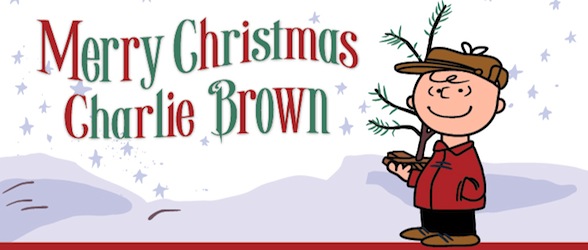
In 1965, an animated Christmas special was aired, “Charlie Brown’s Christmas.” Peanuts character Linus quoted from Luke in the New Testament, “For unto you is born this day in the city of David a savior which is Christ the Lord. That’s what Christmas is all about.” It was widely hailed as a thoughtful and joyous statement.

Back then, virtually no one thought about registering a complaint against “Charlie Brown’s Christmas” being performed in a public school. But a half century later, activist Christmas haters now threaten lawsuits, and nervous school administrators cave in to the intimidation. That is why Kentucky lawmakers have said enough is enough.

At Christmastime 2015, a Kentucky school in Johnson County, W.R. Castle Elementary, was ordered by Superintendent Tom Salyer to excise the scene featuring Linus’ statement about the true meaning of Christmas from the school’s presentation of “Charlie Brown’s Christmas.” One person complained. That was enough to muzzle free speech.

Parents and public officials were not pleased with this act of censorship, and began to reexamine the role of religion in the schools. Two bills are now pending to rectify conditions.

The Senate bill, SB 17, is the more comprehensive of the two: it seeks to ensure the religious rights of teachers and students; it passed 31-3 and is now pending before the House. The other, HB 128, passed the House 80-14, and awaits Senate approval.

The Senate bill is in direct response to the censoring of “Charlie Brown’s  Christmas.” The sponsor, Sen. Albert Robinson, would like to expand the religious and political rights of students, whether expressed in homework assignments, artwork or other modes of speech.

In addition, his bill would respect speeches given by students at a school forum: the text of their remarks could not be altered before delivering them. Religious messages on student clothing would also be covered, as would the right of students to meet outside the classroom for religious purposes. Teachers could use the Bible to teach history and the study of religion; they could also use it to discuss biblical influences on art and music.

The House bill would allow an elective social studies course on “the Hebrew Scripture, Old Testament of the Bible, the New Testament, or a combination” of the two. The bill’s sponsor, Rep. D.J. Johnson, reminds us that “The Bible is the single most impactful literary work that we have in Western civilization. It affects our culture, our values, our laws.”

That these measures are needed in 2017 is a sign of how militant the nation’s secular activists have become. All these bills would do is lock in what should be considered the uncontroversial rights of students and teachers.

A Pew Forum on Religion and Public Life report of 2007 accurately summarized these rights. The following four principles can be found in two documents: the 1995 “Religious Expression in Public School” report by the U.S. Department of Education, and its revised guidelines in 2003:

  • “Students, acting on their own, have the same right to engage in religious activity and discussion as they do to engage in comparable secular activities.
  • “Students may offer a prayer or blessing before meals in school or assemble on school grounds for religious purposes to the same extent as other students who wish to express their personal views or assemble with others.
  • “Students may not engage in religious harassment of others or compel other students to participate in religious expression, and schools may control aggressive and unwanted proselytizing.
  • “Schools may neither favor nor disfavor students or groups on the basis of their religious identities.”

Regarding the rights of teachers, while they cannot teach religion, they have every right to teach about religion. There is a difference between mandating that students believe that Jesus is the Son of God and teaching that this is what Christians believe.

The American people want to guarantee religious rights in the public schools. A Pew survey from 2006 found that 69 percent agreed that “liberals have gone too far in trying to keep religion out of the schools and the government.” In 2002, a Rasmussen poll found that 82 percent favor celebrating at least some religious holidays in school, Christmas being first among them. In 2013, a Rasmussen survey reported that a majority of Americans believe that “public schools need more religion.”

This past Christmas, a school district in Texas banned a “Charlie Brown Christmas” display because the dreaded word “Christ” was mentioned. The school board agreed. Fortunately, the censors were overruled by Bell County State District Judge Jack Jones. “Religious discrimination toward Christians has become a holiday tradition of sorts among certain groups,” he noted.

Kentucky lawmakers need to insist that the religious rights of students and teachers are respected, and the governor needs to be supportive of them. They would then be providing a great model for all states. Not to do so would be to award the censors with constitutional rights they should never have.


“CHARLIE BROWN CHRISTMAS” WRONGLY NIXED

Bill Donohue comments on the latest anti-Christmas incident:

The superintendent in charge of schools in Johnson County, Kentucky has censored all references to religion in this year’s Christmas celebrations. Specifically, he has banned a presentation of “A Charlie Brown Christmas” at one school, and ordered another not to allow “Silent Night” to be performed. He said he was following the advice of school district attorneys.

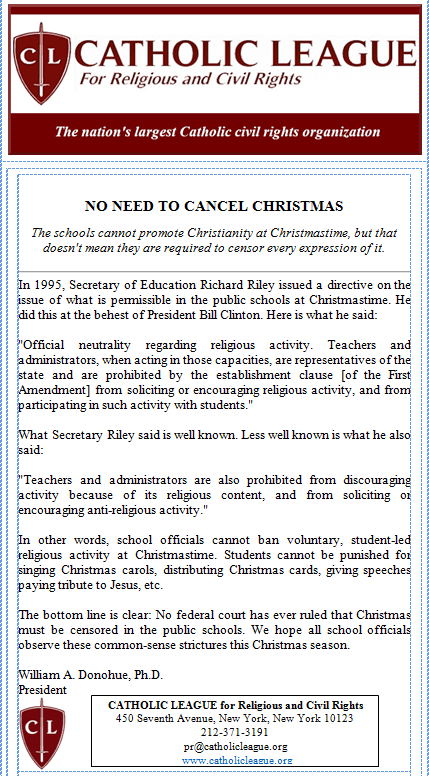
This is madness. It is also not constitutionally mandated. In my letter to Superintendent Thomas Salyer, I pointed out that the U.S. Supreme Court let stand a 1980 ruling by the U.S. Court of Appeals for the Eighth Circuit, Florey v. Sioux Falls, that conditionally permitted religious themes at Christmas assemblies. Pursuant to this ruling, the Sioux Falls School District allowed Christmas presentations of a religious nature to be performed as long as they were presented “in a prudent and objective manner and as a traditional part of the cultural and religious heritage of the particular holiday.” This is a reasonable, and not very high, bar to clear.

Who’s to blame for this yearly debacle? There is much blame to go around. For example, the U.S. Supreme Court has not definitively ruled on this issue, allowing for some degree of uncertainty. To be sure, school officials such as Superintendent Salyer are neither required nor forbidden from allowing assemblies of a religious nature. But if anything, the ruling in Florey v. Sioux Falls empowers them to permit these annual events.

It’s time school attorneys got up to speed on this issue. There is no legal reason to ban bona fide Christmas performances in the schools.


POLITICIZING CHRISTMAS; REVOLT AGAINST INTOLERANCE

No religious holiday sparks as much controversy as Christmas. It’s not because most Americans are anti-Christmas—they are not. It’s because so many activists, public officials, and educators are working against them. Quite frankly, they have unnecessarily politicized Christmas.

Some of them are bigots; some are ignorant of what the courts have ruled; and some are simply cowards. No matter, the result is an annual mess. But the good news is that our side continues to push back.

We played a role in beating back the Christmas foes in several instances, but none was more satisfying than our input in the University of Tennessee (UT) case.

The Office of Diversity and Inclusion at UT issued guidelines indicating which kinds of “holiday” celebrations would be tolerated, and which would not be. All parties, the multicultural gurus said, should be absent any “emphasis on religion or culture.” They did not say how it was possible to celebrate a holiday without also celebrating that part of the culture from which it springs.

Best of all was their admonition not to hold “a Christmas party in disguise.” They can hold gay pride celebrations all year long, but they cannot tolerate Christmas parties, even if held in a speak-easy.

Bill Donohue pulled the Catholic League staff to work overtime on this issue. We contacted every Tennessee lawmaker who has anything to do with education, as well as other public officials, calling for an investigation into the workings of the Office of Diversity and Inclusion. We also notified all the other legislators—those who do not deal with education. We blanketed the Tennessee media.

We were pleased to hear of the support we received from some of the lawmakers. We also were happy that the Tennessee media picked up on our work, including newspapers on the UT campus. Most of all we were delighted that our protest led to the guidelines being withdrawn; we were gratified that the person most to blame for this decision was removed from making such rulings again.

Last month we reported in Catalyst that we contacted town officials in Wadena, Minnesota, advising them that they could display a nativity scene in a “public forum,” such as a park. We are pleased to say that a local resident picked up on this idea and successfully erected a crèche in a park. It was also great to learn that residents of Wadena responded by displaying a record number of manger scenes on private property.

The Supreme Court needs to offer more clarity on what is constitutional and what is not. Until then, the controversy will rage.


MICROSOFT’S LGBT CHRISTMAS AD

Ask any schoolboy what the meaning of Christmas is, and he will say it celebrates the birth of Jesus. Ask the ideologues at Microsoft, and they will say it means whatever their politics dictate. This past year it represented an opportunity to exploit Christmas by pushing the LGBT agenda.

Microsoft released a TV ad, “Art of Harmony,” that was laden with Christmas overtones, yet absent of Christian content. “This holiday season we brought together a group of people who are making a difference in the world,” the ad said. It did not say what holiday was being observed, though we have a hunch it wasn’t Kwanzaa; the ad ended by showing a Christmas tree in the background.

As it turns out, this was no ordinary “group of people.” Included was Jazz Jennings, described by Microsoft as “the youngest person to publicly identify herself as transgender, now a national role-model and activist for transgender youth.” No doubt she is—her agents have seen to that. [Little Jazz was not mentioned by name but she was seen speaking before the Human Rights Campaign, a pro-gay and anti-religion organization.]

Zea Bowling also made the cut. Zea was described as “a 7-year old first grader who stood firm in the face of hate during a celebration of the Supreme Court ruling that legalized same-sex marriage.” Such courage for a kid fresh off her tricycle. And such brains: she may not know how to tell time, but she sure knows who the haters are—those who believe marriage is between a man and a woman.

In a scene where a rainbow flag was waved, we received our marching orders: “People should let people be whoever they want to be.” Were Jazz and Zea’s parents listening?

No one, of course, was shown celebrating Christmas. Nor were there any kids  shown standing up to corporate bullies who rip off the Christmas season to make cheap political points.

Anyone who thinks this isn’t a political statement needs to read what the ad agency that created it had to say. “This year has been challenging for many and much of what we hear in the news can be negative. Microsoft wanted to lift people up and remind them that ordinary people can make a difference. The message focuses on the spirit of the holidays, people coming together and celebrating what is good and right with the world—what unites us, instead of what divides us.”

Bill Donohue guessed this was open to interpretation, so he offered his:

Much of what I heard in the news was indeed negative. Hillary’s criminal behavior, her lying, her scheming, and her dancing to Jay Z’s “f**king n***ers” lyrics did not make me happy. But the ordinary people, those adorable “deplorables,” did put a smile on my face, proving that even they can make a difference.

Yes, we do need to “celebrate what is good and right with the world,” which is precisely why so many will be dancing in the streets come January 20. It’s on a Friday, so it’s a sure bet the champagne will be flowing. Keep the Advil handy.

If the bi-coastal elites at Microsoft really believe in diversity, then let them have their LGBT celebrations in June during gay pride month, and leave December to Christians.


WAL-MART BAGS CHRISTMAS: BOYCOTT LAUNCHED

A woman who recently complained to Wal-Mart that the store was replacing “Merry Christmas” with “Happy Holidays” received an e-mail response from Customer Service. It appears below in its exact form:

“Walmart is a world wide organization and must remain conscious of this. The majority of the world still has different practices other than ‘christmas’ which is an ancient tradition that has its roots in Siberian shamanism. The colors associated with ‘christmas’ red and white are actually a representation of the aminita mascera mushroom. Santa is also borrowed from the Caucuses, mistletoe from the Celts, yule log from the Goths, the time from the Visigoth and the tree from the worship of Baal. It is a wide wide world.”

To which Catholic League president Bill Donohue says: “This statement was signed by someone called Kirby. When I read it, I fought he might be drunk. But I was wrong. We sent Kirby’s response to Wal-Mart’s headquarters only to find that Dan Fogleman, Senior Manager, Public Relations, agrees. After acknowledging that he read Kirby’s response, Fogleman said, in part, the following”:

“As a retailer, we recognize some of our customers may be shopping for Chanukah or Kwanza gifts during this time of year and we certainly want these customers in our stores and to feel welcome, just as we do those buying for Christmas. As an employer, we recognize the significance of the Christmas holiday among our family of associates… and close our stores in observance, the only day during the year that we are closed.”

Bill Donohue says: “It’s nice to know that Wal-Mart is closed on a federal holiday. Now here is why I am asking the leaders of 126 religious organizations that span seven religious communities to boycott Wal-Mart. Go to its website and search for Hanukkah and up come 200 items. Click on Kwanzaa and up come 77. Click on Christmas, and here’s what you get: ‘We’ve brought you to our ‘Holiday’ page based on your search.’ In other words, Wal-Mart is practicing discrimination.”

Contact Fogleman at [email protected]


KENTUCKY PROTECTS RELIGION IN SCHOOL

In February, the Catholic League contacted every member of the Kentucky legislature in support of SB 17, a bill to ensure the religious rights of teachers and students. We are pleased to report that the bill, sponsored by Sen. Albert Robinson, passed the State Senate and House overwhelmingly, and has now been signed into law by Gov. Matt Bevin.

This bill was a direct response to the censoring of “Charlie Brown’s Christmas.”

In 1965, the animated Christmas special, “Charlie Brown’s Christmas,” was first aired. Peanuts character Linus quoted from Luke in the New Testament, “For unto you is born this day in the city of David a savior which is Christ the Lord. That’s what Christmas is all about.” It was widely hailed as a thoughtful and joyous statement.

Back then, virtually no one thought about registering a complaint against “Charlie Brown’s Christmas” being performed in a public school. But a half century later, activist Christmas haters now threaten lawsuits, and nervous school administrators cave in to the intimidation. That is why Kentucky lawmakers have said enough is enough.

At Christmastime 2015, a Kentucky school in Johnson County, W.R. Castle Elementary, was ordered by Superintendent Tom Salyer to excise the scene featuring Linus’ statement about the true meaning of Christmas from the school’s presentation of “Charlie Brown’s Christmas.” One person complained. That was enough to muzzle free speech.

Parents and public officials were not pleased with this act of censorship, and began to reexamine the role of religion in the schools. This resulting law expands the religious and political rights of students, whether expressed in homework assignments, artwork or other modes of speech.

In addition, this new law respects speeches given by students at a school forum: the text of their remarks cannot be altered before delivering them. Religious messages on student clothing are also protected, as is the right of students to meet outside the classroom for religious purposes. Teachers may use the Bible to teach history and the study of religion; they may also use it to discuss biblical influences on art and music.

As we went to press a second bill, HB 128, was still pending in the Kentucky Senate. This bill would allow an elective social studies course on “the Hebrew Scripture, Old Testament of the Bible, the New Testament, or a combination” of the two. The bill’s sponsor, Rep. D.J. Johnson, reminds us that “The Bible is the single most impactful literary work that we have in Western civilization. It affects our culture, our values, our laws.”

HB 128 passed the House, 80-14, and was unanimously approved by the Senate Education Committee, sending it to the full Senate for a vote.

That these measures are needed in 2017 is a sign of how militant the nation’s secular activists have become. All these bills do is lock in what should be considered the uncontroversial rights of students and teachers.

A Pew Forum on Religion and Public Life report of 2007 accurately summarized these rights. The following four principles can be found in two documents: the 1995 “Religious Expression in Public School” report by the U.S. Department of Education, and its revised guidelines in 2003:

  • “Students, acting on their own, have the same right to engage in religious activity and discussion as they do to engage in comparable secular activities.
  • “Students may offer a prayer or blessing before meals in school or assemble on school grounds for religious purposes to the same extent as other students who wish to express their personal views or assemble with others.
  • “Students may not engage in religious harassment of others or compel other students to participate in religious expression, and schools may control aggressive and unwanted proselytizing.
  • “Schools may neither favor nor disfavor students or groups on the basis of their religious identities.”

Regarding the rights of teachers, while they cannot teach religion, they have every right to teach about religion. There is a difference between mandating that students believe that Jesus is the Son of God and teaching that this is what Christians believe.

The American people want to guarantee religious rights in the public schools. A Pew survey from 2006 found that 69 percent agreed that “liberals have gone too far in trying to keep religion out of the schools and the government.” In 2002, a Rasmussen poll found that 82 percent favor celebrating at least some religious holidays in school, Christmas being first among them. In 2013, a Ras-mussen survey reported that a majority of Americans believe that “public schools need more religion.”

This past Christmas, a school district in Texas banned a “Charlie Brown Christmas” display because the dreaded word “Christ” was mentioned. The school board agreed. Fortunately, the censors were overruled by Bell County State District Judge Jack Jones. “Religious discrimination toward Christians has become a holiday tradition of sorts among certain groups,” he noted.

Kentucky lawmakers, and Gov. Bevin, are insisting that the religious rights of students and teachers are respected. In doing so, they are providing a great model for all states. Not to do so would be to award the censors with constitutional rights they should never have.


HUNTING FOR RACISM AT CHRISTMAS EVENTS

Catholic League president Bill Donohue comments on two controversial Christmas events:

The Arkansas Sons of Confederate Veterans had a float in the November 24 Christmas Parade of the Ozarks in Springdale, Arkansas. Its members claim it is a patriotic organization and is not in the business of promoting racism. But some disagreed.

The Dorchester Historical Society in Dorchester, Massachusetts recently ran a promotional piece for its holiday party that read, “Dreaming of a white Dorchester.” The words were changed from the classic Christmas song to have a more local meaning, and were accompanied by the lyric, “May your Dorchesters be merry and bright.” On November 26, the ad was pulled and an apology was granted for the “oversight.”

This raises several questions.

Have we become so hypersensitive about racism that we are constantly on the alert seeking to find any whiff of bigotry?

Why it is okay to have a gay float in the St. Patrick’s Day Parade but not a Confederate float in a Southern Christmas parade?

Why are we told that clear instances of anti-Catholic art have multiple meanings and should not be considered as bigoted, but Confederate displays have only one meaning?

Why is the term “Black Friday” not seen as racist by the sensitivity police?

Is the song, “White Christmas,” a testimony to racism?

Notice, too, the sensitivity cuts only one way. How many filthy movies have been made trashing Christmas, yet are always seen as funny, not bigoted? They just don’t get it.


EDUCATION ELITES NIX CHRISTMAS AD

Catholic League president Bill Donohue comments on a pro-Christmas ad that has been nixed by elites:

The Catholic League became the latest victim of the cancel culture when education elites refused to run an ad with a pro-Christmas message. This is a story that should upset all Americans, not simply followers of the Catholic League. Everything that follows is documented.

In early September, I asked the policy staff to research the nation’s leading elementary and secondary school publications and organizations. The goal was to send its subscribers and officials a short ad on the legal issues governing Christmas celebrations in the schools. By reaching a wide audience, it was hoped that we might persuade some in the education establishment to allow more Christmas events this year.

In late September, we sent the ad that I wrote to the marketing and advertising departments of Education Week, the National Association of Education, Scholastic magazine and the American School Board Journal. None of the four got back to us. Education Next offered us a spot in its quarterly publication, but that was not practical given our desire to affect decision making in time for Christmas celebrations. One publication, Education Leadership, simply rejected the ad.

On September 29, we received promising news from the American Association of School Superintendents and Administrators (AASA).

“The content of your E-blast is subject to AASA review and approval. We often have minor feedback once the team reviews, so I would anticipate a round or two of edits before the message deploys. We will ensure ample time to do so and we have never had an instance when E-blast was prevented from deploying on schedule.”

I asked our director of communications, Mike McDonald, to contact the agent at AASA and ask whether we could pay the fee by credit card, and what the chances of it being accepted are. “To pay via credit card, I will send you a payment link. As far as the ad goes, we only invoice when ads run, so yes, your ad has been approved and will not be rejected.” (My italics.)

The ad was scheduled to be digitally distributed on November 13. But on the afternoon of November 6, we received the following email. “I am very sorry to share this news, but, per our Media Kit, AASA has rejected your ad for the DEDICATED EBLAST on November 13, 2020. I regret to share we are officially cancelling this contract for that reason.” (All the emphasis is in the original.)

We asked our members in October to pay for the ad, which they did, anticipating its publication. I will explain to them in the December issue of Catalyst, our monthly (ten times a year) journal, what happened. The Catholic League has been officially cancelled by the public school establishment.

Having spent 20 years in education, teaching every grade from the second through graduate school, I am not shocked by the outcome. As I have said on many occasions, there is more free speech allowed in local pubs than there is on local college campuses.

The schools are quick to celebrate the alleged achievements of Muslims and so-called Indigenous peoples, but they want nothing to do with celebrations of Christians, and this certainly includes Christmas. So the censorship continues.

To read the ad the education elites cannot stomach, click here.

Contact Daniel A. Domenech, executive director, AASA: [email protected]